Warehouse Aisle Width Compliance Standards Guide
Most warehouse managers assume there’s a fixed number baked into federal law — something like “aisles must be at least 4 feet wide.” That assumption is wrong, and it’s exactly the kind of thinking that leads to OSHA citations. Warehouse aisle width compliance standards are built around a performance-based concept: sufficient safe clearances specific to your equipment, your operations, and your facility layout. This guide walks you through the actual regulations, how to calculate widths correctly, how to mark and maintain them, and how to prepare for an inspection with confidence.
Table of Contents
- Key takeaways
- Warehouse aisle width compliance standards: what OSHA actually says
- Calculating the right aisle width for your equipment
- Marking, maintaining, and enforcing aisle compliance
- Fire safety and accessibility codes that affect aisle widths
- Verifying compliance and preparing for OSHA inspections
- My take on the real compliance challenge
- Get your aisles marked right the first time
- FAQ
Key takeaways
| Point | Details |
|---|---|
| No fixed OSHA number | OSHA 29 CFR 1910.176(a) requires safe clearances, not a specific numeric width. |
| Equipment drives the math | Aisle width must account for your largest forklift’s footprint, turning radius, and load dimensions. |
| Marking is mandatory | Permanent aisle markings are required by OSHA, though color and line width are left to industry practice. |
| Fire and ADA codes add requirements | High-piled storage, sprinkler design, and ADA accessibility rules can impose stricter widths than OSHA alone. |
| Inspections focus on obstructions | Blocked or faded aisles are among the most cited violations, with penalties compounding per instance. |
Warehouse aisle width compliance standards: what OSHA actually says
The governing regulation is OSHA 29 CFR 1910.176(a), and it does not contain a number. What it contains is a requirement that aisles and passageways used by mechanical handling equipment maintain safe clearance for operations and that permanent aisles be appropriately marked. That’s the entire foundation of federal aisle width compliance for most warehouses.
This matters because compliance officers who design layouts around a fixed “4-foot rule” or “8-foot rule” are working from industry folklore, not law. OSHA inspectors evaluate whether your aisles provide sufficient clearance for the specific equipment operating in them. A narrow aisle forklift working in a 6-foot aisle may be perfectly compliant. A standard counterbalanced forklift in a 10-foot aisle may not be, if the turning radius or load width makes that clearance unsafe.
Several related standards fill out the picture:
- 29 CFR 1910.22 covers general walking-working surfaces and requires that floors be kept clean, dry, and free of obstructions, which directly affects aisle maintenance.
- 29 CFR 1910.36 and 1910.37 address means of egress, requiring unobstructed exit routes that often overlap with primary aisles.
- The Americans with Disabilities Act (ADA) sets separate pedestrian route requirements where employees or visitors with disabilities use warehouse spaces.
- International Building Code (IBC) and local fire codes may impose additional minimums based on occupancy type and storage configuration.
OSHA’s compliance concept for aisle widths is not a universal fixed dimension. It is a site-specific determination based on the equipment used, the materials handled, and the clearances needed to perform those operations safely.
OSHA inspectors also focus heavily on marking. Aisles must be permanently marked, but the regulation does not specify color or line width. That flexibility is real, but it does not mean markings are optional. Unmarked or faded aisles are a reliable path to a citation.
Calculating the right aisle width for your equipment

This is where compliance becomes engineering. The starting point is always your largest piece of mechanical handling equipment, not your smallest or most common.
Here’s a practical process for calculating minimum safe aisle widths:
- Identify the largest equipment. List every forklift, reach truck, order picker, and pallet jack operating in each zone. Note the model, load capacity, and any attachments such as side shifters or clamp attachments that increase the overall width.
- Measure the loaded width. The load itself often extends beyond the forks. A 48-inch pallet on a forklift with a 42-inch carriage still needs clearance for the full 48-inch load width, plus the mast and any attachments.
- Calculate the turning radius. Aisle width must account for the equipment’s turning radius during normal operation, not just its static footprint. Your equipment vendor can supply the right-angle stacking aisle (RASA) specification for each model.
- Add safety clearance margins. OSHA’s “sufficient safe clearance” language implies margins beyond the equipment’s minimum operational width. Industry practice adds 12 to 18 inches of clearance on each side for pedestrian safety and load swing.
- Account for pedestrian co-use. If workers on foot share the aisle with forklifts, the required width increases significantly. Many facilities add a designated pedestrian lane, marked separately, within the same aisle corridor.
Pro Tip: Contact your forklift vendor and request the RASA specification sheet for every model in your fleet before finalizing any aisle layout. This single document can defend your width calculations during an OSHA inspection.
The table below shows how different forklift types affect minimum practical aisle widths before adding safety margins:
| Equipment type | Typical loaded width | Minimum operating aisle | Recommended aisle with margins |
|---|---|---|---|
| Counterbalanced forklift | 48–72 in | 10–12 ft | 12–14 ft |
| Reach truck | 36–48 in | 8–10 ft | 10–12 ft |
| Narrow aisle order picker | 24–36 in | 5–7 ft | 6–8 ft |
| Pallet jack (manual) | 27–30 in | 5–6 ft | 6 ft |
These figures are starting points, not final answers. Your actual clearance requirements depend on your specific equipment, load profiles, and the frequency of pedestrian traffic in each zone. Consulting a warehouse layout specialist before finalizing dimensions can save significant rework costs.
Marking, maintaining, and enforcing aisle compliance
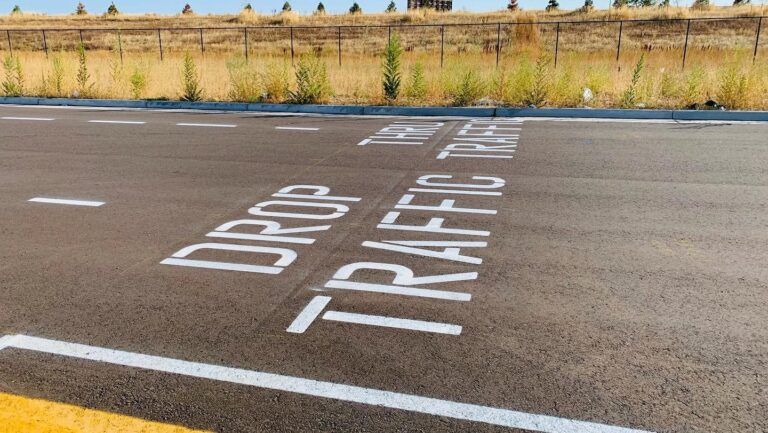
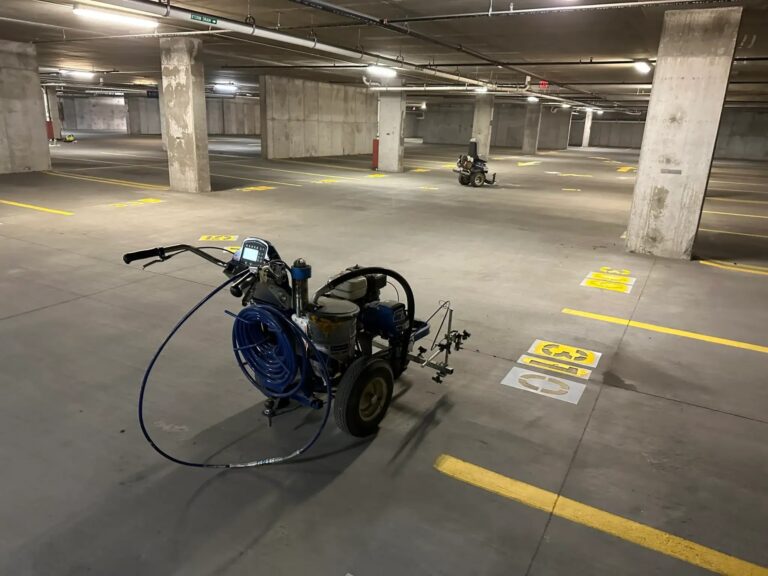
Getting the width right is step one. Keeping it right is where most facilities struggle. OSHA requires permanent markings, and industry standard practice uses 4-inch wide lines, typically in yellow, though no federal mandate specifies that color or width. The 4-inch standard exists because it’s visible from forklift height and durable enough to withstand traffic.
Common failures that lead to citations include:
- Transient storage creep. Pallets, returned goods, or equipment staged “temporarily” inside marked aisles are one of the most frequent OSHA findings. Inspectors do not distinguish between permanent and temporary obstructions.
- Faded or damaged markings. High-traffic floors wear through paint and tape faster than most managers expect. Faded aisle markings are treated as absent markings during inspections.
- Equipment drift. Racks and shelving units shift over time. A rack that started 2 inches outside the aisle line can end up inside it within a year of heavy forklift operation nearby.
- Unmarked secondary routes. Many facilities mark primary aisles and neglect cross-aisles, staging lanes, or receiving areas where violations are equally likely.
Pro Tip: Schedule a monthly walk-through specifically for aisle compliance. Bring a tape measure, not just your eyes. Aisles that look clear from a distance often have subtle encroachments that only measurement reveals.
The stakes for ignoring these issues increased significantly after OSHA expanded its instance-by-instance citation policy in recent years. Under this policy, each blocked aisle section or each unmarked route can be cited as a separate violation, multiplying penalties across a single inspection. A facility with six blocked aisles is not looking at one fine. It’s looking at six.
Fire safety and accessibility codes that affect aisle widths
OSHA is not the only agency with a stake in your aisle widths. Two other regulatory frameworks impose requirements that can be more stringent than federal workplace safety rules alone.
High-piled storage and fire code triggers
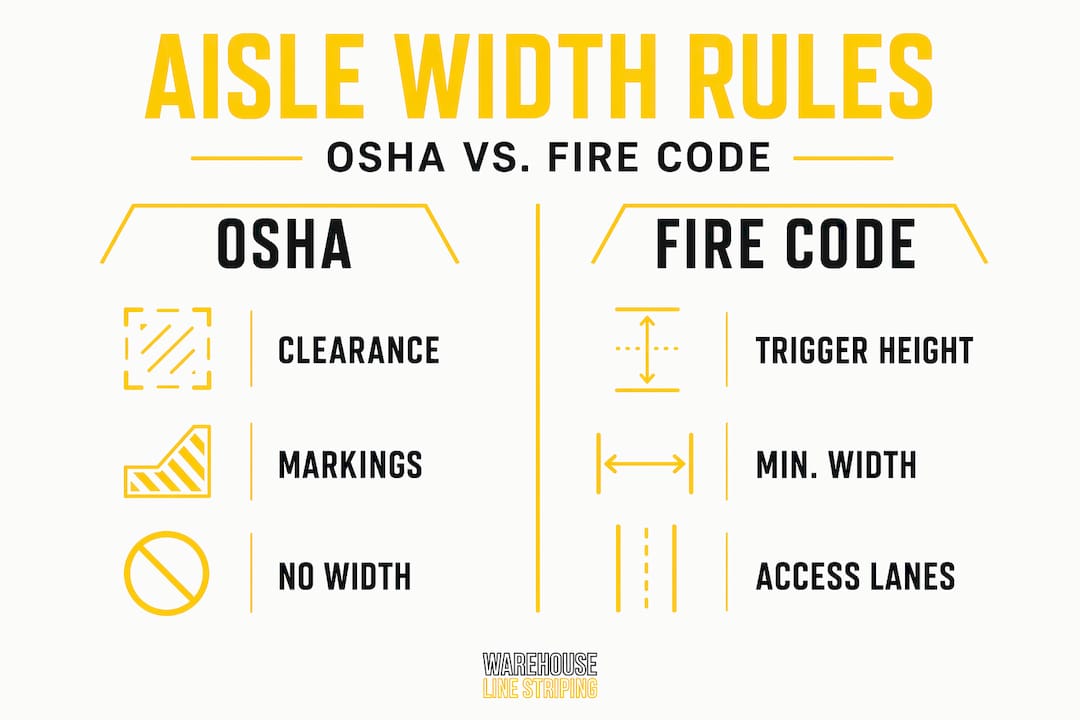
When storage exceeds 12 feet in height (or 6 feet for higher-hazard materials), fire protection requirements under the International Fire Code (IFC) activate. These include minimum aisle widths for fire department access, in-rack sprinkler design, and storage configuration rules that directly affect how wide your aisles must be. The fire code’s aisle requirements are separate from OSHA’s and can require wider clearances than your forklift calculations would suggest.
| Code | Trigger | Aisle width impact |
|---|---|---|
| IFC high-piled storage | Storage over 12 ft (6 ft for high hazard) | Minimum aisle widths for fire access |
| NFPA 13 sprinkler design | High-density rack storage | Minimum 3.5 ft flue spaces and aisle coordination |
| ADA accessible routes | Pedestrian use by employees or visitors | Minimum 36-inch width, 60-inch passing spaces |
NFPA 13 sprinkler design rules add another layer. Rack storage configurations must maintain flue spaces at specified intervals, and those flue space requirements interact directly with aisle geometry. If your sprinkler designer and your warehouse layout team are not coordinating, you can end up with a rack configuration that satisfies OSHA but fails fire protection code, or vice versa. For facilities in fire-prone regions, reviewing warehouse fire safety planning alongside aisle design is worth doing early, not after installation.
ADA pedestrian routes
The ADA requires a minimum 36-inch clear width for accessible pedestrian routes. If that route narrows below 60 inches at any point, passing spaces must be provided every 200 feet. These requirements apply wherever employees with disabilities or visitors use the space, which in many warehouses includes receiving areas, offices, and break room corridors that run through or adjacent to storage zones.
Verifying compliance and preparing for OSHA inspections
Documentation is what separates a facility that passes an inspection from one that passes but can’t prove it. Here’s a practical sequence for building a defensible compliance record:
- Conduct a physical measurement audit. Measure every marked aisle at three points: both ends and the midpoint. Record the narrowest measurement, not the average.
- Photograph current conditions. Date-stamped photos of clear, marked aisles provide evidence of compliance at a specific point in time.
- Document equipment specifications. Keep RASA sheets, load dimension records, and equipment modification logs in a compliance file that OSHA can review on request.
- Log housekeeping and inspection records. A dated log showing regular aisle inspections and corrective actions taken demonstrates an active compliance program, which inspectors weigh favorably.
- Review marking condition quarterly. Use a simple rating scale (good, fair, needs restriping) and schedule restriping before markings reach the “needs” category.
The table below summarizes the most common OSHA aisle-related findings and the corrective action for each:
| Common violation | Root cause | Corrective action |
|---|---|---|
| Blocked aisle | Transient storage or equipment parking | Remove obstruction, add signage, enforce housekeeping policy |
| Faded or missing markings | Wear, chemical exposure, or age | Restripe with durable epoxy or industrial tape |
| Unmarked secondary routes | Incomplete initial layout | Mark all permanent aisles including cross-aisles and staging lanes |
| Insufficient width for equipment | Layout designed without RASA data | Reconfigure racks or restrict equipment type in that zone |
For facilities preparing for a planned inspection or responding to a prior citation, a professional compliance assessment can identify gaps that internal teams overlook. The logistics striping best practices guide from Warehouse Line Striping is also a practical starting point for auditing your current layout against OSHA and fire code requirements.
My take on the real compliance challenge
I’ve reviewed dozens of warehouse layouts where the markings looked perfect on paper and were a liability in practice. The gap is almost always operational discipline, not knowledge. Managers know the rules. The problem is that compliance erodes between inspections.
What I’ve found is that the facilities with the cleanest inspection records treat aisle compliance the way they treat inventory accuracy: as a continuous operational metric, not a one-time setup task. They measure aisles on a schedule. They tie housekeeping to shift sign-off procedures. They restripe before they have to, not after a citation forces them to.
The other pattern I’ve seen repeatedly is over-reliance on the initial layout. A layout that was compliant on opening day can drift out of compliance within six months as operations evolve, equipment changes, and storage demands shift. The “rule of thumb” widths that get passed down from one facility manager to the next are particularly dangerous because they feel authoritative without being defensible. Measure your actual equipment. Document it. Then mark it clearly and keep it clear.
— ET
Get your aisles marked right the first time
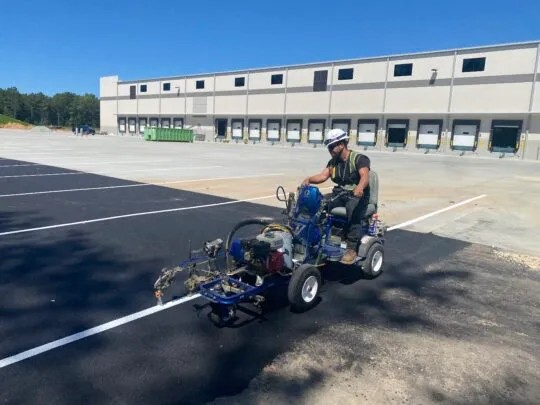
Warehouse Line Striping has completed over 10,000 floor marking projects across warehouses, distribution centers, and industrial facilities nationwide. Their team works directly from your equipment specifications and OSHA compliance requirements to design aisle layouts that hold up under inspection. Using industrial-grade epoxy coatings that last 3 to 7 years, they eliminate the fading and wear that turns compliant aisles into citation risks. Whether you need a full facility restripe or targeted corrections ahead of an inspection, Warehouse Line Striping offers 24/7 support and professional removal of outdated markings. Start with their pallet storage marking guide or get a quote directly at Warehouse Line Striping.
FAQ
What does OSHA require for warehouse aisle widths?
OSHA 29 CFR 1910.176(a) requires sufficient safe clearances for the equipment used and permanent markings for all aisles. It does not specify a fixed numeric width.
How wide should a forklift aisle be?
Forklift aisle width depends on the equipment’s loaded width and turning radius. A counterbalanced forklift typically requires 12 to 14 feet including safety margins, while narrow-aisle equipment may operate in 6 to 8 feet.
Are aisle markings required by OSHA?
Yes. OSHA requires that permanent aisles be appropriately marked, but does not mandate a specific color or line width. The industry standard is 4-inch yellow lines, which are visible from forklift height and durable under traffic.
Do fire codes affect warehouse aisle width requirements?
Yes. Storage above 12 feet triggers IFC high-piled storage rules that impose minimum aisle widths for fire department access. NFPA 13 sprinkler design also requires coordinated aisle and flue space dimensions in rack storage areas.
What are the most common OSHA aisle violations?
Blocked aisles from transient storage, faded or missing floor markings, and insufficient clearance for operating equipment are the most frequently cited violations. Under OSHA’s instance-by-instance policy, each blocked section can be cited separately.