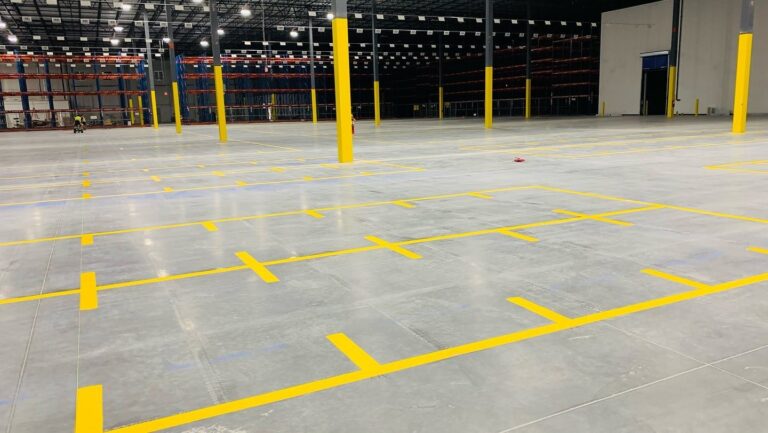
Why Warehouse Floor Flatness Matters for Markings
Most warehouse managers assume a floor is fine if forklifts roll across it without obvious wobble. That assumption is costing facilities real money. Understanding why warehouse floor flatness matters for markings requires looking at two things most teams treat as separate problems. Floor surface geometry and line striping are deeply connected. When one fails, the other underperforms. This article walks through the technical standards, operational consequences, and practical steps that warehouse managers and facility operators need to make smart decisions about both.
Table of Contents
- Key takeaways
- Why warehouse floor flatness matters for markings
- Operational risks of uneven floors
- How floor markings drive safety and compliance
- Steps to measure, maintain, and remediate
- When flatness and markings interact
- My take after years of watching facilities get this wrong
- Get your floor markings right the first time
- FAQ
Key takeaways
| Point | Details |
|---|---|
| FF and FL are distinct metrics | Floor flatness (FF) and levelness (FL) measure different things; both must meet your equipment’s specifications. |
| Early testing prevents costly delays | Test floor flatness within 72 hours of finishing to allow remediation before equipment commissioning begins. |
| OSHA requires permanent markings | Aisle markings must be at least 2 inches wide where mechanical equipment operates, per 29 CFR 1910.22. |
| Flat floors and markings work together | A well-built floor with degraded markings still generates safety risk from pedestrian-forklift conflicts. |
| Defined-path testing is more stringent | General FF/FL averages can pass while Fmin testing along actual forklift routes reveals non-compliance. |
Why warehouse floor flatness matters for markings
The industry uses two specific numbers to measure what most people loosely call a “flat floor.” These are FF and FL, defined under ASTM E1155. FF measures short-distance surface waviness using approximately 12-inch intervals. FL measures long-distance slope across approximately 10-foot spans. Higher numbers mean flatter and more level surfaces.
These are not interchangeable. A floor can score well on FF (locally smooth) but still have a significant slope overall, or the reverse. FF and FL are independent metrics, and ignoring either one creates real operational problems regardless of how the other metric performs.
Typical warehouse floors for standard pallet racking and counterbalanced forklifts need roughly FF 25 to FF 35. Narrow-aisle operations push that requirement to FF 50 or higher. Automated guided vehicles (AGVs) often demand FF 40 to FF 50 minimum. These numbers are not suggestions. Equipment manufacturers specify them because machines, not humans, are operating at height and speed where even small surface irregularities cause measurable problems.
Pro Tip: Always request your equipment manufacturer’s exact FF and FL specifications in writing before finalizing your floor construction contract. Match specs to the most demanding equipment you plan to run.
| Floor type | Typical FF range | Typical FL range | Best suited for |
|---|---|---|---|
| Standard distribution | FF 25–35 | FL 20–25 | Counterbalanced forklifts, pallet jacks |
| High-reach narrow aisle | FF 40–50 | FL 30–35 | Reach trucks, turret trucks |
| Fully automated / AGV | FF 50+ | FL 35+ | AGVs, robotic systems, VNA forklifts |
Operational risks of uneven floors
The safety and efficiency consequences of poor floor flatness are concrete. Uneven floors increase vibration and mechanical stress on forklifts, reduce handling speed, and raise the risk of product damage and operator fatigue. For high-reach equipment operating at 20-plus feet, mast sway from surface irregularities is not a minor annoyance. It is a tipping hazard.
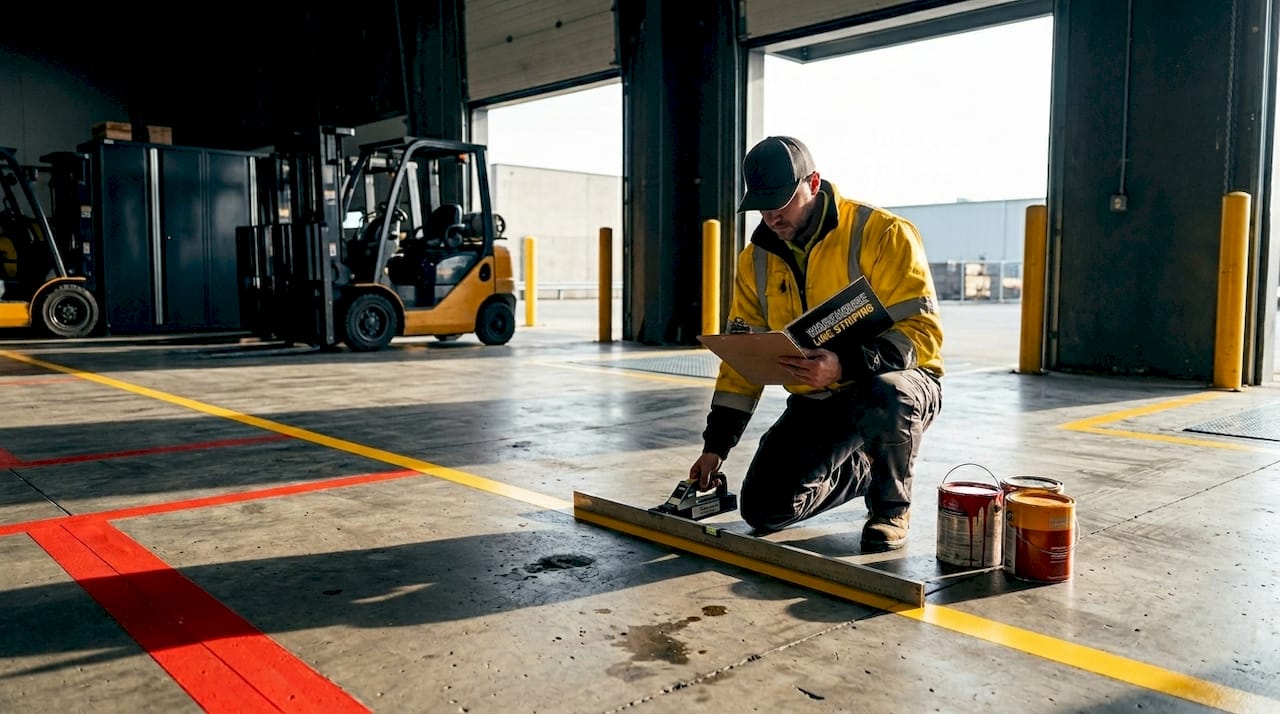
Automated systems have even less tolerance for surface irregularities. Floor flatness around FF 40 to 50 is required for AGVs to navigate correctly. When floors fall short, AGV sensors misread their positioning, triggering error stops or, worse, silent drift that causes misaligned picks and putaways. The impact on throughput can be severe.
Here are the most common operational consequences of inadequate floor flatness:
- Forklift instability. Mast sway in narrow-aisle equipment amplifies with height, turning a modest floor deviation into a load stability problem.
- Sensor errors in automated systems. Local irregularities from poor patching near joints create wheel vibration and sensor errors that degrade AGV performance without obvious global floor failure.
- Increased operator fatigue. Repetitive vibration during multi-hour shifts raises error rates and contributes to injury claims.
- Product damage. Bottles, glass, and fragile items are especially vulnerable when pallets travel over bumpy surfaces at speed.
- Commissioning delays. The gap between vendor floor requirements and actual conditions is the top cause of automated system start-up delays, often running weeks to months.
Pro Tip: If you are retrofitting automation into an existing facility, budget for flatness assessment before you sign equipment contracts. Discovering flatness deficiencies after your AGVs arrive on-site is an expensive problem.
How floor markings drive safety and compliance
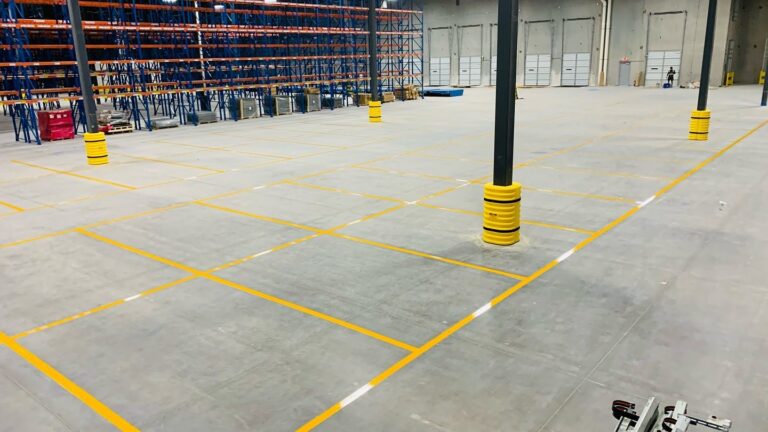
Even if your floor geometry is perfect, the wrong marking program creates its own hazards. OSHA 29 CFR 1910.22 requires permanent aisle markings in any area where mechanical handling equipment operates. Markings must be at least 2 inches wide, though 4 to 6 inches is the preferred standard for high-traffic areas.
Color contrast matters more than many operators realize. Yellow lines on gray concrete are highly visible, but markings on surfaces with heavy dust accumulation or worn concrete coating can fade within months without the right material specification. Faded or obstructed markings fail to provide the required safety benefits and expose facilities to OSHA non-compliance findings during inspections.
The operational value of good markings extends well beyond compliance:
- Clearly marked forklift lanes reduce pedestrian conflicts, which account for a significant share of warehouse injuries.
- Defined storage zones reduce “ad hoc” pallet placement that blocks egress and fire exits.
- Clear aisle markings reduce driver hesitation, cutting motion waste and improving throughput during peak hours.
- Designated pedestrian walkways create predictable foot traffic patterns that operators can plan around.
Learn more about how pallet storage grid marking supports OSHA compliance while improving storage density. For aisle-specific requirements, the warehouse aisle width compliance guide covers how marked aisle widths need to match both regulatory minimums and the actual operating envelope of your equipment.
Pro Tip: Schedule floor marking inspections on the same cadence as forklift maintenance reviews, typically quarterly. Markings that look acceptable to the naked eye often fall below OSHA standards when measured for contrast and line width.
Steps to measure, maintain, and remediate
Knowing the standards is not enough. The process of getting there and staying there requires specific sequencing.
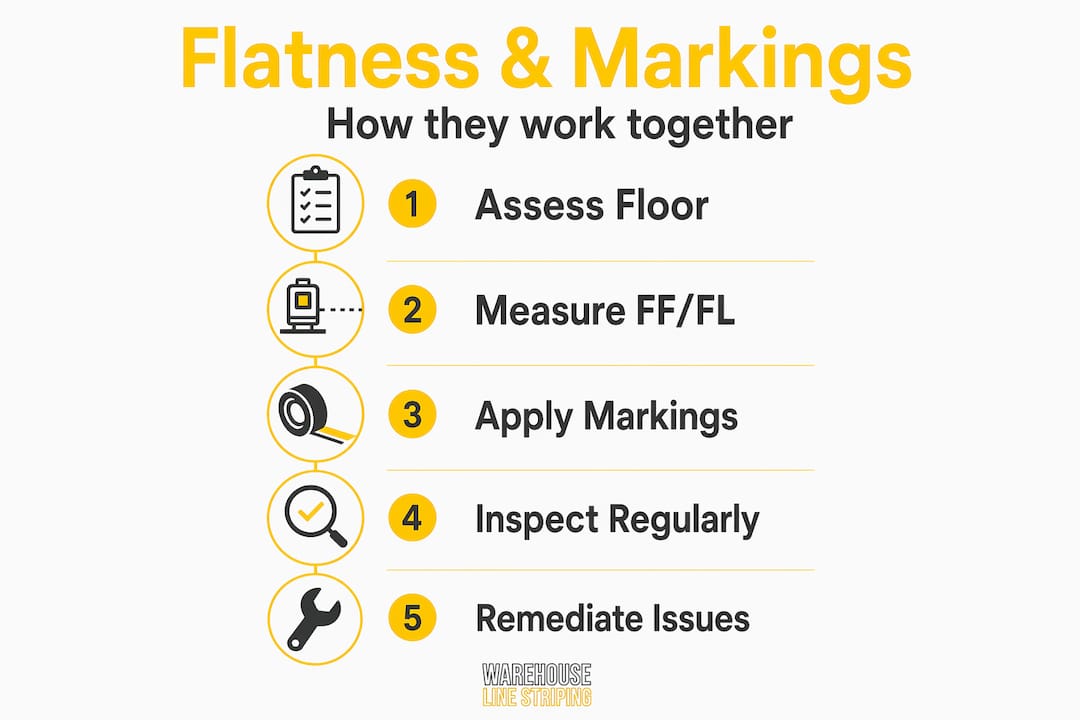
Specify FF and FL before construction starts. Work with your equipment vendors to define the minimum Fmin values for every vehicle route in the facility. General FF/FL numbers can pass while Fmin testing along forklift aisles reveals non-compliance. Nail down the specs before concrete is poured.
Test within 72 hours of finishing. Independent flatness testing must happen within 72 hours after the concrete is finished. Waiting until equipment arrives is not a timing strategy. It is a budget risk, because remediation windows close fast and costs compound.
Choose the right measurement method. Use ASTM E1155 for general floor surveys. Use defined-path Fmin testing along actual vehicle routes for narrow-aisle and automated operations. The two methods serve different purposes and both belong in a serious flatness program.
Remediate proactively. The main tools are diamond grinding for high spots, thin overlays for broader depressions, and full slab repair for joint-related irregularities. Scheduling testing late in construction eliminates your best remediation window and can delay entire commissioning timelines.
Establish a marking program with durable materials. Epoxy and polyurethane coatings outperform paint by years in high-traffic warehouse environments. A well-specified marking program with slip and fall prevention in mind reduces liability and supports OSHA readiness.
Review and re-stripe on a scheduled basis. Even the best markings degrade under forklift traffic. Build re-striping into your annual maintenance budget the same way you budget for floor cleaning and lighting maintenance.
| Remediation method | Best use case | Typical timeline |
|---|---|---|
| Diamond grinding | High spots, joint lips, isolated bumps | 1–3 days per zone |
| Thin overlay | Broad depressions, general surface correction | 3–7 days including cure |
| Full slab repair | Joint failures, cracked sections | 1–2 weeks per area |
When flatness and markings interact
These two factors do not operate in isolation. Poorly maintained markings negate the safety advantages of a well-constructed flat floor by increasing pedestrian and forklift interactions in areas that were never designed to mix traffic. A flat floor with faded lines is still a floor where forklift operators are guessing where the lane boundaries are.
The reverse is equally true. New, bright markings applied over a floor with significant flatness deficiencies may look compliant, but the underlying surface problems will degrade marking adhesion faster than normal and create hazardous zones where floor movement causes coating separation or cracking.
“Early and precise FF/FL specification coupled with consistent marking maintenance is key to avoiding costly floor-related safety incidents and operational disruptions.” — IFTI Flooring Experts
The practical implication is that both programs need to be managed together. Assign ownership of floor flatness assessment and marking maintenance to the same team or at minimum require them to share data. A maintenance department that does not know the flatness history of a floor section cannot make good decisions about whether to re-stripe, repair, or both.
My take after years of watching facilities get this wrong
I have watched warehouses invest heavily in automated equipment and then spend three to four months in commissioning delay because no one tested the floor until the AGVs were already on the dock. The floor failed Fmin by a meaningful margin and the project schedule collapsed. That is not a contractor problem. It is a planning and specification problem that starts in the project kickoff meeting.
On the marking side, the most common failure I see is treating re-striping as a reactive task. Lines fade, someone complains after a near-miss, and a maintenance crew scrambles to re-stripe over damaged concrete. The result rarely meets OSHA standards and never lasts as long as a planned installation on a properly prepared surface.
The facilities that manage this well treat floor flatness and floor markings as infrastructure, not aesthetics. They build testing schedules into project plans, coordinate with equipment vendors before concrete is poured, and run marking inspection programs on fixed cycles. That approach keeps commissioning timelines intact and keeps OSHA inspectors from finding easy non-compliance findings during walkthroughs.
My honest advice: do not let construction teams or facilities managers treat FF/FL specs as nice-to-have numbers. Tie them to equipment acceptance criteria. And do not let marking programs run on the “it looks okay” standard. Measure line width, check contrast, and re-stripe before lines fail rather than after.
— ET
Get your floor markings right the first time
Warehouse Line Striping works with facility managers and operations directors across the country to deliver OSHA-compliant floor marking programs built for the demands of modern warehouse environments. With over 10,000 completed projects, the team brings the experience to spec the right materials, plan layouts that complement your floor’s flatness profile, and install markings that hold up under heavy forklift traffic for years. Whether you are commissioning a new facility, re-striping after a renovation, or addressing a compliance gap, Warehouse Line Striping offers nationwide floor marking services with 24/7 support and minimal disruption to your operations. Explore distribution center safety zone examples to see how a well-designed marking layout supports both safety and throughput.
FAQ
What is floor flatness in a warehouse?
Floor flatness is a measured property of a concrete slab, quantified by the FF number under ASTM E1155. It describes how much short-distance waviness exists in the surface. Higher FF numbers mean a flatter floor.
What FF number do automated warehouses require?
AGV and narrow-aisle operations typically require a minimum FF of 40 to 50. Specific requirements depend on the equipment manufacturer’s specifications and should be confirmed before construction begins.
What does OSHA say about warehouse floor markings?
OSHA 29 CFR 1910.22 requires permanent aisle markings where mechanical handling equipment operates. Lines must be at least 2 inches wide, with 4 to 6 inches preferred in high-traffic areas.
Can a floor pass FF testing but still fail for forklift use?
Yes. General FF and FL averages can meet specifications while defined-path Fmin testing along actual vehicle routes reveals non-compliance, particularly in narrow-aisle and automated operations.
How often should warehouse floor markings be inspected?
Quarterly inspections are a reliable standard. Markings should be re-striped before they fall below the minimum OSHA-required line width, not after a near-miss or an inspection finding.