How Floor Markings Support Pick Paths in Warehouses
Floor markings are defined as visual traffic management systems that physically separate pedestrian routes, equipment lanes, and operational zones to guide pickers through a warehouse safely and efficiently. Understanding how floor markings support pick paths is the foundation of any serious picking efficiency strategy. Without a deliberate marking scheme, pickers default to improvised routes that create congestion, increase travel distance, and raise the risk of forklift conflicts. The right system, applied with industrial-grade materials and aligned to your rack configuration, turns the floor itself into a silent navigation tool that works every shift.
How floor markings support pick paths in warehouse operations
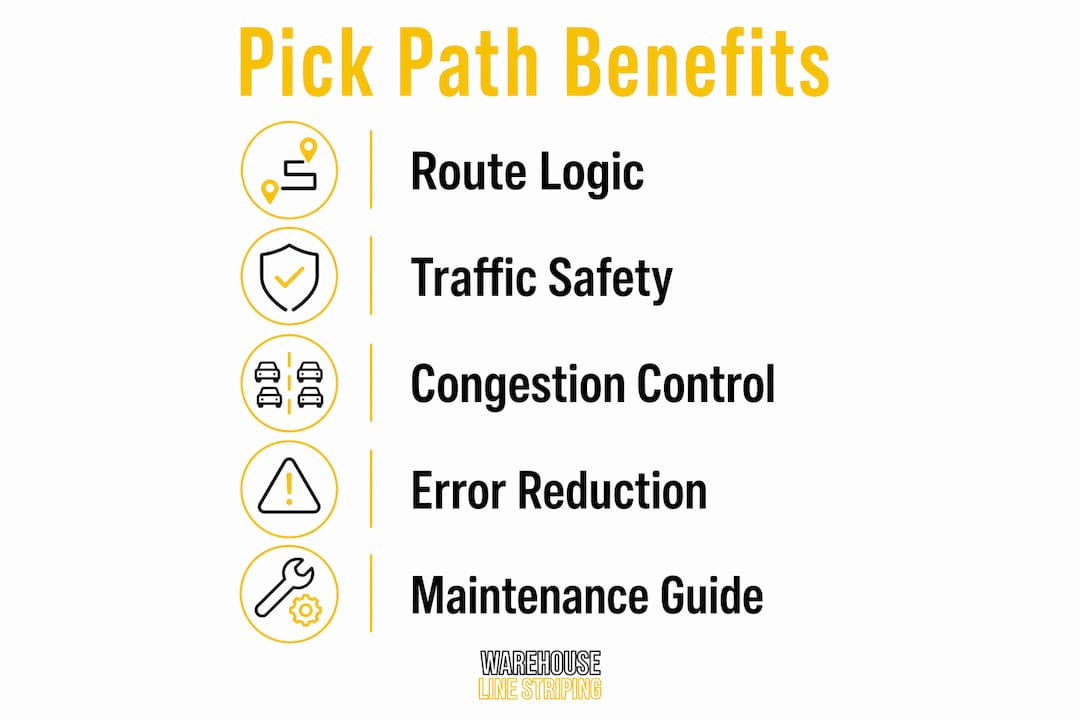
Floor markings guide pick paths by encoding route logic directly into the floor surface, removing the need for pickers to make navigation decisions in real time. Visual clarity of floor markings enables quick identification of pedestrian lanes, equipment traffic, and hazard zones, which reduces hesitation and cognitive load during high-volume picking. The result is a workforce that moves faster and makes fewer errors, not because of training alone, but because the environment itself communicates the correct path.
The five core marking types that define a functional pick path system are:
- Pedestrian walkways and crossings: Yellow lines, typically 4 inches wide, define where foot traffic belongs. Marked crossings at aisle intersections give pickers a predictable point to cross forklift lanes without guessing.
- Forklift and powered equipment lanes: Blue or white markings separate powered industrial truck routes from pedestrian zones, reducing the conflict points that cause the most serious warehouse injuries.
- Storage zones and pick faces: Marked pick faces tell pickers exactly where a location begins and ends, reducing misidentification errors at the shelf level.
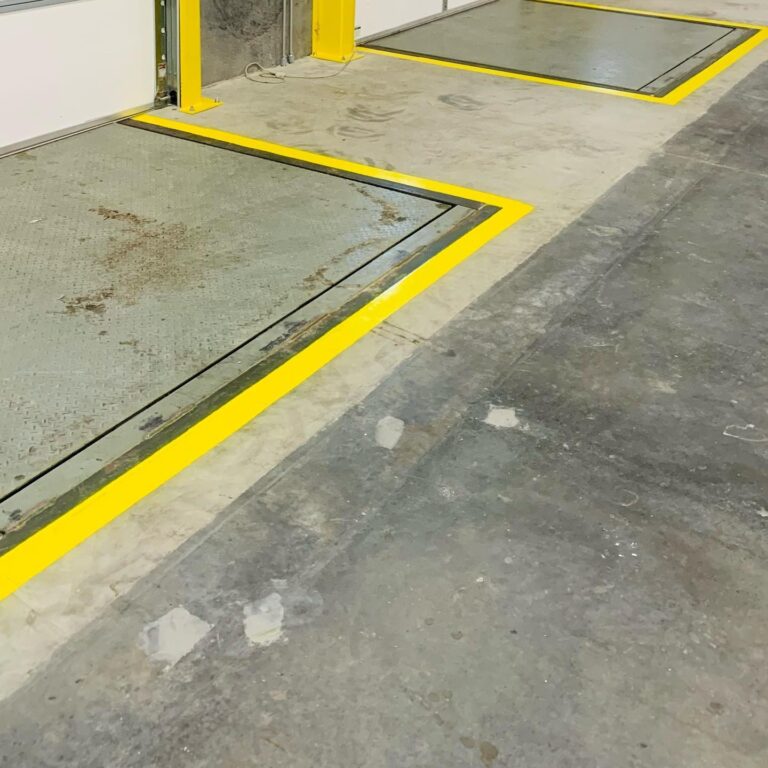
- Hazard and keep-clear areas: Red or orange markings around dock doors, charging stations, and emergency exits create buffer zones that pickers learn to avoid automatically.
- Directional arrows and symbols: Arrows embedded in aisle markings enforce one-way flows and signal turn points, which is especially critical in narrow-aisle environments.
Color coding under ANSI Z535 and OSHA aisle marking standards creates a shared visual language across your entire facility. A picker who transfers from one zone to another reads the same color logic without retraining.
| Marking type | Primary function | Common color |
|---|---|---|
| Pedestrian walkway | Defines safe foot traffic routes | Yellow |
| Equipment lane | Separates forklifts from pickers | Blue or white |
| Hazard zone | Warns of danger or restricted access | Red or orange |
| Pick face boundary | Identifies exact pick location | White |
| Directional arrow | Enforces one-way or turn logic | Yellow or white |
How aisle geometry and marking design work together
Pick path efficiency depends directly on rack and aisle geometry. Through-aisles provide smoother flow than dead-end aisles, which force pickers to reverse direction and add unnecessary steps to every route. Floor markings must reinforce this geometry, not fight it. Marking a dead-end aisle as a two-way pedestrian route without a cross-aisle exit creates a bottleneck that no amount of picker training will fix.

The most effective warehouse layouts combine main picking aisles with cross-aisles at regular intervals that allow pickers to exit mid-route without traveling to the end of the rack. Floor markings at these cross-aisle junctions should include directional arrows and yield indicators so pickers and equipment operators know who has priority. Centralized packing and staging areas, marked clearly with a distinct color, reduce the final travel leg after picking is complete.
Serpentine or S-pattern pick routes are the standard in batch picking environments. The floor marking scheme should trace this pattern explicitly, with arrows at each turn point and a clear return lane marked separately from the outbound picking lane. This separation prevents head-on congestion between pickers moving in opposite directions, which is one of the most common sources of delay in high-SKU facilities.
Pro Tip: Align your floor marking refresh cycle with your slotting review. When fast-moving SKUs shift to new locations, the marking logic that guided pickers to the old locations becomes misleading. Updating both at the same time prevents the confusion that erodes picker confidence and speed.
Markings should also encode pick sequence logic where possible. Markings aligned with picker sequencing reduce direction changes and backtracking, which compounds into significant time savings across thousands of daily picks. A facility running 500 picks per shift that eliminates two direction changes per pick route saves measurable labor hours every week.
How do floor markings reduce picking errors and improve safety?
Floor markings reduce picking errors by eliminating ambiguity at every decision point in the pick route. OSHA standards mandate marked, clear aisles to safely separate pedestrian and mechanical traffic, and this separation is the single most effective structural intervention for preventing picker-forklift conflicts. When pickers know exactly where they belong, they focus on the pick task rather than scanning for approaching equipment.
The safety benefits extend beyond collision avoidance:
- Reduced decision fatigue: A picker who follows a marked route makes fewer navigation choices per shift. Fewer choices mean fewer errors, particularly during the last two hours of a shift when cognitive performance declines.
- Consistent behavior across shifts: Markings enforce the same route logic for day, evening, and overnight crews without requiring supervisors to re-explain traffic rules at every shift change.
- Faster onboarding: New pickers in a well-marked facility reach full productivity faster because the floor communicates the workflow. Floor markings act as a silent trainer that reduces the learning curve without adding supervisor time.
- Compliance documentation: Marked aisles and hazard zones provide visible evidence of OSHA compliance during inspections, reducing the risk of citations under 29 CFR 1910.22.
Maintenance is where most facilities lose the benefit they paid for. Faded or peeling markings create confusion that is worse than no markings at all, because pickers assume a route exists and follow a ghost line into a hazard zone. Scheduled refresh cycles prevent fading and peeling, which otherwise degrade route clarity and safety. Pairing your marking inspection schedule with your regular floor cleaning program is the most practical way to catch deterioration before it affects operations.
What are best practices for applying and maintaining durable floor markings?
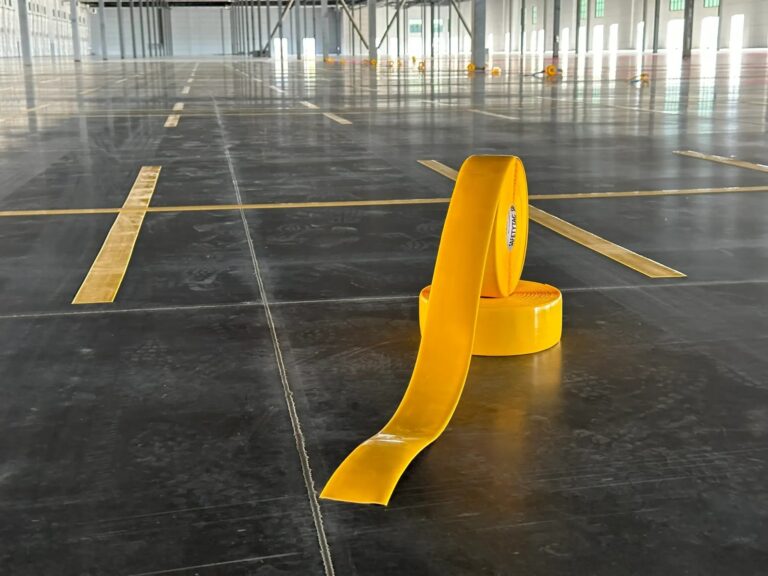
Durable floor markings start with material selection matched to your specific traffic conditions. Epoxy-based paint systems last 3 to 7 years in high-traffic warehouse environments and bond directly to concrete, making them the preferred choice for permanent pedestrian lanes and equipment boundaries. Vinyl floor marking tape works well for zones that change with slotting updates, but only when applied correctly.
Follow this sequence for a reliable application:
- Clean and profile the surface. Concrete must be free of oil, dust, and existing coating residue. Shot blasting or diamond grinding creates the surface profile that allows epoxy to bond properly. Skipping this step is the primary cause of early delamination.
- Select the right product for the zone. High-forklift-traffic areas require thicker epoxy or polyurethane coatings. Pedestrian-only zones can use heavy-duty vinyl tape rated for foot traffic. Mixing product types without a clear zone map creates inconsistent durability across the facility.
- Apply at the correct temperature and humidity. Most epoxy floor coatings require surface temperatures between 50°F and 90°F and relative humidity below 85%. Applications outside these ranges fail prematurely regardless of product quality.
- Allow full cure time before traffic. Foot traffic typically requires 24 hours of cure time. Forklift traffic requires 72 hours minimum. Rushing this step is the second most common cause of early marking failures.
- Document the layout and schedule the first inspection. Photograph the completed layout and set a 90-day inspection for high-traffic zones. Early detection of edge lifting or color fade allows spot repairs before full replacement is needed.
Pro Tip: For facilities running 24/7 operations, schedule marking applications in sections during planned maintenance windows rather than shutting down the entire floor. Warehouse Line Striping’s installation teams are experienced in phased applications that keep operations moving while new markings cure.
Proper warehouse floor maintenance directly extends marking life. Aggressive floor scrubbers with the wrong pad type abrade tape edges and thin epoxy coatings faster than forklift traffic does. Coordinate with your cleaning team on pad selection and scrubber pressure settings for marked zones.
What role does congestion control play in floor marking strategy?
Congestion control is the most underestimated dimension of floor marking strategy for pick paths. A 2026 simulation study found that free movement shortest paths cause five times more congestion than structured unidirectional routing. This finding overturns the intuitive assumption that marking the shortest path between two points produces the fastest picking operation.
“Marking shortest travel paths alone does not guarantee throughput gains. Congestion management via controlled flows is equally important, particularly in facilities with more than 20 active pickers on the floor simultaneously.”
One-way aisle systems, enforced through directional arrows and entry/exit point markings, distribute picker traffic across the available floor space rather than concentrating it at the most direct routes. The trade-off is a slightly longer individual pick path in exchange for a significantly higher throughput rate across the entire operation. Facilities that resist one-way systems because individual pickers complain about longer routes are optimizing for the wrong metric.
Congestion hotspots typically form at three locations: aisle entry points near high-velocity SKU zones, cross-aisle intersections without yield markings, and staging areas where pickers converge to deposit completed picks. Entry and exit point markings that coordinate human and equipment movement are the structural fix for all three. Consistent enforcement of route rules, supported by visible markings that leave no ambiguity about direction, is what converts a well-designed layout into a well-functioning one.
Key takeaways
Floor markings directly determine pick path efficiency by encoding route logic, traffic separation, and congestion control into the physical environment of the warehouse.
| Point | Details |
|---|---|
| Markings encode route logic | Directional arrows and zone boundaries remove navigation decisions from the picker’s cognitive load. |
| Aisle geometry drives marking design | Through-aisles with cross-aisle exits require different marking schemes than dead-end configurations. |
| Congestion control beats shortest path | Unidirectional flows reduce congestion five times more effectively than free-movement shortest-path routing. |
| Material selection determines durability | Epoxy coatings last 3 to 7 years in high-traffic zones; tape requires planned refresh cycles to stay reliable. |
| Maintenance preserves the investment | Scheduled inspections tied to cleaning programs prevent fading and peeling before they degrade route clarity. |
What I’ve learned from watching floor marking projects transform picking operations
The facilities that get the most from their floor marking investment are not the ones with the most elaborate color schemes. They are the ones where the marking layout was designed by someone who actually walked the pick routes during a live shift. I have reviewed projects where the marking plan looked perfect on a CAD drawing and failed within 90 days because it ignored the informal shortcuts pickers had developed over years of working the floor.
The practical lesson is that teams take time to adjust routes, and consistent marking across shifts is what drives steady operational gains. A marking scheme that contradicts established picker behavior will be ignored until behavior is retrained. The most successful implementations I have seen combine a well-designed layout with a two-week supervised transition period where supervisors actively reinforce the new routes.
The future of warehouse floor marking is moving toward integration with warehouse management systems. Facilities are beginning to use color-coded floor zones that correspond directly to WMS pick zone assignments, so the physical floor and the digital pick list reinforce each other. This integration reduces the gap between what the system tells a picker to do and what the floor tells them to do. That gap is where most picking errors live.
Consistent marking upkeep also has a measurable effect on worker confidence. Pickers in facilities with clean, visible markings report higher comfort levels with the traffic environment, which translates directly into faster movement and fewer hesitation stops. The floor is always communicating something. The question is whether you are controlling that message or leaving it to chance.
— ET
Optimize your pick paths with Warehouse Line Striping
Warehouse Line Striping has completed over 10,000 floor marking projects for warehouses, distribution centers, and logistics facilities nationwide. Every project starts with a layout consultation that maps your actual pick routes, rack configuration, and traffic patterns before a single line is applied.
Their pallet storage grid marking service is specifically designed to align storage zone boundaries with pick path logic, so your floor markings and your slotting strategy work as a single system. Industrial-grade epoxy coatings rated for forklift traffic, OSHA-compliant color standards, and professional removal of outdated markings are included in every engagement. For facilities ready to stop losing picks to poor routing and start building a floor that guides every shift, contact Warehouse Line Striping for a layout assessment.
FAQ
What colors are used for warehouse pick path floor markings?
Yellow marks pedestrian walkways and crossings, white defines pick face boundaries and storage zones, blue or white separates equipment lanes, and red or orange designates hazard and keep-clear areas. ANSI Z535 and OSHA standards provide the compliance framework for color assignments.
How do floor markings reduce picking errors?
Floor markings reduce picking errors by removing navigation ambiguity at every decision point, separating pedestrian and forklift traffic, and encoding pick sequence logic directly into the route. Pickers who follow a marked path make fewer direction changes and spend less cognitive effort on routing.
How long do warehouse floor markings last?
Epoxy-based floor markings last 3 to 7 years in high-traffic warehouse environments when applied to a properly prepared surface. Vinyl tape in high-forklift-traffic zones requires more frequent inspection and replacement, typically on a 12 to 24-month cycle depending on traffic intensity.
Does a one-way aisle system actually improve throughput?
A 2026 simulation study found that structured unidirectional routing reduces congestion five times compared to free-movement shortest-path systems. The individual pick route may be slightly longer, but total facility throughput increases because congestion at high-velocity zones is eliminated.
How often should warehouse floor markings be inspected?
High-traffic zones should be inspected every 90 days, with a full facility review annually. Planned refresh cycles tied to your cleaning schedule catch edge lifting and color fade before they create route confusion or safety hazards.