Last-Mile Distribution Center Design: 2026 Guide
Last-mile distribution center design is the practice of configuring a facility’s physical layout, dock systems, and operational zones to maximize parcel sorting speed and outbound dispatch efficiency. A last-mile distribution center (LMDC) is not a traditional warehouse. It is a purpose-built facility where packages are prepared for final delivery with every square foot oriented toward outbound movement, not long-term storage. Understanding what is last-mile distribution center design means recognizing that speed, flow, and vehicle turnover are the primary design constraints, not inventory depth or pallet density.
What is last-mile distribution center design?
Last-mile distribution center design is the discipline of aligning a facility’s structural specifications, dock configuration, and internal flow paths to support rapid parcel dispatch to end customers. LMDCs receive pre-sorted goods, scan and group them, then load them onto delivery vehicles within hours. That operational intent separates them from conventional fulfillment centers, which are built around storage density and pick accuracy over longer time horizons.
Typical LMDC footprints range from 50,000 to 200,000 square feet, with layouts that prioritize rapid turnover and specialized loading for sprinter vans and smaller delivery vehicles. That size range reflects a deliberate trade-off: large enough to handle urban parcel volumes, compact enough to locate near dense population centers. The efficient distribution center layout inside an LMDC looks nothing like a bulk goods warehouse. Staging zones, sorting buffers, and outbound lanes dominate the floor plan.

Four operational features define every LMDC: receiving docks for inbound freight, sorting and scanning zones, staging areas organized by delivery route, and outbound loading positions sized for last-mile vehicles. Each zone must connect to the next with minimal travel distance. Any layout that forces workers or parcels to backtrack adds seconds per package, and at thousands of packages per shift, those seconds become hours.
What are the key design elements of last-mile distribution centers?
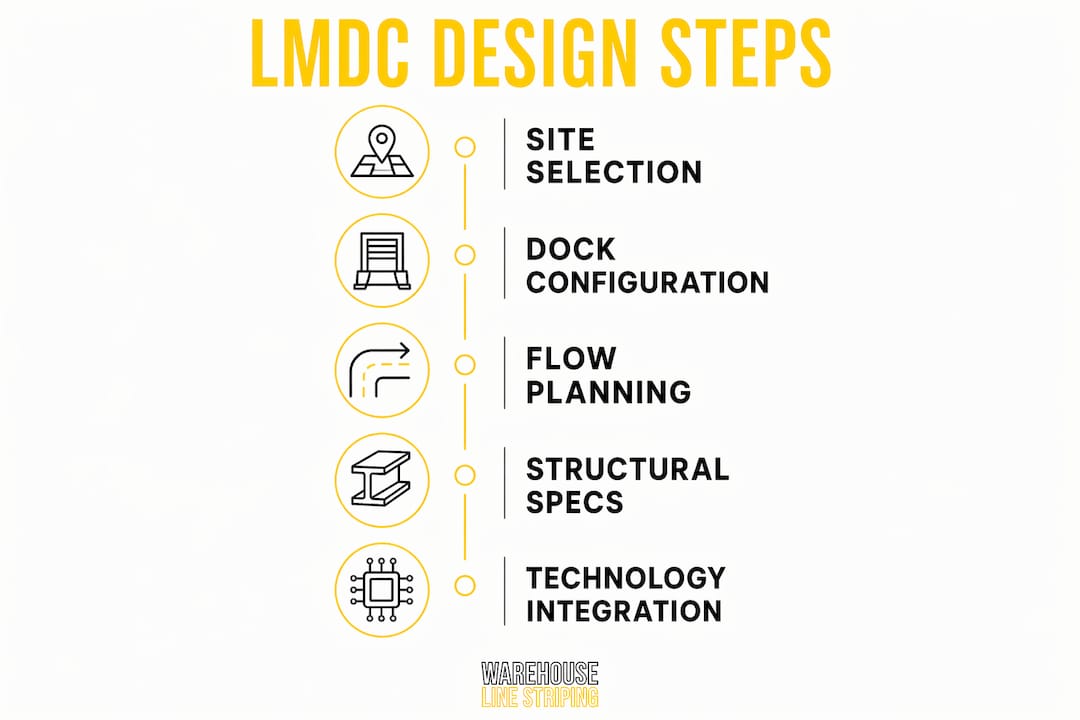
The physical and operational design of an LMDC starts with dock configuration. The cross-dock “I” layout places inbound docks on one side and outbound docks on the opposite wall. This minimizes travel distance and maximizes sight lines across the sorting floor. T-shaped and X-shaped alternatives serve facilities with high door counts or irregular site geometries, but the I-layout remains the default for pure speed.
Dock sizing follows a clear benchmark. One dock position per 5,000–10,000 square feet is the standard, with high-turnover operations targeting the higher end of that ratio. Dock height for semi-trailers is typically 48–52 inches. Mis-specified docks create throughput bottlenecks that no amount of additional staffing can fix.
Key design elements that logistics managers must specify early include:
- Facility footprint: 50,000–200,000 sq ft, sized to the served delivery zone population density
- Dock door ratio: One position per 5,000–10,000 sq ft, adjusted for peak shift volume
- Clear height: 32–40 ft minimum to support automation and mezzanine staging
- Floor flatness: Tolerances that support safe forklift and conveyor operation
- Staging zone depth: Adequate buffer for route-sorted parcels awaiting vehicle loading
- Vehicle court design: Wider aprons and tighter turning radii for sprinter vans versus semi-trailers
Pro Tip: Design your outbound staging zones before finalizing dock count. Facilities that add docks without proportional staging space create floor congestion that slows loading, not speeds it up.
The distribution center flow path through an LMDC should read like a one-way street: inbound freight enters, moves through sorting, accumulates in staging, and exits through outbound docks with no cross-traffic. Any layout that allows inbound and outbound flows to intersect introduces collision risk and sorting errors.
How does site selection impact last-mile distribution center design?
Site selection is the first design decision, and it constrains every choice that follows. Location near dense population centers reduces last-leg delivery distance, which directly cuts transportation cost and vehicle wear. Proximity to Interstate highways and major arterials reduces travel time for both inbound freight and outbound delivery routes.
Urban sites introduce constraints that suburban or exurban locations do not. Traffic congestion limits dispatch windows. Parking availability affects how many delivery vehicles can stage simultaneously. Land scarcity drives up real estate costs and often forces vertical or multi-level facility designs that complicate flow. Supply chain managers must weigh these trade-offs explicitly, not assume that the cheapest available site near a city center will support the required throughput.
The site’s shape and orientation also affect internal design. A narrow urban parcel may force a U-shaped layout rather than the preferred I-shaped cross-dock. A site with limited truck court depth may restrict dock door count below the operational requirement. These are not problems to solve after construction. They are constraints to identify during site due diligence.
- Population proximity: Target sites within 10–15 miles of the primary delivery zone centroid
- Road access: Direct access to highways reduces inbound freight travel time and vehicle wear
- Site geometry: Confirm the parcel supports the preferred dock layout before signing a lease
- Congestion windows: Map peak traffic hours against planned dispatch times to identify conflicts
- Parking capacity: Verify the site can accommodate peak delivery vehicle count plus employee parking
Pro Tip: Run a vehicle circulation simulation on the site plan before committing. A site that looks adequate on paper often reveals turning radius conflicts for sprinter vans or delivery trucks at the design stage, not after construction.
What operational challenges does last-mile distribution center design address?
Dock congestion is the most common operational failure in LMDCs. Static dock assignments and uneven trailer arrival patterns create queuing at specific doors while adjacent positions sit idle. The result is a throughput bottleneck that cannot be resolved by adding workers. The fix is a combination of dynamic dock assignment and integrated scheduling software that signals trucks to specific positions based on real-time availability.
The design response to congestion risk follows a clear sequence:
- Separate inbound and outbound vehicle flows with dedicated court zones and clearly marked entry and exit routes.
- Install dock management controls including levelers, seals, and vehicle restraints at every position to reduce dwell time per truck.
- Integrate scheduling software with dock controls so that truck arrival times align with available door assignments.
- Design for smaller vehicle turnover by including dedicated aprons and loading positions sized for sprinter vans, not just semi-trailers.
- Plan for peak surge capacity by reserving flex dock positions that activate during high-volume periods without disrupting core operations.
Vehicle circulation design determines whether an LMDC functions as a genuine speed-to-door asset. Facilities that mix inbound semi-trailers and outbound sprinter vans in the same court create conflict points that slow both flows. Dedicated lanes, clear pavement markings, and signalized entry points resolve this at the design stage.
Pro Tip: Dock bay placement for cycle time matters more than raw door count. A facility with 30 well-placed docks and dynamic assignment will outperform one with 40 static positions every time.
How do structural and technological specifications influence design?
Clear height is the single most consequential structural specification in LMDC design. Clear height typically ranges from 32 to 40 feet, and each additional foot increases usable storage volume by approximately 7–10%. More critically, clear height determines whether the facility can support automated storage and retrieval systems (AS/RS), conveyor mezzanines, or high-bay sortation equipment. This specification is nearly impossible to change after construction, which makes early validation against operational goals non-negotiable.
| Specification | Typical Range | Design Impact |
|---|---|---|
| Clear height | 32–40 ft | Determines AS/RS feasibility and mezzanine options |
| Floor flatness (FF) | FF 50–100 | Supports safe forklift and conveyor operation |
| Dock height | 48–52 in | Aligns with semi-trailer bed height for level loading |
| Electrical capacity | 2,000–4,000 amps | Supports automated sortation and charging infrastructure |
| Column spacing | 50–60 ft bays | Maximizes unobstructed floor area for staging and flow |
Floor flatness tolerances directly affect equipment safety and conveyor alignment. A floor specified at FF 50 supports standard forklift operation. Facilities planning automated guided vehicles (AGVs) or high-speed conveyors require FF 100 or higher. Getting this wrong means expensive remediation after installation.
Warehouse management systems (WMS) and RF scanning networks are not add-ons. They are core infrastructure that must be designed into the facility from the start. Conduit routing, server room placement, and wireless access point coverage all affect where sorting zones and staging areas can be located. Early design decisions dictate downstream automation choices, including dock configuration and flow path orientation.
Pro Tip: Validate your clear height requirement against your five-year automation roadmap, not just current operations. Retrofitting ceiling height is cost-prohibitive. Designing for 36 ft when you plan to install AS/RS in year three is a recoverable mistake. Designing for 28 ft is not.
What best practices optimize last-mile distribution center performance?
The most effective last-mile logistics strategy blends layout archetypes rather than committing to a single pattern. Mixing straight-through, U-shaped, and modular zoned layouts provides the operational flexibility to handle returns volume spikes, carrier mix changes, and seasonal surges without redesigning the core floor plan. Pure archetypes rarely survive contact with real-world operational variability.
Practical design strategies that consistently improve throughput and labor efficiency include:
- Prioritize flow balance over door count. A facility with balanced inbound and outbound capacity outperforms one that maximizes doors on one side.
- Dedicate staging buffers for returns. Returns processing is the most disruptive flow in an LMDC. Isolating it prevents contamination of outbound staging.
- Design parking for rapid turnover. Sprinter van positions need shorter aprons and faster access than semi-trailer docks. Mixing them creates delays.
- Adopt dynamic dock assignment. Static assignments waste capacity. Dynamic systems tied to scheduling software fill positions based on real-time demand.
- Build in flex space. Reserve 10–15% of floor area for seasonal surge operations. This space should be adjacent to, but separable from, core sorting zones.
For a deeper look at cross-docking floor layout examples that apply these principles to real facility configurations, the options range from simple I-layouts to complex multi-zone designs for high-volume urban nodes.
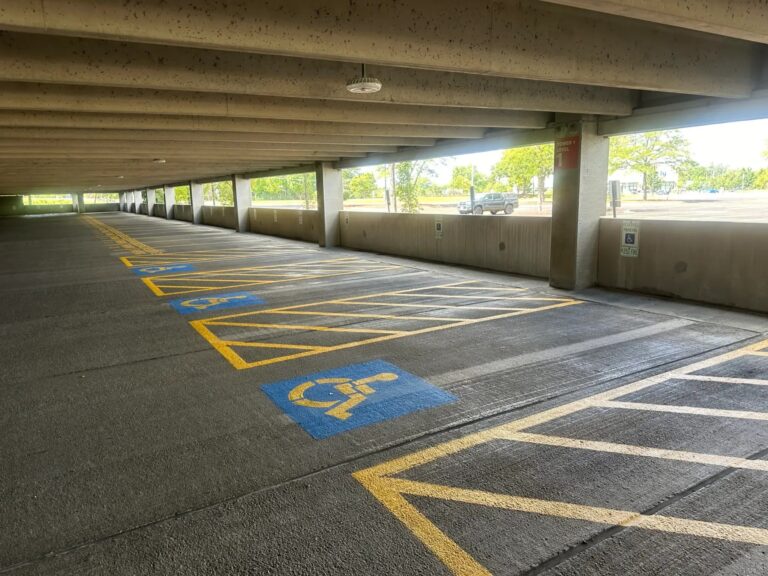
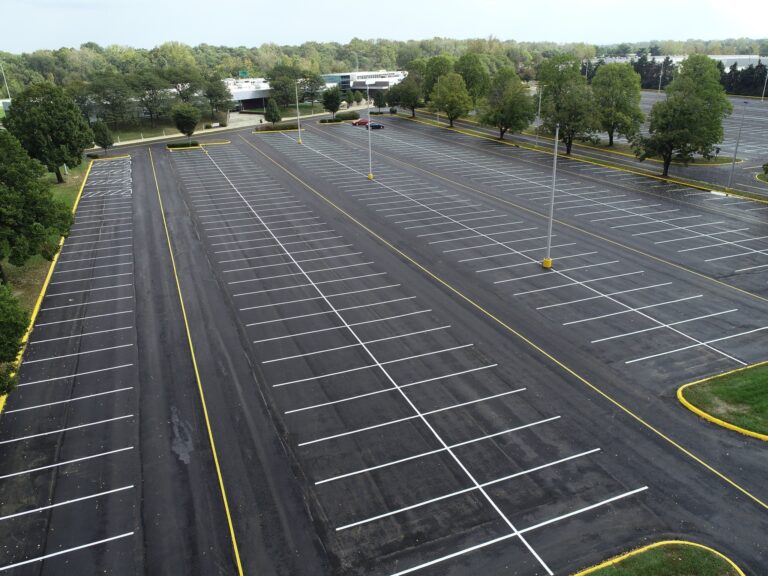
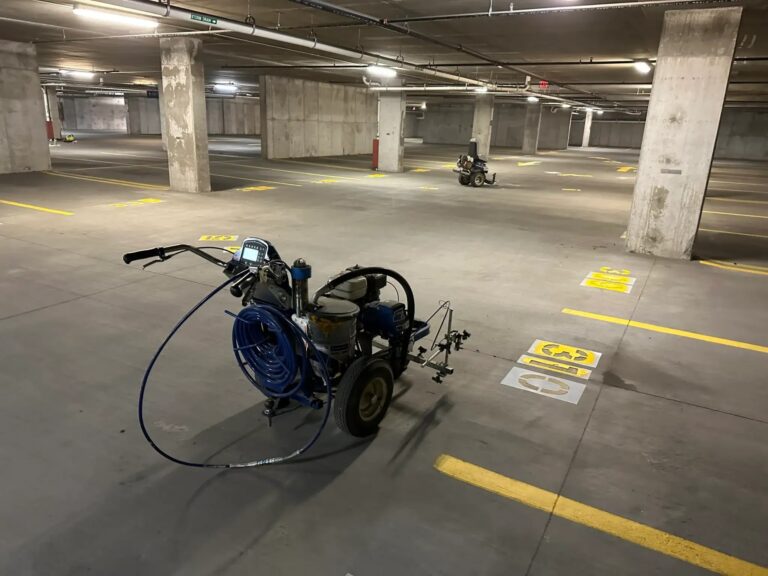
Pro Tip: Label every zone on the floor before operations begin. Clear floor markings for staging lanes, vehicle paths, and sorting zones reduce worker errors and speed up onboarding for seasonal labor. This is not a finishing touch. It is a throughput tool.
Key takeaways
Effective last-mile distribution center design requires aligning structural specifications, dock configuration, and internal flow paths with the operational cadence of rapid parcel dispatch.
| Point | Details |
|---|---|
| Flow over storage | LMDCs are built for speed and outbound movement, not inventory depth. |
| Dock ratio matters | Target one dock per 5,000–10,000 sq ft and integrate dynamic assignment software. |
| Clear height is permanent | Validate clear height against automation goals before construction, not after. |
| Site selection shapes layout | Urban constraints like congestion and parking directly limit throughput capacity. |
| Blend layout archetypes | Mixing straight-through, U-shaped, and modular zones handles real-world variability better than any single pattern. |
The design mistake i see most often in lmdcs
Most LMDC design failures I have observed come down to one root cause: teams optimize for door count and ignore cycle time. A facility with 50 dock doors and static assignments will underperform one with 35 doors and a dynamic management system every single shift. The number on the drawing looks impressive. The throughput data tells a different story.
The second most common mistake is treating clear height as a cost line to cut. I have seen facilities designed at 28 feet because the developer wanted to reduce structural steel costs. Two years later, the operator needed to install a sortation conveyor and had to choose between a low-clearance system that limited throughput and a full redesign. Neither option was cheap. Early validation of structural specs against automation goals is the single highest-return design investment you can make.
The third pitfall is designing the building before designing the operation. Layout choices must align physical flow to dispatch cadence. That means mapping your dispatch windows, vehicle mix, and peak parcel volumes before you draw a single dock door. The building serves the operation. When teams reverse that sequence, they end up with a facility that looks right on paper and fails on the floor.
My recommendation: blend your layout archetypes, validate your structural specs against a five-year automation plan, and integrate dock management systems from day one. The facilities that perform best at last-mile delivery solutions are not the ones with the most doors. They are the ones where every design decision traces back to a specific operational requirement.
— ET
How warehouse line striping supports last-mile distribution centers
Clear floor markings are not cosmetic. In a high-turnover LMDC, they are the physical infrastructure that keeps sorting lanes, staging zones, and vehicle paths functioning at speed.
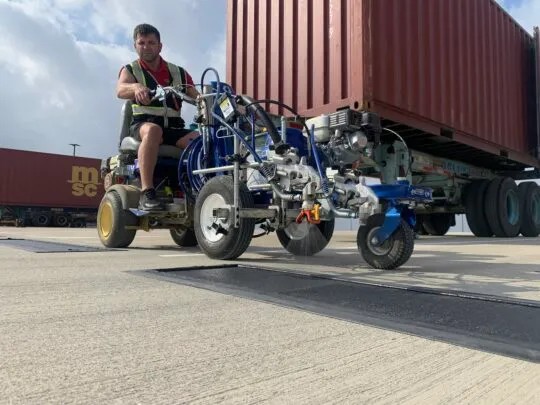
Warehouse Line Striping has completed over 10,000 projects in distribution centers and logistics facilities nationwide. Their OSHA-compliant epoxy coatings last 3–7 years under heavy forklift and delivery vehicle traffic. For LMDCs, they design staging area floor marking workflows that align with your dispatch cadence and vehicle routing patterns. They also provide professional removal of outdated markings when layouts change, with 24/7 support to minimize operational disruption. If you are building or redesigning an LMDC, explore their floor marking systems for inventory flow to see how precision striping translates directly into throughput gains.
FAQ
What is a last-mile distribution center?
A last-mile distribution center is a facility designed for rapid parcel sorting, staging, and dispatch to end customers. Unlike traditional warehouses, LMDCs prioritize outbound flow speed over long-term storage capacity.
How big is a typical last-mile distribution center?
Most LMDCs range from 50,000 to 200,000 square feet. Size is determined by the population density of the served delivery zone and the required daily parcel throughput.
What is the best dock layout for an LMDC?
The I-shaped cross-dock layout, with inbound docks on one wall and outbound on the opposite, is the most efficient configuration for minimizing travel distance and maximizing sorting floor visibility.
How does clear height affect LMDC design?
Clear height ranging from 32 to 40 feet determines whether a facility can support automated sortation systems and mezzanine staging. Each additional foot of clear height increases usable storage volume by approximately 7–10%.
Why does site selection matter for last-mile facilities?
Site location directly affects delivery distance, vehicle routing efficiency, and dispatch window flexibility. Urban sites near population centers reduce last-leg transportation costs but introduce constraints like congestion and limited parking that must be resolved at the design stage.