Aisle Markings and Forklift Routing: 2026 Manager’s Guide
Aisle markings are the primary visual control system that directs forklift traffic, separates pedestrians, and defines safe travel paths across warehouse floors. The role of aisle markings in forklift routing goes far beyond painted lines. They reduce collisions, support OSHA compliance under 29 CFR 1910.176(a), and give operators the consistent visual cues they need to move loads quickly and safely. For distribution center managers running facilities with dozens of daily forklift movements, a well-designed marking system is the difference between a facility that flows and one that creates near-misses every shift.
What are the OSHA aisle marking requirements for forklift routing?
OSHA 29 CFR 1910.176(a) requires that permanent aisles and passageways be “appropriately marked.” Violations carry penalties up to $16,550 per citation. That single number reframes the economics of floor marking immediately.
What OSHA does not do is specify exact colors or line widths. That flexibility is both an opportunity and a trap. OSHA does not mandate specific colors or widths, but inconsistent or absent markings still trigger citations because inspectors evaluate whether aisles are clearly defined and whether pedestrian and forklift paths are separated. The standard is functional, not cosmetic.
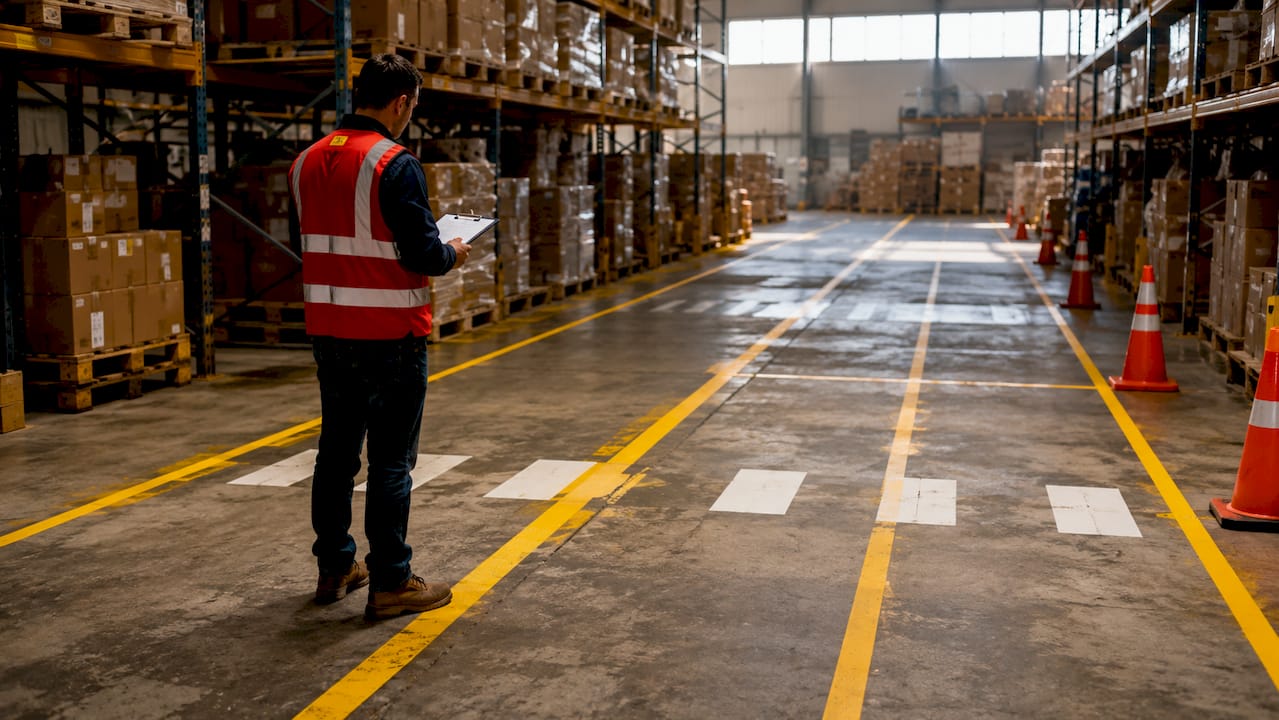
The Warehouse National Emphasis Program runs through July 2026, which means OSHA inspections of distribution centers and fulfillment operations are at elevated frequency this year. Facilities without clearly marked aisles, or with faded and obstructed markings, are the most common citation targets. The program specifically flags pedestrian and forklift separation as a high-priority inspection item.
Key compliance benchmarks every manager should know:
- Aisles must be permanently marked, not just temporarily taped during audits
- Pedestrian walkways require distinct separation from forklift travel lanes
- Markings must remain visible. Visibility under 70% triggers a maintenance obligation
- Unmarked or obstructed aisles are among the most common causes of OSHA citations
Aisle markings are not decoration. They are a documented safety control, and OSHA treats their absence or deterioration as a direct indicator of management failure.
How to design aisle markings that optimize forklift routing and pedestrian safety
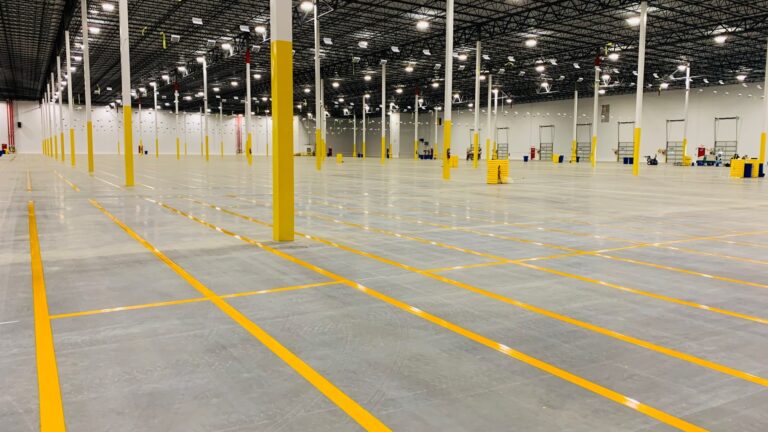
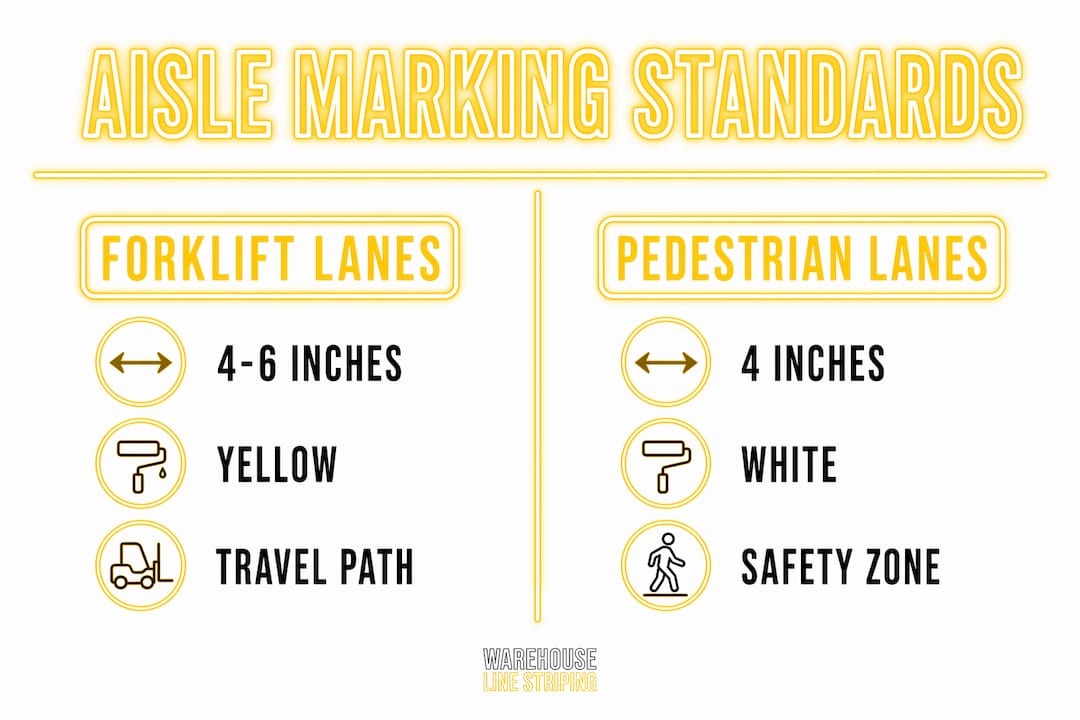
Effective forklift lane signage starts with a clear separation principle: forklift travel lanes and pedestrian walkways must never share the same visual space. Continuous yellow lines define forklift travel paths, while pedestrian lanes typically use white or green markings with hatching or striping to signal a different use zone. This color distinction reduces the cognitive load on both operators and workers moving on foot.
Here is a practical design sequence for a new or revised marking layout:
- Map all forklift routes first. Identify primary travel lanes, cross-aisles, staging zones, and loading dock approaches before marking anything.
- Calculate aisle width from equipment specs. Aisle width must account for forklift turning radius, load width, and safety clearance. Generic widths create bottlenecks. A counterbalance forklift with a 48-inch pallet load needs a different aisle than a narrow-aisle reach truck.
- Mark intersections with stop bars and directional arrows. These reduce forklift-pedestrian conflicts at blind corners, which account for a disproportionate share of incidents.
- Add speed limit markings in high-density zones. Painted speed indicators near dock doors and pick areas reinforce verbal policies with a physical cue operators see every pass.
- Apply crosswalk markings at every pedestrian crossing point. Crosswalks with yield lines tell forklift operators exactly where to expect foot traffic.
Line width standards follow a simple rule: 4 inches is the baseline for standard aisles, and 6 inches applies in high-visibility or high-traffic zones. The table below summarizes common marking types and their recommended specifications.
| Marking type | Recommended width | Primary color | Purpose |
|---|---|---|---|
| Forklift travel lane | 4 to 6 inches | Yellow | Define vehicle path |
| Pedestrian walkway | 4 inches | White or green | Separate foot traffic |
| Stop bar | 6 inches | White or yellow | Control intersection behavior |
| Hazard zone border | 6 inches | Red or orange | Indicate restricted areas |
| Directional arrow | Standard stencil | Yellow | Guide routing decisions |
Pro Tip: Before committing to epoxy or paint, use industrial floor tape to test your layout for two to four weeks. Tape lets you adjust aisle widths and intersection placements without downtime or rework costs. Only paint once the layout proves out under real traffic.
Common challenges in aisle marking and forklift routing
The most expensive mistake in forklift lane signage is marking aisles based on available floor space rather than actual equipment dimensions. A facility that marks 8-foot aisles for a forklift that needs 10 feet of clearance with a loaded pallet does not have a marking problem. It has a planning problem that markings cannot fix.
The second most common failure is treating floor markings as the only safety control. Line marking is a baseline control. In blind corners, loading dock approaches, and high-speed travel lanes, paint alone does not stop a 10,000-pound forklift. Convex mirrors, bollards, and physical barriers must supplement markings in any zone where a forklift operator cannot see a pedestrian until it is too late.
Other challenges that consistently surface during facility audits:
- Faded markings left in service too long. Operators stop trusting lines they can barely see, and routing behavior becomes inconsistent.
- Storage placed inside marked aisles. This is a direct OSHA violation and a sign that the original layout did not account for actual storage behavior.
- Pedestrian and forklift paths that converge at dock doors. Dock areas are the highest-risk zones in most warehouses, yet they are often the least marked.
- No distinction between one-way and two-way forklift lanes. Directional arrows are cheap. Head-on forklift collisions are not.
Pro Tip: Conduct a walk-through of your facility at shift change, when both forklift and pedestrian traffic peaks. The conflicts you observe in that 15-minute window will tell you more about your marking gaps than any audit checklist.
What are the best practices for maintaining aisle markings over time?
Aisle markings degrade under forklift wheel loads, cleaning chemicals, and UV exposure from dock doors. A marking system that was compliant at installation becomes a liability if it is not maintained on a defined schedule.
Follow this maintenance framework to keep forklift routing markings effective:
- Inspect quarterly. Walk every marked aisle and document visibility ratings. Any section below 70% visible requires immediate attention, not a note for the next budget cycle.
- Plan for re-marking cycles by material. Industrial tape requires re-marking every one to three years. Epoxy coatings last three to five years under normal forklift traffic. Budget accordingly rather than reacting to failures.
- Prioritize high-traffic zones first. Dock approaches, main travel lanes, and pedestrian crossings degrade faster than storage area perimeters. Allocate maintenance resources where failure has the highest consequence.
- Train staff to report marking damage. Forklift operators and pickers see the floor every shift. A simple reporting protocol, such as a floor marking damage tag or a line item in the daily checklist, catches problems before they become citations.
- Remove outdated markings completely before re-marking. Ghost lines from old layouts confuse operators and create routing errors. Professional removal is not optional when layouts change.
A 50,000-square-foot warehouse floor marking system costs between $5,000 and $15,000. That is less than a single serious OSHA violation fine. Framing maintenance budgets against that comparison makes approval conversations with finance significantly shorter.
How do aisle markings integrate into broader warehouse traffic safety?
Aisle markings do not operate in isolation. They are the visual layer of a traffic management system that also includes signage, physical barriers, training, and operational procedures. Floor markings reduce operator cognitive load by providing consistent visual cues, which means fewer decisions per trip and fewer near-miss incidents over a shift.
Within a 5S or lean operations framework, floor markings are the “Set in Order” and “Standardize” steps made physical. A facility using consistent color coding for pick paths and staging zones reduces the time operators spend interpreting their environment and increases the time they spend moving product. The cognitive benefit compounds across hundreds of daily forklift cycles.
The table below compares the contribution of different traffic management controls to overall warehouse safety.
| Control type | Primary function | Limitation |
|---|---|---|
| Floor markings | Define lanes, separate traffic types | Passive. Cannot stop a moving forklift |
| Convex mirrors | Improve sightlines at blind corners | Requires operator attention to be effective |
| Physical barriers | Prevent vehicle entry into pedestrian zones | Fixed. Reduces layout flexibility |
| Signage | Reinforce rules and speed limits | Ignored when overused or poorly placed |
| Training | Build operator awareness and habit | Degrades without reinforcement |
Consistent color schemes also simplify OSHA inspections. When yellow always means forklift travel, red always means fire safety, and green always means pedestrian, an inspector can assess compliance in minutes. A facility with ad hoc color choices forces inspectors to ask questions, and questions during an inspection rarely end in your favor.
Key takeaways
Effective forklift routing requires aisle markings designed to equipment specifications, maintained above 70% visibility, and integrated with physical barriers and consistent color standards.
| Point | Details |
|---|---|
| OSHA compliance is non-negotiable | 29 CFR 1910.176(a) requires marked aisles; violations reach $16,550 per citation. |
| Design to equipment specs | Calculate aisle width from forklift turning radius and load dimensions, not available space. |
| Markings are a baseline control | Supplement floor markings with mirrors, bollards, and barriers in high-risk zones. |
| Maintain on a defined schedule | Re-mark tape every one to three years and epoxy every three to five years; replace anything below 70% visibility. |
| Color consistency multiplies value | Standard color schemes reduce cognitive load for operators and speed up OSHA inspections. |
What I’ve learned from facilities that get this right
Most warehouse managers treat aisle markings as a compliance checkbox. The facilities that actually reduce incidents treat them as an operational design tool. There is a meaningful difference between those two mindsets, and it shows up in incident logs within six months of a layout change.
The counterintuitive lesson I keep seeing: wider aisles do not automatically mean safer aisles. A 12-foot aisle with no directional markings and no stop bars at intersections generates more near-misses than a properly marked 9-foot aisle. The markings create the behavioral structure. The width just provides the physical space.
I also think the industry underestimates how much faded markings cost in productivity, not just safety. When operators cannot clearly see lane boundaries, they slow down, take wider paths, and make more conservative turns. That caution is rational, but it adds seconds to every cycle. Across a 10-hour shift with 200 forklift movements, those seconds become hours. Maintaining markings is not just a safety investment. It is a throughput investment.
The tape-before-paint approach from the research pool is genuinely underused. Facilities that test layouts with industrial tape before committing to epoxy avoid the expensive and disruptive process of grinding out permanent markings when a layout does not work as planned. If you are redesigning a section of your facility, tape costs almost nothing compared to the rework you avoid.
— ET
Get your aisle markings right the first time
Warehouse Line Striping has completed over 10,000 floor marking projects for warehouses and distribution centers nationwide. Their team designs OSHA-compliant aisle layouts calibrated to your specific forklift equipment, load dimensions, and traffic patterns. Industrial-grade epoxy coatings last three to seven years under heavy forklift traffic, and every project includes professional removal of outdated markings so ghost lines never confuse your operators. If you are preparing for a Warehouse National Emphasis Program inspection or redesigning your facility’s traffic flow, start with a floor marking assessment from Warehouse Line Striping. You can also review the aisle width compliance guide to confirm your current layout meets 2026 standards before an inspector does it for you.
FAQ
What does OSHA require for warehouse aisle markings?
OSHA 29 CFR 1910.176(a) requires that permanent aisles be “appropriately marked” but does not specify exact colors or widths. Inspectors evaluate whether markings clearly define forklift and pedestrian paths and whether they remain visible and unobstructed.
How wide should forklift aisle markings be?
The standard line width is 4 inches for most aisles and 6 inches in high-visibility or high-traffic zones. Aisle width itself must be calculated from the forklift’s turning radius, load dimensions, and required safety clearance rather than available floor space.
How often should warehouse aisle markings be replaced?
Industrial floor tape requires re-marking every one to three years. Epoxy paint markings last three to five years under normal forklift traffic. Any marking section with visibility below 70% should be replaced immediately regardless of age.
Can floor tape replace paint for permanent aisle markings?
Floor tape meets OSHA requirements for permanent aisle marking when it remains visible and intact. Many facilities use tape to test new layouts before applying epoxy, which reduces rework costs when traffic patterns change.
What colors should forklift and pedestrian lanes use?
Yellow is the industry convention for forklift travel lanes, while white or green typically marks pedestrian walkways. Red designates fire safety zones and hazard areas. These are not OSHA-mandated colors, but consistent use of standard color schemes simplifies compliance inspections and reduces operator confusion.