Forklift Zone Marking Standards: 2026 OSHA Guide
Forklift zone marking standards are federally mandated safety requirements that define how warehouses must mark aisles, pedestrian paths, and hazard zones to prevent collisions and OSHA citations. The governing regulation, 29 CFR 1910.22, requires all permanent aisles to be clearly marked with lines between 2 and 6 inches wide. ANSI Z535.1 adds a color-coding layer that assigns specific hues to specific risks. Together, these standards form the foundation of every compliant warehouse floor marking program in 2026.
1. What are OSHA’s requirements for forklift zone lane widths and line markings?
OSHA mandates that permanent aisles be marked with lines no narrower than 2 inches and no wider than 6 inches. The 4-inch line is the industry standard because it delivers visibility at forklift operating speeds without consuming excessive floor space.
Aisle width requirements go beyond the line itself. OSHA requires clearance of at least 3 feet on each side of the largest forklift operating in that aisle. In practice, this puts most compliant one-way aisles in the 10-to-16-foot range, depending on equipment size.
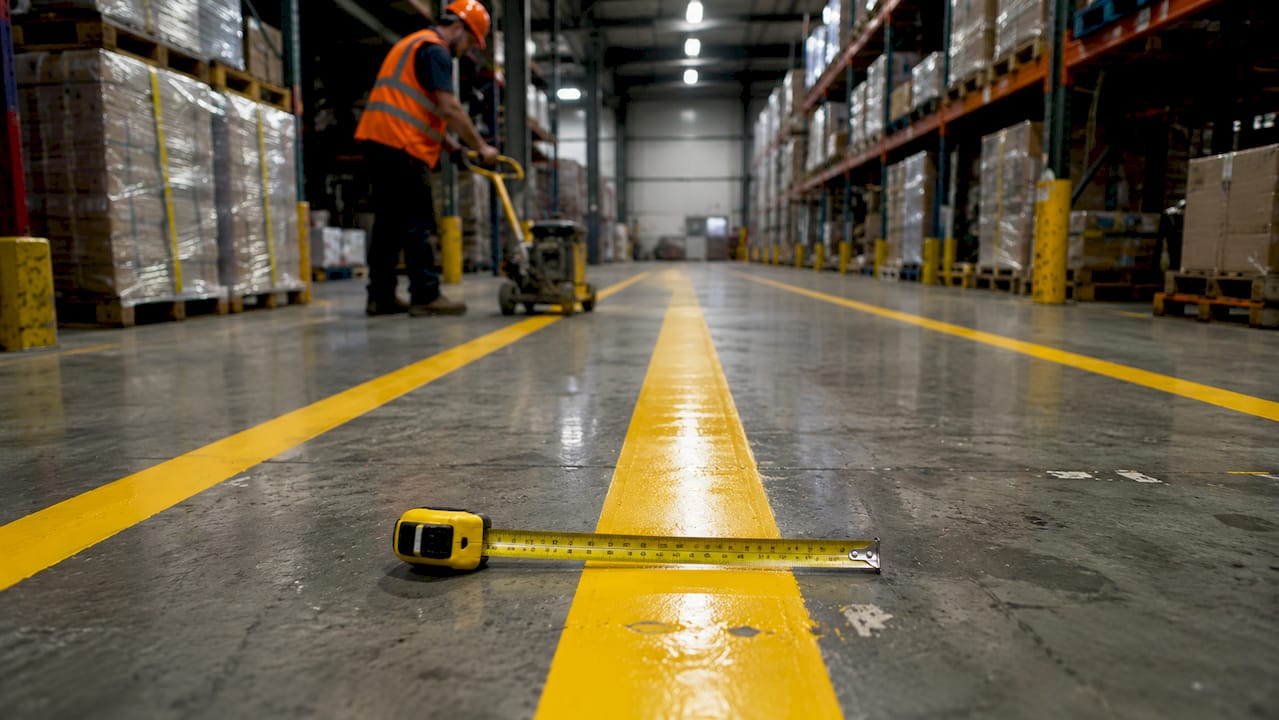
Two-way aisles require additional width to allow safe passing. A facility running counterbalance forklifts with a 7-foot body width needs a two-way aisle of at least 20 feet to meet clearance requirements on both sides simultaneously.
Key dimensional rules to follow:
- Minimum line width: 2 inches (legal floor); 4 inches (best practice for visibility)
- Maximum line width: 6 inches per OSHA 29 CFR 1910.22
- One-way aisle clearance: forklift width plus 3 feet minimum on each side
- Two-way aisle clearance: two forklift widths plus 3 feet on each outer edge
- Narrowest aisle point: must meet clearance requirements, not just the average width
Pro Tip: Measure the narrowest point in every aisle, not the widest. Ignoring narrow aisle points creates non-compliance regardless of how well the rest of the floor is marked.
2. Which color codes are standard for forklift zones, pedestrian paths, and hazard areas?
ANSI Z535.1 color standards assign specific colors to specific risk categories. Following this system gives every worker an immediate visual cue about what a zone contains and what behavior it requires.
The standard color assignments are:
- Yellow: forklift traffic lanes, caution zones, and areas where pedestrians and equipment share space
- Red: fire protection equipment, emergency stops, and danger zones requiring immediate attention
- Green: first aid stations, safety equipment, and designated safe areas
- White or blue: equipment staging areas, storage zones, and lower-risk operational areas
- Orange: warning zones around machinery with moving parts
Beyond color, line style carries meaning. Solid lines define fixed boundaries that workers and operators must not cross. Dashed lines indicate directional guidance or route separation within a shared zone.
| Color | Zone Type | Line Style |
|---|---|---|
| Yellow | Forklift lanes, caution areas | Solid boundary |
| Red | Fire equipment, danger zones | Solid boundary |
| Green | First aid, safe zones | Solid boundary |
| White | Staging, storage areas | Solid or dashed |
| Dashed (any color) | Directional routing | Dashed |
Consistent color coding reduces accidents by giving staff immediate comprehension of zone rules without reading a sign. A worker who sees yellow on the floor knows a forklift operates there. That instant recognition is what makes ANSI compliance worth the investment.
3. How should pedestrian walkways and forklift lanes be separated?
Pedestrian walkways require a minimum width of 28 inches under OSHA regulations. The recommended width is 36 to 48 inches for facilities with two-way pedestrian traffic or workers carrying materials.
Visual separation alone is not always sufficient. Combining painted lines with physical barriers creates the highest level of safety at busy intersections. Bollards, guardrails, and raised curbs add a physical layer that painted lines cannot provide.
Crosswalk markings follow the same logic as road crosswalks. Zebra-stripe patterns at forklift crossing points signal both operators and pedestrians to slow and check before proceeding. Pair these with directional arrows and stop lines on the forklift approach side to create predictable traffic behavior.
Additional elements that strengthen pedestrian separation:
- Convex mirrors at blind intersections and corners
- Speed limit floor markings in high-pedestrian zones
- Pedestrian-only zone markings with clear signage at entry points
- Keep-clear zones of 36 inches minimum around electrical panels and fire equipment, marked with red boundaries and text
Pro Tip: Mark pedestrian zones in a contrasting color to forklift lanes. A yellow forklift lane next to a white pedestrian path creates an immediate visual boundary that workers recognize without training.
4. What are the best maintenance practices for forklift zone markings?
Faded or worn markings are legally equivalent to no marking under OSHA standards. An inspector who finds a line worn below visibility will cite the facility the same way they would cite a completely unmarked aisle.
OSHA requires that markings be maintained. The practical standard is quarterly inspections of high-traffic zones and annual touch-ups across the full facility. Here is a structured maintenance approach:
- Quarterly walkthroughs: inspect all forklift lanes, pedestrian paths, and hazard zones for fading, chipping, or damage
- Immediate repairs: address any marking that has lost more than 20% of its original visibility before the next scheduled inspection
- Annual full review: reassess the entire floor plan for layout changes, new equipment, or workflow shifts that require updated markings
- Material assessment: evaluate whether current marking materials match traffic volume and floor conditions
Material choice drives maintenance frequency. Vinyl tape requires replacement every 6 to 12 months in high-traffic areas. Epoxy coatings last 3 to 7 years under comparable conditions. Thermoplastic markings fall between the two in durability and cost.
Treating floor marking as an ongoing program rather than a one-time installation prevents the compliance gaps that lead to citations and accidents. Facilities that integrate marking schedules with their warehouse management systems catch degradation earlier and spend less on emergency repairs.
Pro Tip: Photograph every marked zone after installation. Use those photos as your compliance baseline during quarterly inspections. The comparison takes seconds and gives you documentation if OSHA ever audits.
5. How to customize forklift zone marking plans for different warehouse layouts
No two warehouse floors are identical. A marking plan that works for a 50,000-square-foot distribution center will not translate directly to a 12,000-square-foot manufacturing facility. The starting point is always measurement.
Effective marking plans begin with equipment width and the narrowest aisle point, then work outward to design compliant clearances. Skipping this step produces markings that look correct but fail inspection.
Key steps for customizing your marking plan:
- Measure all equipment: record the widest point of every forklift, reach truck, and pallet jack operating in the facility
- Map traffic flow: identify one-way and two-way routes before marking to avoid costly repaints
- Mark staging and loading dock zones: loading dock safety standards require clear boundaries between active dock doors and pedestrian staging areas
- Identify machine hazard zones: mark exclusion zones around presses, conveyors, and other fixed machinery with appropriate ANSI colors
- Plan intersection controls: high-volume crossing points need directional arrows, stop lines, and potentially physical barriers
Facilities with seasonal volume spikes face an additional challenge. A layout that handles standard throughput safely may create bottlenecks during peak periods. Building extra clearance into the original marking plan costs nothing at installation and prevents expensive redesigns later. Review your floor layout practices annually to confirm the marking plan still matches actual traffic patterns.
Key Takeaways
Compliant forklift zone marking requires correct line widths, ANSI-standard colors, measured aisle clearances, and a scheduled maintenance program to remain legally effective.
| Point | Details |
|---|---|
| Line width compliance | Use 4-inch lines as standard; 2 inches is the legal minimum under OSHA 29 CFR 1910.22. |
| ANSI color coding | Yellow marks forklift lanes, red marks danger zones, green marks first aid areas. |
| Aisle clearance | Maintain at least 3 feet of clearance on each side of the widest forklift in every aisle. |
| Pedestrian separation | Walkways need a minimum of 28 inches width and must be visually or physically separated from forklift lanes. |
| Ongoing maintenance | Quarterly inspections and scheduled touch-ups keep markings compliant; faded lines equal no lines under OSHA. |
What I’ve learned after years of watching warehouse marking programs fail
The most common mistake I see is treating the initial installation as the finish line. A facility spends real money on a professional marking job, the floor looks great on day one, and then nothing happens for three years. By the time an OSHA inspector arrives, the high-traffic intersections are bare concrete and the pedestrian lanes are ghosts of their original color.
The second mistake is ignoring non-standard zones. Electrical panels, fire extinguisher stations, and emergency exits all require specific keep-clear markings. These are legally required zones that safety officers routinely overlook because they fall outside the forklift lane planning conversation. A 36-inch red keep-clear boundary around an electrical panel is not optional.
Color inconsistency is the third failure point. I have walked facilities where yellow means forklift lane in one building and pedestrian path in another. Workers who rotate between buildings carry the wrong mental model into the wrong space. Standardizing on ANSI Z535.1 across every building in a campus eliminates that confusion entirely.
The facilities that get this right treat floor marking the same way they treat equipment maintenance: scheduled, documented, and tied to accountability. That mindset is what separates a compliant program from a citation waiting to happen.
— ET
Warehouse Line Striping’s floor marking solutions for OSHA compliance
Warehouse Line Striping has completed over 10,000 floor marking projects across warehouses, distribution centers, and industrial facilities nationwide. Every project follows OSHA 29 CFR 1910.22 and ANSI Z535.1 standards, with industrial-grade epoxy coatings that last 3 to 7 years under heavy forklift traffic.
Whether you need a full facility layout, a targeted refresh of worn pedestrian zones, or a loading dock marking plan, Warehouse Line Striping delivers customized solutions with minimal operational disruption. The team also handles professional removal of outdated markings before new installation. Review the floor marking systems guide to see how a structured marking program supports both safety compliance and inventory flow, then contact Warehouse Line Striping for a facility-specific plan.
FAQ
What line width does OSHA require for forklift aisles?
OSHA requires lines between 2 and 6 inches wide for permanent aisles. The 4-inch width is the industry standard for optimal visibility.
What color should forklift lanes be marked?
ANSI Z535.1 designates yellow for forklift traffic lanes and caution zones. Yellow is the recognized standard across warehouses and distribution centers in the United States.
How wide must pedestrian walkways be in a warehouse?
The legal minimum is 28 inches, but 36 to 48 inches is recommended for two-way pedestrian traffic or workers carrying materials.
How often should warehouse floor markings be inspected?
Quarterly inspections of high-traffic zones are the recommended standard. Faded or worn markings count as non-compliant under OSHA and must be repaired promptly.
Are keep-clear zones around electrical panels required?
Yes. A minimum 36-inch keep-clear zone around electrical panels and fire equipment is legally required and must be marked with red boundaries and text.