What Is a Distribution Center Flow Path?
A distribution center flow path is the end-to-end route and task sequence that products follow through every operational stage of a facility, from receiving through shipping and returns. In professional logistics, this concept is often called product flow or warehouse flow, and understanding it is the foundation of any serious distribution center operations improvement effort. The flow path includes both the physical travel of goods across the floor and the work sequences, scanning events, and Warehouse Management System (WMS) tasks that accompany each movement. Getting this right determines whether your facility runs at capacity or bleeds labor hours into congestion, backtracking, and missed handoffs.
What is a distribution center flow path and how is it structured?
A distribution center flow path is composed of two linked systems: the physical SKU journey across the facility floor and the task and information flows controlled by WMS and scanning events. Both systems must align for the flow path to function as designed. When either breaks down, the other follows.
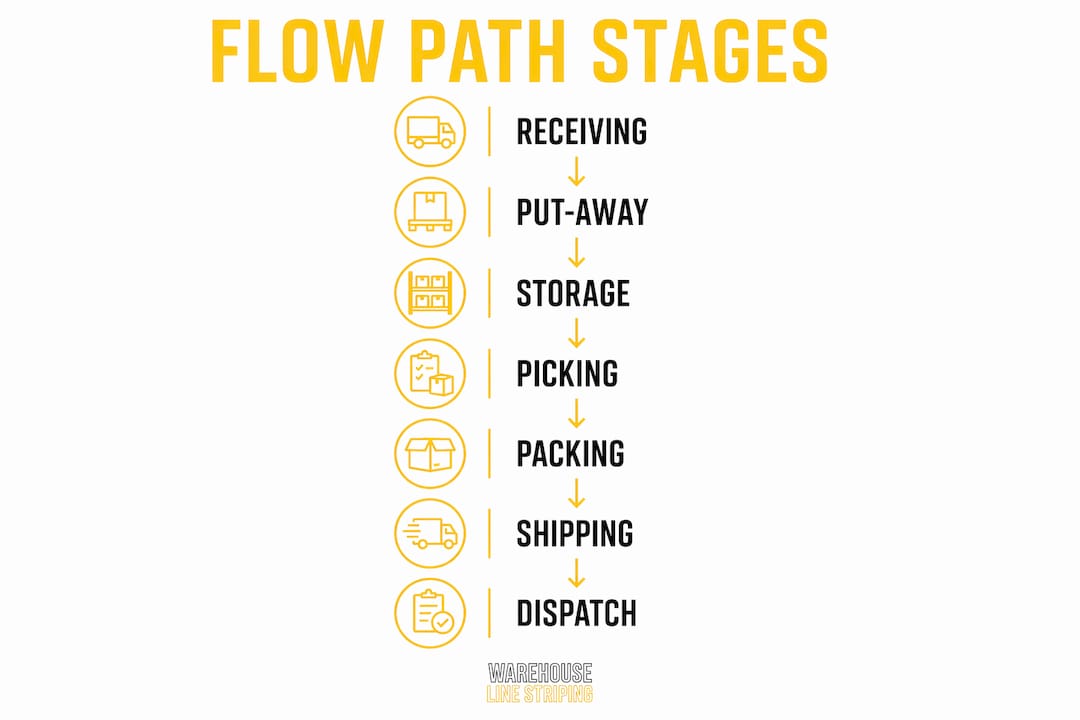
The physical journey moves product through seven core stages: receiving, put-away, storage, picking, packing, shipping, and returns. Each stage has a defined location in the facility and a defined sequence of actions. The information journey mirrors this movement through WMS task assignments, barcode scans, and inventory updates that confirm each handoff. A flow path without accurate data synchronization is just a floor plan with good intentions.

Distribution centers prioritize rapid throughput with minimal storage time, which makes flow path speed and accuracy the two metrics that matter most. Unlike traditional warehouses that hold inventory for weeks, a distribution center may move goods within hours. That compression of time means any friction in the flow path compounds quickly across hundreds or thousands of daily transactions.
What are the common flow path layouts in distribution centers?
The three macro patterns used in distribution center layout design are U-flow, I-flow, and L-flow. Each positions docks and storage zones to minimize cross-traffic and travel distance, but they suit different building configurations and throughput profiles.
| Layout | Configuration | Best for | Key limitation |
|---|---|---|---|
| U-flow | Receiving and shipping docks on the same wall | Mixed-use facilities with varied SKU velocity | Bottlenecks at the dock-side narrow point |
| I-flow | Docks on opposite ends of the building | Cross-docking and high-throughput straight-line operations | Requires long building footprint |
| L-flow | Docks on adjacent walls at a right angle | Facilities with irregular building shapes | Compromise layout with moderate cross-traffic risk |
The U-shaped flow layout is the most common configuration in North American distribution centers. Receiving and shipping share the same dock wall, product arcs through storage, and truck maneuvering is simplified because drivers work from a single yard area. The tradeoff is that high-volume periods can create congestion near the docks where inbound and outbound flows converge.
The I-flow layout suits operations built around cross-docking, where product moves directly from inbound trailers to outbound trailers with minimal storage time. Goods enter one end, travel a straight path, and exit the other. This model works well for cross-docking floor layouts where speed of transfer is the primary objective, but it demands a building long enough to separate the two dock walls meaningfully.
Pro Tip: When evaluating layout options, map your top 20% of SKUs by volume first. The layout that puts those fast movers closest to the shipping dock will almost always outperform the layout that looks cleanest on paper.
How does flow path differ from physical layout?
Layout is the physical placement of docks, racks, workstations, and zones. Flow is the choreography of movement of goods, people, and information within that physical arrangement. The distinction matters because a facility can have an excellent layout and still suffer from poor flow. The two are interdependent but not the same thing.
Consider a distribution center with a well-designed U-flow layout. If pickers and replenishment workers share the same aisle without a defined direction of travel, they create friction regardless of how well the racks are positioned. If staging pallets are placed in walkways because no dedicated staging lane exists, the layout’s efficiency disappears at the operational level. Good flow synchronizes movements and data updates within the physical arrangement rather than simply relying on the arrangement itself to produce efficiency.
Micro flow elements are where most facilities either win or lose:
- One-way aisles eliminate head-on conflicts between forklifts and pickers
- Dedicated staging lanes keep inbound pallets off the main travel path
- Fast-pick zones position high-velocity SKUs within a short walk of packing stations
- Separate velocity lanes route slow movers to deeper storage without crossing fast-mover paths
Pro Tip: Before investing in a layout redesign, audit your current flow choreography for one week. In most facilities, fixing one-way aisle compliance and staging lane discipline alone recovers 10 to 15 percent of daily labor hours without moving a single rack.
What operational stages make up the distribution center flow path?
The seven stages of a distribution center flow path each represent a discrete physical location and a defined set of tasks. Understanding each stage’s role is the starting point for any serious flow path analysis.
- Receiving: Inbound trailers are unloaded, product is counted and verified against purchase orders, and WMS receives the inventory. Errors here propagate through every downstream stage.
- Put-away: Product moves from the receiving dock to its assigned storage location. WMS directs the put-away task, and a scan confirms placement. Delays here create dock congestion.
- Storage: Product rests in its assigned location until a pick task is generated. Slotting decisions made at this stage directly affect pick travel time.
- Picking: A picker travels to the storage location, pulls the required quantity, and confirms the pick via scan. This stage consumes the largest share of labor in most distribution centers.
- Packing: Picked items are consolidated, packed into shipping containers, and labeled. Packing station placement relative to pick zones determines how much non-value travel occurs between these two stages.
- Shipping: Packed orders are staged by carrier or route, loaded onto outbound trailers, and confirmed in WMS. Poor staging discipline at this stage causes load errors and missed pickups.
- Returns: Returned product re-enters the facility, is inspected and dispositioned, and either returns to storage or moves to a separate processing area. Returns flow is often the least-designed stage and the most disruptive when volume spikes.
Distribution centers focus on fast product flow, often moving goods within hours or days, which means a bottleneck at any single stage stalls the entire sequence. A receiving backup at stage one delays put-away, which delays available inventory, which delays picks. The flow path is only as fast as its slowest stage.
Pro Tip: Map each stage as a node on a physical floor plan and draw the actual travel paths your team takes during a peak shift. The paths that cross or double back are your highest-priority improvement targets.
How can flow path design improve distribution center efficiency?
Flow path optimization works by reducing stops, starts, touches, and cross-traffic at every stage of the product journey. Each unnecessary direction change or unplanned stop adds seconds to a transaction. Across thousands of daily picks, those seconds become hours of lost labor.
Slotting high-velocity SKUs near docks and routing low-velocity SKUs to deeper storage is one of the highest-return adjustments available to operations managers. Fast movers travel shorter distances on every pick cycle, which reduces picker travel time without requiring any change to the physical layout. Separating flow paths for different velocity segments prevents fast-mover picks from being blocked by slow-mover replenishment activity.
Micro design elements such as one-way aisles, fast-pick zones, and staging lanes often determine operational success more than macro layout shapes. A facility with a mediocre U-flow layout and excellent micro flow discipline will outperform a facility with a perfect I-flow layout and no aisle direction enforcement.
| Optimization tactic | Expected benefit |
|---|---|
| Slot fast movers near shipping docks | Reduces average pick travel distance |
| Implement one-way aisle markings | Eliminates forklift and pedestrian conflicts |
| Designate dedicated staging lanes | Keeps pallets off main travel paths |
| Separate velocity-based flow paths | Prevents slow-mover activity from blocking fast-mover picks |
| Align WMS task sequencing with physical flow | Reduces out-of-sequence movements and rescans |
WMS task management is the information-side counterpart to physical flow optimization. When WMS assigns tasks in a sequence that matches the physical flow path, workers move in one direction without backtracking. When task sequencing ignores physical flow, even a well-marked facility produces chaotic movement patterns.
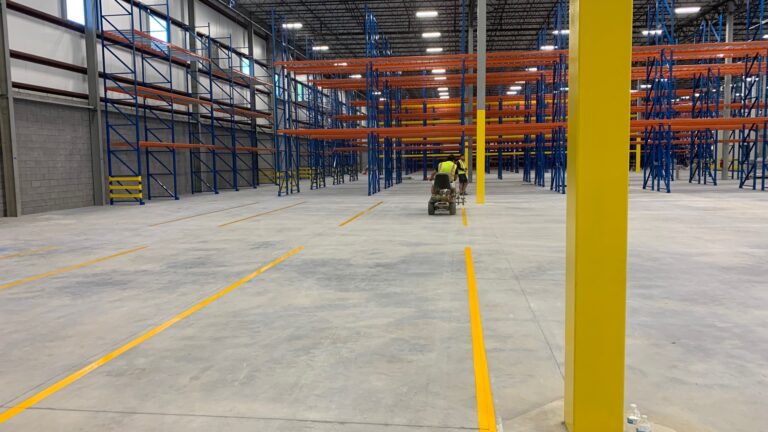
Pro Tip: Review your staging area floor markings quarterly. Floor markings that are faded or missing are the first sign that flow discipline has broken down, and they are the cheapest fix available before a full flow path audit.
Key takeaways
A distribution center flow path is the structured physical and informational route products follow through all seven operational stages, and optimizing that route at the micro level produces greater efficiency gains than layout changes alone.
| Point | Details |
|---|---|
| Flow path definition | The end-to-end route covering receiving, put-away, storage, picking, packing, shipping, and returns. |
| Layout vs. flow | Physical layout sets the structure; flow choreography determines whether that structure performs. |
| Macro layout patterns | U-flow, I-flow, and L-flow each suit different building shapes and throughput profiles. |
| Micro flow elements | One-way aisles, staging lanes, and fast-pick zones often deliver more value than layout redesigns. |
| SKU velocity slotting | Placing fast movers near docks reduces pick travel time without changing the physical layout. |
Why flow choreography beats layout redesign every time
I have reviewed enough distribution center operations to say this with confidence: most facilities do not have a layout problem. They have a choreography problem. The racks are in reasonable positions. The docks are functional. What is broken is the sequence of movements happening within that space every shift.
The most common mistake I see is treating flow path optimization as a capital project. Operations managers wait for a lease renewal or a major expansion to fix flow problems that could be addressed this week with floor markings, aisle direction signs, and a WMS task sequencing adjustment. A distribution center redesign is sometimes necessary, but it should never be the first tool you reach for.
The facilities that perform best are the ones where someone is actively monitoring flow path compliance on a regular basis, not just at the annual operations review. Flow discipline degrades naturally over time as volume grows, SKU mixes shift, and workarounds accumulate. The operations managers who treat flow path as a living system rather than a fixed design are the ones whose facilities hold their efficiency numbers through peak season.
My advice: start with a one-week flow audit before you spend a dollar on physical changes. Map where your people actually walk, not where the floor plan says they should walk. The gap between those two pictures is your improvement opportunity.
— ET
How Warehouse Line Striping supports your flow path
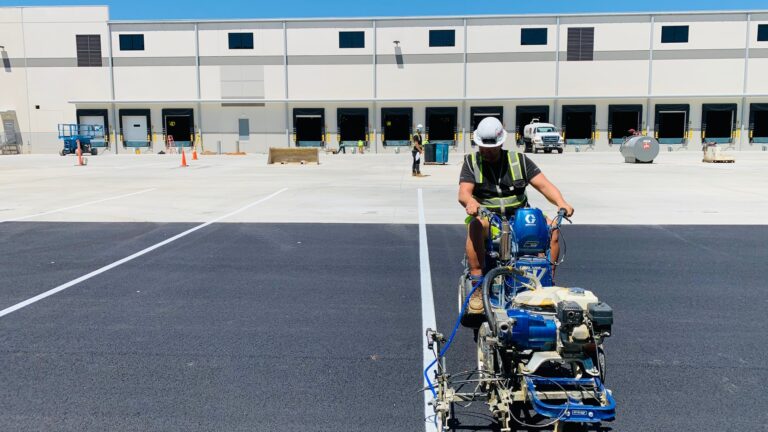
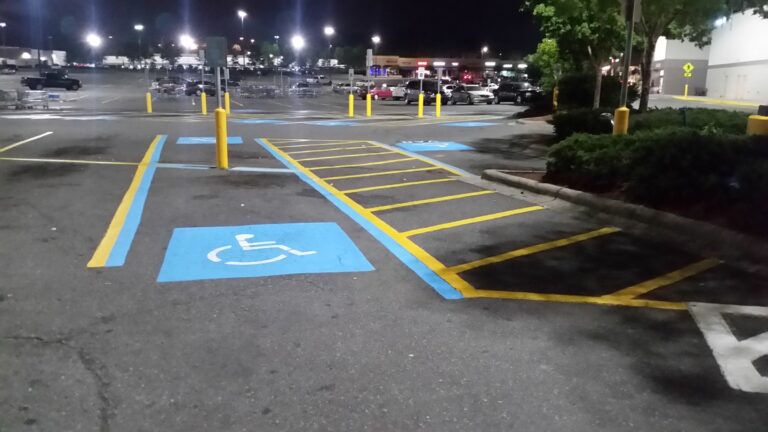
Clear, durable floor markings are the physical infrastructure of flow path discipline. Without them, one-way aisles become suggestions, staging lanes disappear under pallet stacks, and fast-pick zones lose their boundaries within weeks of being established. Warehouse Line Striping has completed over 10,000 projects in distribution centers and industrial facilities nationwide, applying OSHA-compliant, high-durability epoxy coatings that last three to seven years under heavy forklift traffic.
Whether you need a pallet storage grid system that locks your slotting strategy into the floor or a complete staging area marking layout that keeps your dock clear during peak volume, Warehouse Line Striping delivers precision marking solutions with 24/7 support and minimal disruption to your operations. Visit Warehouse Line Striping to discuss your facility’s flow path marking needs.
FAQ
What is a distribution center flow path?
A distribution center flow path is the defined physical route and task sequence that products follow through receiving, put-away, storage, picking, packing, shipping, and returns. It includes both the movement of goods across the facility floor and the WMS and scanning events that track each handoff.
What is the difference between U-flow, I-flow, and L-flow layouts?
U-flow places receiving and shipping docks on the same wall, I-flow places docks on opposite ends for straight-through movement, and L-flow positions docks on adjacent walls as a compromise for irregular building shapes. Each layout suits different throughput profiles and building configurations.
How does flow path differ from warehouse layout?
Layout is the physical placement of racks, docks, and workstations. Flow path is the choreography of how goods, people, and information move within that layout. A well-designed layout can still produce poor results if the flow choreography is not actively managed and enforced.
Why do micro flow elements matter more than macro layout?
Dedicated staging lanes, one-way aisles, and fast-pick zones prevent cross-traffic and workflow blockages that macro layout shapes cannot address on their own. These micro decisions determine whether the facility’s designed capacity is actually realized during peak operations.
How does SKU velocity affect flow path design?
High-velocity SKUs slotted near shipping docks reduce average pick travel distance on every cycle, directly cutting labor hours. Low-velocity SKUs routed to deeper storage keep fast-mover paths clear and prevent replenishment activity from blocking active pick lanes.