Conveyor System Floor Marking: 2026 Manager’s Guide
A conveyor system floor marking is a visual safety communication system that uses painted lines, color-coded zones, symbols, and cross-hatching to define conveyor boundaries, traffic lanes, and hazard areas in warehouses and distribution centers. Known in industry practice as conveyor zone marking or conveyor boundary marking, this system is the primary method facilities use to separate pedestrian traffic, forklifts, and moving machinery. High-visibility lines 4–6 inches wide effectively delineate conveyor and traffic boundaries, making them a major factor in reducing warehouse accidents. OSHA standard 1910.176(a) and 5S/Lean frameworks both depend on this system to keep workers safe and operations moving.
What is a conveyor system floor marking and why does it matter?
Conveyor zone marking is a structured visual language applied directly to the floor surface around conveyor equipment. It tells every worker, forklift operator, and visitor exactly where machinery operates, where people may walk, and where neither should go. Without it, the boundaries between a moving conveyor and a pedestrian aisle exist only in someone’s memory.
The practical impact is significant. Separating pedestrian and forklift paths around conveyors reduces fatalities and collision incidents, which remain among the most serious injury categories in warehouse environments. Clear boundaries also reduce the mental load on operators who must constantly judge safe distances from moving equipment.

Facilities running 5S or Lean programs treat floor markings as a foundational element, not an afterthought. The markings make the standard visible. When a zone is marked, deviation from the standard becomes immediately obvious to supervisors and workers alike.
What are the common types and color codes of conveyor floor markings?
Several distinct marking types work together around a conveyor system. Each serves a specific communication purpose.
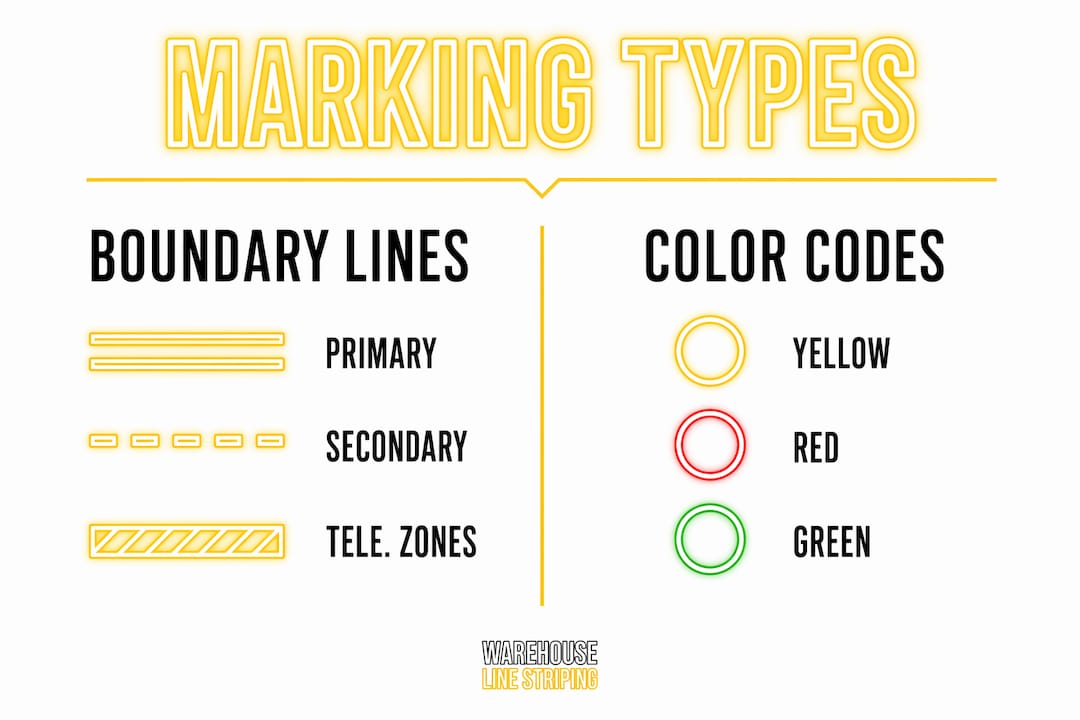
Primary boundary lines outline the full operating footprint of the conveyor, including its maximum extended position. Extension zones mark the area a telescopic or extendable conveyor sweeps through during operation. Hazard stripes use alternating black and yellow diagonal lines to signal physical danger near pinch points, drives, or discharge ends. Cross-hatching marks keep-clear areas in front of emergency stops and access panels.
Standard color conventions
The 5S/Lean color system is the most widely adopted convention in American facilities:
- Yellow: Aisle boundaries, pedestrian walkways, and general traffic lanes
- Red: Fire equipment locations, emergency stop zones, and quarantine areas
- Black and yellow stripes: Physical hazards such as conveyor edges, overhead obstructions, and moving parts
- White: Workstation outlines and equipment positions
- Orange: Inspection areas and quality hold zones
- Green: First aid stations and finished goods areas
OSHA standard 1910.176(a) requires aisles to be appropriately marked but does not mandate specific colors. That means your internal color system must be consistent and understood by every person in the facility. Inconsistency across zones creates confusion that defeats the entire purpose of marking.
Line width standards
| Application | Recommended width |
|---|---|
| Primary conveyor perimeter | 4–6 inches |
| Pedestrian crossings near conveyors | 6 inches |
| Aisle boundaries | 4 inches |
| Workstation and equipment outlines | 2–4 inches |
| Secondary storage areas | 2 inches |
Industry standards recommend 2-inch minimum for equipment outlines, 4 inches for aisles, and 6 inches for pedestrian crossings near conveyors. Line width directly affects visibility from a forklift operator’s seat, where the floor angle and cab height make narrow lines difficult to read at speed.
How do floor markings enhance safety and workflow efficiency?
Properly executed conveyor floor marking produces measurable operational benefits beyond basic compliance. The separation of traffic types is the most direct safety gain. When pedestrian corridors are clearly marked away from forklift routes and conveyor zones, the number of near-miss incidents drops because workers no longer have to guess where it is safe to walk.
Wall-mounted safety signage complements floor markings to maintain hazard visibility even when equipment or inventory obscures floor lines. This layered approach means critical safety information reaches workers through multiple channels simultaneously. A forklift carrying a tall load that blocks the driver’s floor view still encounters the wall sign at eye level.
Workflow efficiency improves because marked paths eliminate navigation decisions. Workers follow the marked route without stopping to assess whether a path is clear or safe. That reduction in decision time compounds across hundreds of daily movements.
Pro Tip: Integrate floor markings with overhead hanging signs at conveyor crossings. When a pallet load blocks the floor view, the overhead sign still communicates the hazard. This two-layer system costs little to add during initial installation but significantly improves safety coverage.
Key operational benefits include:
- Reduced collision risk between forklifts and pedestrians near conveyor discharge points
- Clear marked extension zones for telescopic conveyors that prevent collisions during loading operations
- Faster onboarding for new workers who can read the floor layout without memorizing verbal instructions
- Easier compliance with OSHA inspections because marked zones are self-documenting
- Reduced downtime from accidents and near-miss investigations
Marking full telescopic conveyor extension zones is a specific requirement that many facilities miss. A conveyor marked only in its retracted position leaves an unmarked hazard zone every time it extends. The floor marking must represent the maximum operating envelope, not the resting position.
What are the best practices for implementing conveyor floor markings?
Effective conveyor integration floor marking setup follows a deliberate sequence. Skipping steps early creates expensive rework and safety gaps.
Map workflow and traffic patterns first. Planning markings aligned with movement flows ensures safety and operational efficiency. Walk every route that workers, forklifts, and maintenance staff use around each conveyor before drawing a single line. Identify where paths cross the conveyor’s operating envelope.
Define the full operating envelope. For each conveyor, document its maximum extended footprint, including all positions it reaches during normal operation. Extension safety zones for telescopic conveyors must include the full retracted-to-extended footprint. Mark that entire area, not just the static frame.
Select colors and widths based on your facility standard. Assign colors before installation and document them in a facility marking legend. Post that legend at facility entrances and break rooms. Consistency across all conveyor zones is more important than matching any external color guide.
Prepare the floor surface properly. Without thorough cleaning, markings peel within 6–12 months. Remove all oils, residues, and dust before applying tape or epoxy. For high-traffic conveyor areas, seal the floor before marking to extend adhesion life. Check the floor flatness and condition before any installation begins.
Add cross-hatching at critical safety points. Keep-clear cross-hatching in front of emergency stops ensures those zones remain obstruction-free. Apply the same treatment to maintenance access panels and fire equipment locations adjacent to conveyors.
Schedule regular inspection and maintenance. Set a quarterly inspection cycle for all conveyor zone markings. High-traffic areas near conveyor discharge points wear faster than perimeter lines. Replace faded or damaged sections immediately rather than waiting for a full facility refresh.
Pro Tip: Photograph every marked zone immediately after installation. Store those images in your facility safety file. When markings fade or shift over time, the photos give your team an exact reference for restoration without guessing the original layout.
Common pitfalls to avoid include ignoring clearance zones around conveyor drives, failing to mark emergency access routes that cross conveyor areas, and using tape products rated for light-duty applications in high-forklift-traffic zones. For pick path integration near conveyor discharge areas, coordinate marking colors with the broader warehouse pick path system so workers read a consistent visual language across the entire facility.
How do regulatory requirements shape conveyor marking choices?
OSHA and industry standards create two separate but complementary layers of obligation for operations managers.
OSHA 1910.176(a) states that aisles and passageways must be appropriately marked. The word “appropriately” gives facilities flexibility on color and method but creates an obligation to mark. OSHA inspectors assess whether the marking system communicates hazards clearly to workers. A system that exists but fails to communicate is still a violation.
“OSHA does not require specific colors for markings. Consistency and clarity within the facility’s own system are more important for compliance and safety.” — Warehouse Markings Advice, WJ
OSHA’s Warehouse National Emphasis Program through July 2026 places increased scrutiny on floor markings as a primary inspection item. Non-compliance can result in fines up to $16,550 per serious finding. That financial exposure makes a documented, consistent marking program a direct cost-control measure, not just a safety formality.
Industry best practices from 5S/Lean frameworks fill the gaps OSHA leaves open. They provide the color conventions, line widths, and zone definitions that turn a vague compliance obligation into a functional system. Facilities that adopt these conventions benefit from worker familiarity, since many employees have encountered the same color system at previous employers.
To build an enforceable internal standard:
- Create a written facility marking legend with color assignments and line width specifications
- Include the legend in new employee orientation and annual safety training
- Assign ownership of marking maintenance to a specific role, not a department
- Review and update the marking plan whenever conveyor equipment is added, relocated, or modified
- Document all marking decisions in your safety management system for audit readiness
Understanding why OSHA markings are required in warehouses helps operations managers frame marking investments as compliance infrastructure rather than discretionary spending.
Key Takeaways
Conveyor system floor marking is a safety and workflow tool that requires deliberate planning, consistent color standards, and regular maintenance to deliver lasting protection and compliance value.
| Point | Details |
|---|---|
| Define the full operating envelope | Mark the maximum extended footprint of every conveyor, not just its resting position. |
| Follow line width standards | Use 4–6 inch lines for conveyor perimeters and 6 inches at pedestrian crossings. |
| Map workflow before marking | Analyze traffic patterns first to avoid costly rework and safety gaps. |
| Prepare surfaces thoroughly | Clean and seal floors before installation to prevent markings from peeling within months. |
| Build a written facility standard | Document color assignments and enforce them consistently to satisfy OSHA inspections. |
What I’ve learned from facilities that get this right
The facilities that execute conveyor floor marking well share one habit: they treat it as a cross-department planning exercise, not a facilities maintenance task. Operations, safety, and maintenance all sit at the table before a single line goes down. That collaboration surfaces conflicts early, like a maintenance path that crosses a proposed forklift lane, before they become embedded in the floor.
The most consistently overlooked area I see is emergency access. Facilities mark conveyor perimeters carefully but leave the path to the nearest emergency stop or fire extinguisher unmarked or partially blocked. That gap is exactly what OSHA inspectors look for, and it is the gap most likely to matter in an actual emergency.
Surface preparation is where good intentions fail most often. A facility invests in quality epoxy or heavy-duty tape and then applies it to a floor that was not properly degreased. The marking looks fine for three months and then starts lifting at the edges in the highest-traffic zones. The fix costs more than the original installation because you now have to remove the failed marking before reapplying.
My strongest advice: build a review cycle into your calendar before you finish the installation. Conveyor layouts change. New equipment arrives. Workflows shift. A marking plan that was accurate in 2024 may actively mislead workers by 2026 if no one has reviewed it. The floor is a living document. Treat it that way.
— ET
How Warehouse Line Striping handles conveyor zone marking
Conveyor environments demand marking systems built for industrial punishment, not general warehouse use. Warehouse Line Striping installs industrial-grade epoxy coatings rated for 3–7 years in high-forklift-traffic zones, with color systems mapped to your specific conveyor layout and OSHA requirements.
Every project starts with a workflow analysis to map conveyor operating envelopes, traffic crossings, and emergency access routes before any material touches the floor. Explore the floor marking systems guide for a detailed look at how marking design connects to inventory flow and conveyor efficiency. With over 10,000 completed projects and nationwide service coverage, Warehouse Line Striping delivers compliant, durable conveyor zone marking with minimal operational disruption.
FAQ
What is a conveyor system floor marking?
A conveyor system floor marking is a visual safety system using lines, colors, and symbols applied to the floor to define conveyor boundaries, traffic lanes, and hazard zones. It separates pedestrian, forklift, and machinery traffic to prevent accidents and support workflow efficiency.
What line width should I use for conveyor floor markings?
Use 4–6 inch lines for primary conveyor perimeters and 6-inch lines at pedestrian crossings near conveyors. Secondary storage and workstation outlines require only 2–4 inch lines.
Does OSHA require specific colors for conveyor floor markings?
OSHA standard 1910.176(a) requires aisles to be appropriately marked but does not mandate specific colors. Internal consistency across your facility’s marking system is what satisfies both OSHA inspectors and operational safety needs.
How long do conveyor floor markings last?
Properly installed epoxy markings on prepared surfaces last 3–7 years in high-traffic conveyor areas. Tape applied to uncleaned or unsealed floors can begin peeling within 6–12 months.
What areas around a conveyor must be marked?
Mark the full operating envelope including maximum extended positions, pedestrian crossings, forklift lanes, emergency stop access zones, and maintenance access paths. Telescopic conveyors require marking from fully retracted to fully extended positions.