Pallet Storage Grid Floor Marking Guide for Warehouses
Getting pallet storage floor markings wrong doesn’t just create a messy warehouse. It creates OSHA violations, forklift near-misses, and the kind of inventory chaos that costs real money. This pallet storage grid floor marking guide covers everything from layout planning and compliance standards to material selection and long-term maintenance. Whether you’re setting up a new facility or fixing a system that’s drifted out of control, the steps here will help you build a grid that holds up under daily operational pressure.
Table of Contents
- Key takeaways
- Understanding the pallet storage grid floor marking guide
- Compliance standards for line widths and colors
- Step-by-step execution for your floor marking layout
- Maintaining and verifying your floor markings
- What I’ve learned from watching grids succeed and fail
- Get professional floor markings that last
- FAQ
Key takeaways
| Point | Details |
|---|---|
| OSHA requires permanent markings | OSHA 29 CFR 1910.176(a) mandates aisle markings but does not specify colors, giving you flexibility in design. |
| Line width affects compliance | Lines narrower than 2 inches fail visibility standards; 4 to 6 inches is recommended for forklift-heavy zones. |
| Shadowing defines pallet positions | Outlining each pallet footprint on the floor reduces search time and prevents clutter buildup over time. |
| Tape vs. paint depends on permanence | Tape suits layouts that change frequently; epoxy paint is the right call for high-traffic permanent aisles. |
| Markings require ongoing enforcement | Floor markings only work when operational rules back them up. Pallet creep defeats even the best grid design. |
Understanding the pallet storage grid floor marking guide
A pallet storage layout grid is a system of floor markings that defines exactly where pallets should sit, where equipment travels, and where people walk. Think of it as a permanent map drawn directly onto your warehouse floor. Without it, pallets drift, aisles narrow, and forklift operators are forced to make judgment calls in tight spaces.
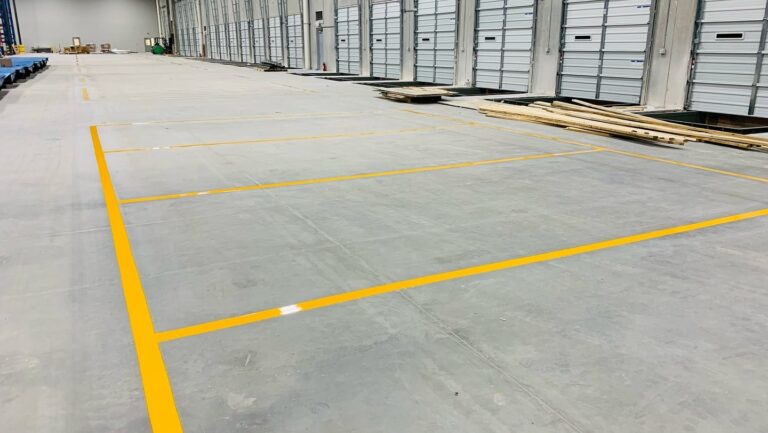
The grid works by dividing your storage floor into fixed zones. Each zone is sized to match your standard pallet footprint, typically 40 by 48 inches for a GMA pallet, with clearance built in for forklift tines and safe stacking. The lines create visual boundaries that tell every operator, picker, and supervisor exactly where things belong at a glance.
Floor marking patterns for pallet storage connect directly to the 5S methodology, which is widely used in lean warehouse operations. The “Set in Order” pillar of 5S specifically calls for marking equipment locations so that missing or misplaced items are immediately visible. Applied to pallets, this means every open grid cell communicates something useful: a position is available, occupied, or blocked.
Here is what a well-designed pallet storage grid accomplishes:
- Prevents pallet creep, where loads gradually shift outside their designated zones and block aisles
- Reduces time spent searching for open storage positions during receiving and putaway
- Creates clear separation between forklift travel lanes and pedestrian walkways
- Provides a visual audit trail that makes cycle counts and inventory checks faster
- Supports OSHA compliance by maintaining defined, permanently marked passageways
The storage grid design also needs to account for your equipment. Counterbalance forklifts require wider turning radii than reach trucks, and your grid spacing must reflect that. Getting the grid wrong at the planning stage means repainting sooner than you want to.
Compliance standards for line widths and colors
OSHA 29 CFR 1910.176(a) requires that permanent aisles and passageways in warehouses using mechanical handling equipment be appropriately marked. Critically, OSHA does not mandate specific colors. The regulation focuses on clarity and recognition. Your markings need to be permanent, visible, and easily understood by every employee in the facility.

That said, industry convention has produced a color code system that most warehouses follow because it works. Deviating from it without a clear internal standard creates confusion, especially when you onboard new staff or bring in temporary workers.
| Color | Common use | Safety meaning |
|---|---|---|
| Yellow | Aisle boundaries, pallet zones | Caution, traffic separation |
| White | Workstations, equipment areas | General location marking |
| Red | Defect/quarantine zones, stop lines | Hazard, do not cross |
| Green | Finished goods, safe pathways | Clear, proceed |
| Orange | Inspection areas, caution zones | Warning, temporary hazard |
| Blue | Informational, raw materials | Non-hazard designation |
Line width is where many facilities make a quiet mistake. Lines narrower than 2 inches fail basic visibility standards, and OSHA sets 2 inches as the minimum. For high-traffic zones or anywhere forklifts operate, 4 to 6 inches is the practical standard. A forklift operator sitting 8 feet off the ground in a moving vehicle needs a line wide enough to register in peripheral vision.
Pro Tip: Use 4-inch lines for standard pallet storage grids and step up to 6-inch lines at intersections and pedestrian crossings. The cost difference in materials is negligible. The visibility difference is not.
Surface contrast matters as much as width. Yellow lines on a light gray concrete floor can wash out under certain lighting conditions. High-contrast combinations like yellow on dark epoxy or black-and-yellow striping at corners and pedestrian intersections significantly improve recognition. This is especially true in facilities with overhead skylights or inconsistent artificial lighting.
Step-by-step execution for your floor marking layout
Choosing your materials
The first decision in any floor marking layout project is tape versus paint, and the answer depends on how permanent your layout is. Tape typically lasts 1 to 3 years and can be removed and repositioned without major downtime. It is the right choice when your storage layout changes seasonally or when you are piloting a new grid design before committing.
Epoxy paint and two-part polyurethane coatings last significantly longer and hold up better under forklift traffic and pallet drag. The tradeoff is curing time. Most epoxy systems require 24 to 72 hours before the floor can return to service, which means planning around production schedules. For permanent, high-traffic aisles, there is no better option.
Planning the grid layout
Before any line hits the floor, map your grid on paper or in a CAD tool. Start with your aisle widths. OSHA requires that aisles accommodate the equipment using them, and most forklift manufacturers publish minimum aisle width requirements in their specs. A standard counterbalance forklift typically needs 11 to 12 feet for a 90-degree turn with a loaded pallet.
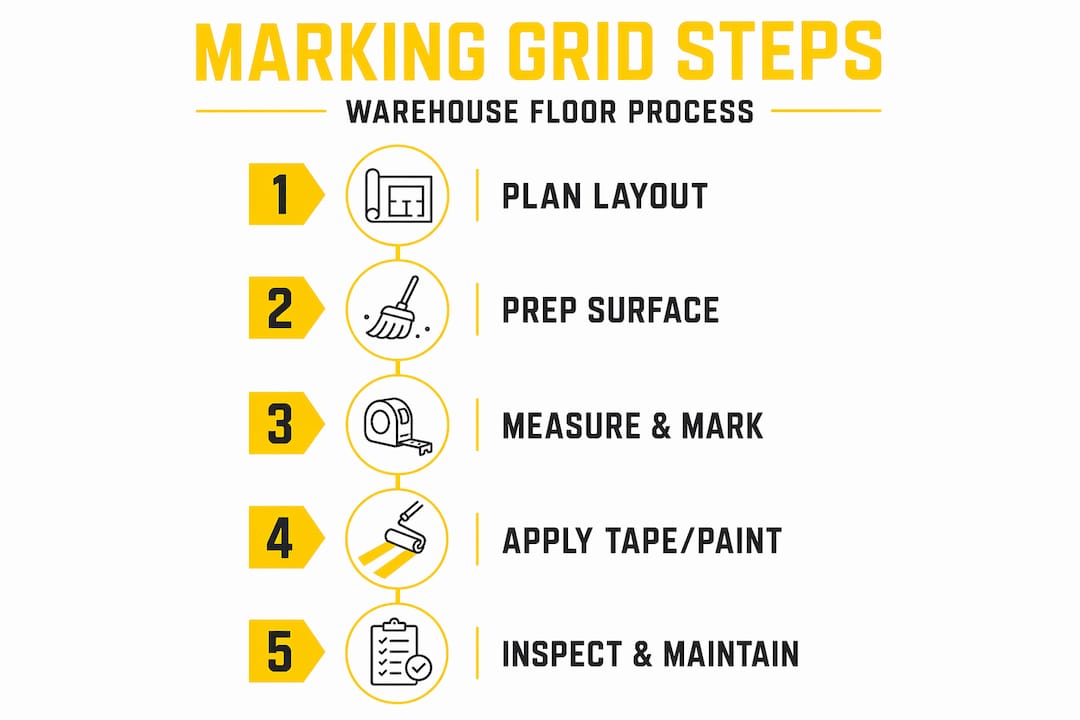
From there, plot your pallet positions. Leave at least 3 inches between adjacent pallet footprints to account for real-world placement variation. Mark your pedestrian corridors as separate, dedicated lanes. Floor markings are critical behavioral cues that segregate pedestrian and vehicle traffic, and mixing the two in a shared lane is where near-miss incidents happen.
Installation best practices
Follow these steps when applying your floor markings:
- Clean the floor thoroughly. Sweep, scrub, and degrease the surface. Any oil, dust, or debris under a marking will cause it to fail early.
- Repair cracks and spalls before marking. Proper surface preparation is the single biggest factor in marking longevity.
- Snap chalk lines or use a laser layout tool to position your grid accurately. Eyeballing creates drift that compounds across a large floor.
- Apply corner markers first to establish the grid anchor points, then connect them with straight runs.
- At intersections and pedestrian crossings, add crosshatch patterns or “LOOK” stencils to reinforce the visual warning.
- Allow full cure time before resuming operations. Rushing this step is the most common reason markings fail within the first year.
Pro Tip: Shadow each pallet position by painting a solid outline of the pallet footprint inside the grid cell. This makes it immediately obvious when a pallet is missing or misaligned, which speeds up cycle counts and daily floor audits.
Maintaining and verifying your floor markings
A floor marking system is not a one-time installation. It is an asset that degrades under daily use and needs scheduled attention to stay functional.
Routine inspection should happen at least monthly. Walk the floor with a checklist and note any markings that are faded, chipped, or partially obscured by debris. Pay particular attention to high-traffic zones near dock doors and at aisle intersections, where forklift tines and pallet drag cause the most wear.
Maintenance practices that extend marking life include:
- Sweeping and scrubbing marked areas regularly to prevent grit buildup, which acts as an abrasive under forklift wheels
- Touching up faded sections promptly rather than waiting for a full repaint cycle
- Replacing tape markings before they peel, since a partially lifted tape edge creates a trip hazard
- Documenting the original layout so repairs match the original grid exactly
Operational enforcement is where most facilities fall short. Pallet creep is the leading cause of grid marking failures. Pallets get placed slightly outside their marked zone, then the next one gets placed next to that one, and within a few weeks the grid is meaningless. The markings did not fail. The operational discipline did.
Floor markings are only as effective as the rules that back them up. A visible grid combined with clear placement expectations and regular supervisor walkthroughs will outperform the most elaborate marking system that nobody enforces.
Training plays a direct role here. New operators should receive explicit instruction on the grid layout during onboarding, not just a general orientation. Quarterly audits that score floor compliance by zone give supervisors a concrete metric to act on. When temporary solutions like cones are used during maintenance or layout changes, employees must be briefed on what they mean and how long they will be in place.
What I’ve learned from watching grids succeed and fail
I’ve reviewed hundreds of warehouse floor marking projects over the years, and the pattern is consistent. The facilities that get the most out of their pallet storage grids are not necessarily the ones with the most expensive materials or the most elaborate color systems. They are the ones where the grid was designed around actual operational behavior rather than an idealized version of it.
The most common mistake I see is designing a grid that assumes perfect pallet placement every time. Real warehouses have worn forklift tines, rushed receiving shifts, and operators working in low light. A grid with zero tolerance for placement variation will be violated constantly, and once operators stop trusting the markings, the whole system collapses.
The second mistake is treating floor markings as a one-time compliance fix. I’ve seen facilities repaint their entire floor, pass an OSHA inspection, and then let the markings deteriorate for three years because “we just did this.” Markings are infrastructure. They need a maintenance budget and a scheduled replacement cycle, just like your dock equipment.
What actually works is combining durable, high-visibility markings with explicit operational rules and regular enforcement walkthroughs. The floor tells people where things go. The rules tell them why it matters. The walkthroughs make sure both stay current.
— Eric
Get professional floor markings that last
Designing and applying a pallet storage grid that holds up under real warehouse conditions takes more than a paint roller and a tape measure. Warehouselines has completed over 10,000 floor marking projects across warehouses, distribution centers, and industrial facilities nationwide. Every project uses industrial-grade epoxy coatings rated for 3 to 7 years of heavy-traffic use, with layouts engineered to meet OSHA requirements from day one.
Whether you need a full warehouse floor striping installation, a targeted refresh of worn pallet zones, or a custom grid design for a new facility, Warehouselines provides professional removal of outdated markings and installs new lines with minimal disruption to your operations. Service is available across the country, including dedicated teams in Ohio and across all nationwide locations. Contact Warehouselines to get a layout assessment and quote for your facility.
FAQ
What is a pallet storage layout grid?
A pallet storage layout grid is a system of floor markings that defines fixed positions for pallets, separates vehicle lanes from pedestrian paths, and organizes storage zones for efficient putaway and retrieval. It is typically based on standard pallet dimensions with added clearance for forklift access.
What line width does OSHA require for warehouse floor markings?
OSHA sets a minimum of 2 inches for aisle markings, but industry best practice recommends 4 to 6 inches for forklift zones and intersections where wider lines improve visibility for operators.
Does OSHA specify colors for warehouse floor markings?
No. OSHA 29 CFR 1910.176(a) requires permanent, clearly visible markings but does not mandate specific colors. Yellow is the most widely used convention for aisle boundaries due to its high visibility and caution association.
How long do warehouse floor markings last?
Floor marking tape typically lasts 1 to 3 years depending on traffic volume and surface conditions. Epoxy and polyurethane paint systems last significantly longer, with quality installations lasting 3 to 7 years when applied over properly prepared concrete.
What causes pallet grid markings to stop working?
The primary cause is pallet creep, where loads are placed slightly outside marked zones and the pattern spreads over time. Markings themselves may still be visible, but without operational rules and regular enforcement, the grid loses its function regardless of marking quality.