Industrial Floor Marking Material Selection Guide
Industrial floor marking material selection is the process of choosing compliant, durable, and visible materials — tape, paint, epoxy, or thermoplastic — to define aisles, safety zones, and operational areas in industrial facilities. The right choice directly determines whether your markings hold up under forklift traffic, chemical spills, and daily wear without becoming a liability. OSHA’s general industry standard 29 CFR 1910.22 requires aisles and passageways to carry durable, visible, and maintained markings, but leaves the material choice to you. That flexibility is both an opportunity and a trap. Choose wrong, and you face faded lines, failed adhesion, and a floor that looks compliant but creates real hazards.
What does OSHA require for industrial floor markings?
OSHA’s 29 CFR 1910 framework mandates appropriate marking wherever mechanical equipment operates, including forklifts, pallet jacks, and automated guided vehicles. The standard does not name a specific material. It requires that markings remain durable and visible throughout their service life. That distinction matters more than most facility managers realize.
Compliance is not a one-time installation event. A marking that fades unevenly, especially along forklift wheel paths, can be more hazardous than no marking at all. Workers begin to ignore partially visible lines, and the facility carries the illusion of compliance without the safety benefit.
“Compliance depends not on specific products but on ensuring markings communicate boundaries reliably every day. Fading lines increase safety risks.” — OSHA 1910 compliance guidance
Color coding adds another layer of obligation. ANSI Z535.1 standardizes safety colors across industrial facilities: yellow signals caution zones, red marks dangerous areas or emergency exits, and green identifies safety equipment and first aid stations. Aligning your floor markings with ANSI Z535.1 reduces cognitive load and speeds up emergency response. Facilities that ignore this standard create confusion during audits and incidents.
Key OSHA and ANSI compliance requirements for floor markings include:
- Markings must remain visible and intact throughout their service life
- Aisles used by mechanical equipment require clear boundary markings
- Color coding should follow ANSI Z535.1 for consistent hazard communication
- Degraded or faded markings must be replaced, not just touched up
- OSHA compliance for warehouses applies to all general industry facilities, not just manufacturing
How do tape, paint, epoxy, and thermoplastic compare?
Material choice drives every downstream decision: installation time, downtime, lifespan, and total cost. Each of the four primary floor marking materials serves a different operational profile.

| Material | Best use case | Lifespan | Key limitation |
|---|---|---|---|
| Floor tape | Dynamic layouts, frequent changes | 1–3 years | Edge failure under forklift wheels |
| Paint (water or solvent-based) | Stable layouts, low chemical exposure | 1–2 years | Cure time causes operational downtime |
| Two-pack epoxy | Internal concrete, chemical exposure, heavy traffic | 3–7 years | Longer cure time, professional application needed |
| Thermoplastic | Outdoor, heavy vehicle traffic | 5–8 years | Unsuitable for indoor use due to fumes and heat |
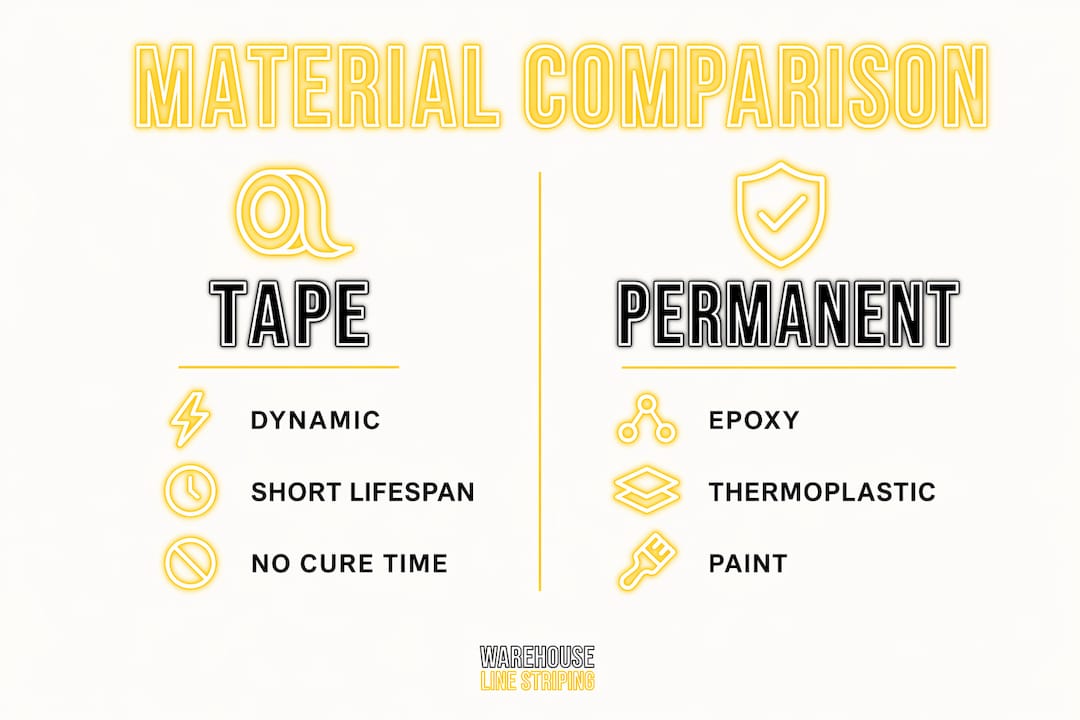
Floor tape suits facilities that reconfigure aisles or storage zones regularly. Application requires no cure time, so operations resume immediately. The tradeoff is durability. Tape edges fail first under forklift wheel turns and mechanical impacts. Heavy-duty tape systems address this with reinforced edges, beveled designs, and impact-resistant carriers, but even these require more frequent replacement than coatings.
Paint works well in stable environments where layout changes are rare. Water-based and solvent-based paints both require cure time before foot or vehicle traffic resumes. That downtime is the primary operational cost. Paint also wears faster than epoxy in high-traffic corridors, making it a better fit for low-traffic pedestrian zones than main forklift aisles.
Two-pack epoxy chemically cures to a hard surface that bonds tightly to concrete. It resists abrasion, chemical spills, and heavy forklift traffic. Warehouse Line Striping’s epoxy coatings are rated to last 3–7 years under industrial conditions. That lifespan makes epoxy the most cost-effective choice for permanent, high-traffic zones despite its higher upfront cost.
Thermoplastic is hot-applied at approximately 200°C and sets in 5–10 minutes. Its 5–8 year outdoor lifespan makes it the standard for loading docks, parking lots, and external roadways. The heat and fumes from application make it unsuitable for enclosed warehouse floors.
Pro Tip: In facilities with both indoor and outdoor marking needs, use epoxy inside and thermoplastic outside. Matching material to environment is the single fastest way to reduce your total replacement cycle.
How to select the right floor marking material for your facility
Material selection is an engineering decision, not an aesthetic one. Choosing unsuitable tape for a high-traffic aisle leads to premature failure and active safety hazards. Work through these five criteria before committing to any material.
Assess traffic volume and type. Forklift aisles demand epoxy or heavy-duty tape with reinforced edges. Pedestrian-only zones tolerate standard paint or lighter tape. Mixed-use corridors need the durability of epoxy or premium tape systems.
Evaluate layout change frequency. Facilities that reconfigure layouts frequently benefit from tape because it removes cleanly and reinstalls quickly. Stable facilities with fixed aisle configurations get better value from epoxy or thermoplastic despite longer installation windows.
Check floor substrate compatibility. Concrete, sealed concrete, and coated floors each respond differently to adhesives and coatings. Floor flatness and surface condition directly affect adhesion. Uneven or contaminated substrates cause premature delamination regardless of material quality.
Account for chemical exposure. Facilities handling oils, solvents, or cleaning agents need chemical-resistant materials. Slip-resistant epoxy systems meeting ANSI A326.3 show Dynamic Coefficient of Friction values around 0.72 when wet. That level of traction matters in zones where spills are routine.
Calculate lifecycle cost, not just purchase price. Total lifecycle costs include installation downtime, maintenance intervals, and reapplication cycles. Tape may cost less upfront but require replacement two to three times more often than epoxy over a five-year period.
Pro Tip: Zone your facility by traffic intensity before selecting materials. A single facility often needs three different materials: epoxy for main forklift aisles, heavy-duty tape for staging areas, and paint for low-traffic pedestrian corridors.
Best practices for application, maintenance, and troubleshooting
Proper installation and ongoing maintenance determine whether your floor markings stay compliant between audits. Most marking failures trace back to two causes: poor surface preparation and deferred maintenance.
Surface preparation is the most skipped step in floor marking projects. Even premium coatings fail if the slab is contaminated with oil, dust, or moisture. Concrete floors require mechanical grinding or shot blasting to open the surface before epoxy application. Tape requires a clean, dry substrate with no wax or sealant residue. Skipping prep is the fastest way to waste your marking budget.
Best practices for installation and ongoing maintenance:
- Grind or shot blast concrete before applying epoxy or thermoplastic
- Allow full cure times before resuming traffic: epoxy typically requires 24–72 hours depending on product and temperature
- Apply edge sealant or use beveled tape profiles in forklift contact zones to delay edge lifting
- Inspect all markings on a quarterly schedule, prioritizing high-traffic corridors and intersections
- Replace degraded sections immediately rather than waiting for full-cycle replacement
The maintenance schedule is where most facilities fall short. Quarterly visual inspections catch edge lifting, fading, and delamination before they become compliance failures. Partial degradation creates an illusion of compliance that is more dangerous than no marking. Workers see a line and assume it is accurate. When that line has shifted or faded, the boundary it communicates no longer matches reality.
Color fading deserves specific attention. Yellow caution markings fade faster than red or white under UV exposure and foot traffic. Facilities with skylights or open dock doors should specify UV-stable pigments in their paint or epoxy formulations. This is a specification detail that most generic paint products do not address.
Key Takeaways
The most effective industrial floor marking material selection strategy matches material type to zone-specific traffic, substrate condition, and lifecycle cost rather than applying one solution across the entire facility.
| Point | Details |
|---|---|
| OSHA requires durability, not a specific material | Markings must stay visible and intact; the material choice is yours to make based on conditions. |
| Epoxy leads for permanent high-traffic zones | Two-pack epoxy bonds to concrete, resists chemicals, and lasts 3–7 years under forklift traffic. |
| Tape suits dynamic layouts, not heavy traffic | Reinforce tape edges in forklift zones or expect frequent replacement and compliance gaps. |
| Surface prep determines marking lifespan | Even the best coating fails on a contaminated or uneven substrate; prep is non-negotiable. |
| Lifecycle cost beats purchase price as a metric | Cheaper tape replaced three times costs more than epoxy installed once over a five-year window. |
Why I think most facilities get floor marking selection backwards
Most facility managers I have worked with approach floor marking as a procurement decision. They compare price per roll or price per gallon and pick the lowest number. That logic fails within 18 months when tape edges are peeling in the main forklift aisle and the safety officer is writing corrective action reports.
The right framework starts with zone mapping. Walk your facility and categorize every marked area by traffic type, chemical exposure, and how often the layout changes. That map tells you which material belongs where before you spend a dollar. A distribution center with stable racking and daily forklift traffic needs epoxy in the pick aisles and can use tape in the receiving staging area where layouts shift weekly.
The other mistake I see consistently is treating maintenance as optional. Markings are not a set-and-forget installation. Quarterly inspections and immediate replacement of degraded sections are the difference between a facility that passes audits and one that generates citations. Involving your operations team in the inspection schedule, not just your safety officer, creates accountability at the floor level where it actually matters.
Total cost of ownership is the only honest way to evaluate floor marking materials. Factor in installation downtime, reapplication frequency, and the labor cost of your maintenance schedule. When you run those numbers, floor marking systems built on epoxy almost always win over a five-year horizon, even in facilities that initially resist the higher upfront cost.
— ET
How Warehouse Line Striping handles material selection for you
Selecting the right floor marking material across a large facility is a technical process with real consequences for safety and compliance. Warehouse Line Striping assesses your traffic patterns, floor substrate, chemical exposure, and layout stability before recommending any material.
Their team handles specification, surface preparation, installation, and removal of outdated markings as a complete service. With over 10,000 completed projects and epoxy coatings rated to last 3–7 years, Warehouse Line Striping delivers durable floor marking solutions that hold up between audit cycles. Facilities that need support with lean-aligned marking layouts or zone-specific material planning can reach their team 24/7 for a site assessment.
FAQ
What does OSHA require for floor marking materials?
OSHA 29 CFR 1910.22 requires aisles and passageways to be clearly marked with durable and visible markings but does not mandate a specific material. The facility is responsible for choosing a material that stays intact and legible under its operating conditions.
Which floor marking material lasts the longest indoors?
Two-pack epoxy lasts 3–7 years on internal concrete floors exposed to forklift traffic and chemical spills. Thermoplastic lasts 5–8 years but is only suitable for outdoor applications due to fumes and heat during application.
When should I use floor tape instead of epoxy?
Floor tape is the right choice when your facility reconfigures aisles or storage zones frequently. It applies without cure time and removes cleanly. Use heavy-duty tape with reinforced edges in any zone where forklifts operate.
What colors should industrial floor markings use?
ANSI Z535.1 defines the standard: yellow for caution zones, red for dangerous areas and emergency exits, and green for safety equipment and first aid stations. Following this standard keeps your facility consistent and speeds up hazard recognition.
Why do floor markings fail prematurely?
The two leading causes are inadequate surface preparation and deferred maintenance. Coatings and tapes applied to contaminated, oily, or uneven concrete delaminate quickly regardless of material quality. Quarterly inspections and immediate replacement of degraded sections prevent compliance failures.