Floor Markings in the 5S System: A Manager’s Guide
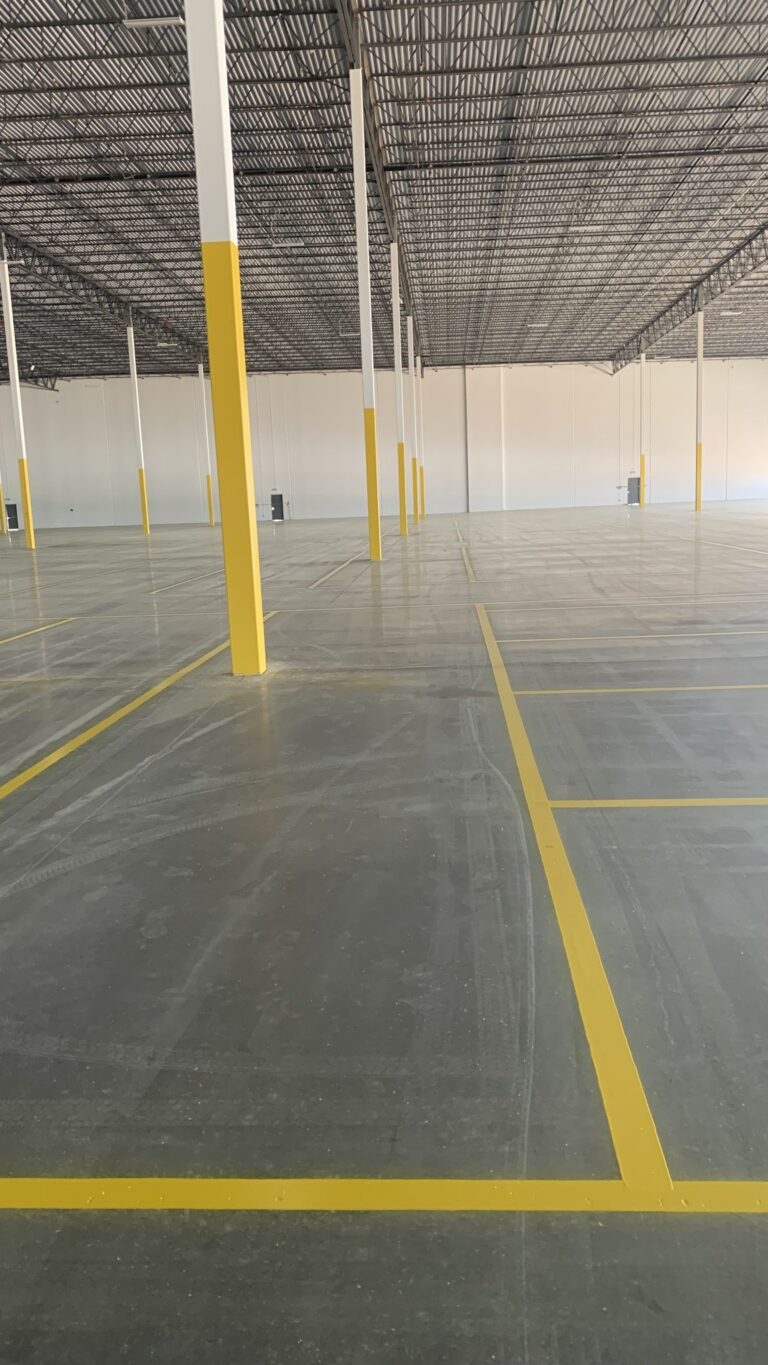
Floor markings are the physical foundation of the 5S workplace organization system, translating abstract principles of order and safety into visible, permanent workspace instructions. The role of floor markings in the 5S system centers on the second S, “Set in Order,” where every aisle, storage zone, and hazard area gets a defined boundary. Without marked floors, 5S remains a concept on paper. With them, it becomes a self-enforcing system your team follows without being told. This guide covers the importance of floor markings, color standards, implementation best practices, and how physical markings connect to digital warehouse management systems.
How do floor markings improve 5S safety and efficiency?
Floor markings deliver measurable results on safety and operational performance. Facilities with comprehensive marking systems report up to 35% fewer navigation-related incidents. That number matters because the Bureau of Labor Statistics recorded 479,480 nonfatal slips, trips, and falls in private industry in 2024 alone.
The most direct safety benefit is separation. Marked pedestrian lanes keep workers out of forklift travel paths. Marked hazard zones around electrical panels, loading docks, and machine perimeters give workers an instant visual warning without requiring a sign or a supervisor. When a forklift operator can see a clearly painted aisle boundary from 30 feet away, reaction time improves and collision risk drops.

Efficiency gains follow the same logic. When storage locations are marked, workers stop searching. Shadowing outlines on floors function like shadow boards on walls, providing immediate visual cues for tool and equipment placement and quickly signaling absences. An empty shadow footprint tells any worker, at a glance, that a pallet jack or hand truck is missing from its station. That single cue eliminates the informal search loops that waste minutes per shift across an entire crew.
OSHA’s standard under 29 CFR 1910.176(a) requires permanent aisles and passageways to be marked. OSHA violations for improper markings can reach $16,550 per serious violation. Compliance is not optional, and the cost of non-compliance far exceeds the cost of a proper marking installation.
Key safety benefits of a complete floor marking program:
- Separates pedestrian and forklift traffic lanes
- Defines hazard zones around machinery, panels, and dock edges
- Marks emergency exit paths and fire equipment locations
- Reduces slip, trip, and fall exposure in high-traffic areas
- Supports OSHA aisle marking compliance under 29 CFR 1910.176(a)
What are the standard 5S floor marking colors and widths?
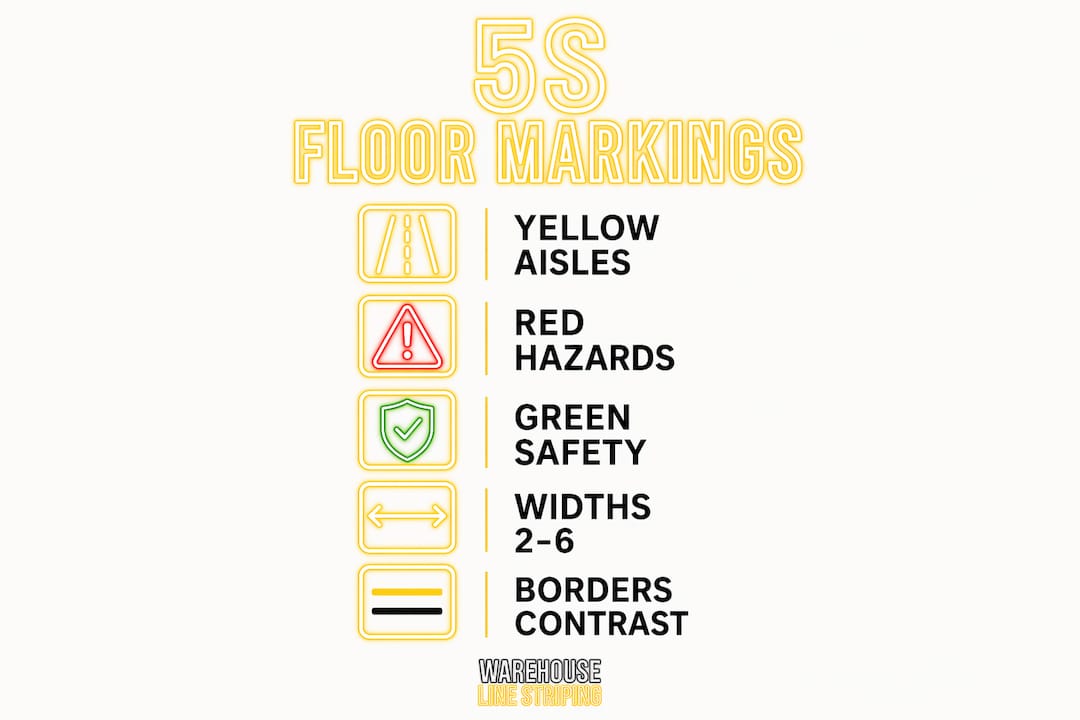
Color coding is the language of visual management in 5S. Different colors serve distinct purposes: yellow marks aisles and traffic lanes, red identifies defect or scrap areas, green designates safety equipment locations, and blue signals work in progress. These conventions are not mandated by OSHA but are widely adopted as industry standard across American warehouses and distribution centers.
The table below shows the most common color assignments used in 5S floor marking programs:
| Color | Primary meaning | Typical application |
|---|---|---|
| Yellow | Aisle and traffic lanes | Forklift paths, pedestrian walkways |
| Red | Defects, scrap, quarantine | Reject bins, nonconforming product zones |
| Green | Safety and first aid | Fire extinguisher locations, first aid stations |
| Blue | Work in progress | Staging areas, active production zones |
| White | General storage | Finished goods, raw material storage areas |
| Orange | Caution or inspection | Inspection stations, areas under review |
| Black/Yellow stripe | Extreme hazard | Dock edges, machine perimeters, fall risks |
Line width is equally important. OSHA requires a minimum of 2 inches for aisle markings, but industry best practice calls for 4–6 inches in high-traffic forklift aisles. Wider lines are not just more visible. They give forklift operators a larger visual target at speed, which directly reduces the chance of drifting into pedestrian zones.
Symbols and text markings add another layer of communication. Arrow markings direct one-way traffic flow. “No Storage” text inside a zone reinforces the boundary when workers are new or unfamiliar with the layout. Shadowing outlines, painted footprints of specific tools or equipment, tell workers exactly where each item belongs and make missing items obvious without any inventory check.
Pro Tip: Use contrasting border colors around shadow outlines. A white shadow with a black border on a gray concrete floor is visible from across a bay, even in low light conditions.
Best practices for implementing and maintaining 5S floor markings
A well-designed floor marking system fails quickly if the installation is poor. These are the steps that separate a marking program that lasts 3–7 years from one that peels up in six months.
Prepare the floor surface first. Proper floor surface preparation is the single most important factor in marking longevity. Clean, sealed, and level concrete holds tape and epoxy paint far longer than oily, cracked, or dusty floors. Degrease the surface, fill cracks, and allow full cure time before applying any marking material. Skipping this step wastes every dollar spent on materials.
Choose the right material for your traffic type. Vinyl floor tape works well in light to moderate foot traffic areas and is easy to reposition during layout changes. Epoxy paint and thermoplastic coatings are the correct choice for forklift aisles and high-traffic zones. Projected laser markings are an emerging option for areas where floor adhesion is impractical, though they require consistent lighting conditions to remain visible.
Plan the layout before you mark. Walk the floor with a tape measure and a layout diagram. Mark proposed lines with chalk or painter’s tape before committing to permanent materials. Involve forklift operators and pickers in the review. They will identify blind spots and pinch points that a manager reviewing a floor plan from a desk will miss.
Set a maintenance and inspection schedule. Regular inspection and maintenance keep floor markings clear and compliant over time. Assign a monthly visual inspection to a specific role, not just “whoever notices.” Document faded, peeling, or damaged sections and schedule repair within a defined window. A marking that is 60% visible is not compliant and not safe.
Replace outdated markings completely. Partial repaints over old lines create visual confusion. Professional removal of old markings before reapplication produces a clean, unambiguous result. Warehouse Line Striping includes removal services as part of its installation process for exactly this reason.
Pro Tip: Schedule floor marking inspections on the same calendar cycle as your 5S audits. Linking the two activities makes it harder for either to get skipped during busy operational periods.
How do floor markings integrate with lean and warehouse management systems?
Floor markings do not operate in isolation. The most effective 5S programs treat physical markings as one layer of a coordinated system that includes warehouse management system (WMS) software, lean inventory practices, and defined pick paths. Floor markings integrate with WMS and lean inventory systems to support workflows such as pick paths and FIFO, creating a physical-digital synchronization that reduces errors and speeds throughput.
FIFO (first in, first out) is a clear example. When floor markings define the entry and exit points of a storage lane, workers load from one end and pick from the other automatically. The floor layout enforces the inventory rule without requiring a WMS alert or a supervisor reminder. You can read more about this in the FIFO floor marking guide published by Warehouse Line Striping.
Pick path markings reduce travel distance per order. When floor arrows and zone color codes align with the pick sequence loaded in the WMS, workers follow a logical route through the facility rather than backtracking. The floor markings and pick path relationship is one of the highest-return investments in warehouse efficiency because it compounds across every order picked every day.
Lean practices like kanban and poka-yoke also rely on floor markings for physical reinforcement:
- Kanban replenishment zones use colored floor areas to signal when stock needs restocking
- Poka-yoke shadow outlines prevent tools from being stored in the wrong location
- Staging area markings coordinate inbound and outbound flow without verbal instruction
- Pallet grid markings create consistent storage density and support inventory flow systems
The physical-digital connection becomes most powerful when a WMS location code maps directly to a marked floor zone. A picker scanning a location barcode that corresponds to a clearly marked yellow zone on the floor has two confirmation points. That redundancy cuts mis-picks and speeds training for new hires.
Key Takeaways
Floor markings are the most direct tool for converting 5S principles into physical workspace order, and their effectiveness depends on color standards, material quality, surface preparation, and integration with broader operational systems.
| Point | Details |
|---|---|
| Safety impact is measurable | Comprehensive marking systems reduce navigation-related incidents by up to 35%. |
| Color standards drive consistency | Yellow, red, green, blue, and white each carry defined meanings across 5S environments. |
| Line width affects compliance | OSHA requires 2-inch minimum width; forklift aisles need 4–6 inches for safe visibility. |
| Surface prep determines longevity | Clean, sealed, and level floors are the foundation for markings that last 3–7 years. |
| Physical and digital systems align | Floor markings that map to WMS location codes reduce mis-picks and speed onboarding. |
Why floor markings are the most underrated tool in 5S
Most 5S conversations start with sorting and end with standardization audits. Floor markings get treated as a finishing step, something you do after the real work is done. That framing is wrong, and I’ve seen it cost facilities months of rework.
The floor is where 5S either works or doesn’t. A well-sorted, well-labeled facility with unmarked floors will drift back to disorder within weeks. Workers default to convenience. Without a marked home location, a pallet jack ends up wherever the last person left it. Without a marked pedestrian lane, workers cut through forklift paths because it’s faster. The floor marking is not decoration. It is the instruction.
What I find most managers underestimate is the cognitive load reduction. When a worker enters a zone and the floor tells them exactly where to stand, where to place materials, and where not to go, they spend zero mental energy on those decisions. That energy goes to the actual task. The visual management principle behind effective floor markings is that they must be instantly understandable. If a worker has to think about what a marking means, the marking has already failed.
Floor condition is the variable most managers ignore until it causes a problem. A cracked or oily floor does not just shorten marking life. It signals to workers that the facility does not maintain its own standards. That perception erodes 5S discipline faster than any single operational failure. Treat the floor surface as infrastructure, not as a backdrop.
My advice: put floor marking design on the agenda before your next 5S rollout, not after. The layout decisions you make at that stage shape every workflow that follows.
— ET
Ready to build a compliant 5S floor marking system?
Warehouse Line Striping designs and installs floor marking systems for warehouses, distribution centers, and industrial facilities across the country. Every project starts with a layout consultation that maps your 5S zones, traffic patterns, and OSHA requirements before a single line is applied.
With over 10,000 completed projects and industrial-grade epoxy coatings rated for 3–7 years of durability, Warehouse Line Striping delivers marking systems that hold up under forklift traffic and daily operations. Their floor marking systems for inventory flow are built to align with your WMS and lean processes from day one. Contact Warehouse Line Striping for a site assessment and get your 5S floor plan right the first time.
FAQ
What is the role of floor markings in the 5S system?
Floor markings define storage zones, traffic lanes, hazard areas, and equipment locations, translating the “Set in Order” phase of 5S into a physical, self-enforcing workspace layout. They are the primary tool of visual management in 5S environments.
What colors are used in 5S floor marking systems?
Yellow marks aisles and traffic lanes, red identifies scrap or defect zones, green designates safety equipment locations, blue signals work in progress, and white marks general storage areas. These are industry conventions, not OSHA mandates.
How wide do 5S floor markings need to be?
OSHA requires a minimum of 2 inches for aisle markings under 29 CFR 1910.176(a). Industry best practice calls for 4–6 inches in forklift aisles, where wider lines give operators a larger visual target at operating speed.
How often should floor markings be inspected and replaced?
Monthly visual inspections are the standard for active warehouse environments. Faded, peeling, or damaged markings should be repaired within a defined window, and full reapplication should align with your 5S audit schedule to keep compliance current.
How do floor markings support FIFO and pick path efficiency?
Marked entry and exit points on storage lanes enforce FIFO inventory rotation without WMS prompts. Pick path arrows and zone color codes that align with WMS sequences reduce travel distance per order and cut mis-picks across every shift.