Distribution Center Floor Layout Planning: 2026 Guide
Distribution center floor layout planning is the strategic process of organizing storage zones, equipment pathways, and workflow sequences to maximize throughput, safety, and space utilization across your facility. Done right, it determines whether your operation runs at peak capacity or bleeds time and labor on every shift. The decisions you make before a single rack is installed, including aisle widths, zoning logic, racking selection, and automation readiness, will define your facility’s performance for years. This guide walks you through each critical decision in sequence, with the data and specificity logistics professionals actually need.
What data do you need before starting distribution center floor layout planning?
Layout planning that starts with a sketch instead of data analysis produces facilities where key functional areas are undersized, poorly positioned, or incompatible with the equipment that actually runs in them. Starting from data before drawing a single line is the single most important discipline in this process.
The foundational data set covers four categories:
- Building dimensions and constraints: Measure column grid spacing, clear ceiling height, dock door count and position, floor load capacity, and utility locations. Dock door count and truck court depth are external constraints that cap your throughput ceiling before internal racking even enters the equation. A minimum 120-foot truck court depth is required for standard semi-trailer maneuvering, and facilities that ignore this create permanent inbound and outbound bottlenecks.
- SKU velocity and order profiles: Classify inventory by velocity (A, B, C) and map which SKUs move in full pallets versus each picks. This directly determines slot locations, pick path design, and zone sizing.
- Equipment inventory: Document every forklift, reach truck, order picker, and conveyor in your fleet, including turning radii and lift heights. Equipment drives aisle width requirements, which in turn drive storage density.
- Flow analysis: Trace the physical path of product from receiving dock to shipping dock. U-shaped, I-shaped, and L-shaped flow patterns each suit different facility geometries and throughput levels. Matching your flow pattern to your building geometry prevents cross-traffic and congestion.
Pro Tip: Map your top 20% of SKUs by velocity before you finalize any zone boundaries. Those fast movers should sit closest to packing and shipping, regardless of what a generic layout template suggests.
Automation planning belongs in this phase, not as an afterthought. Approximately 40% of built-to-suit distribution projects now include automation at opening, and retrofitting automation into a completed layout carries prohibitive costs. Automated Storage and Retrieval Systems (AS/RS), in particular, require floor load capacities and power infrastructure that must be specified during the design phase.
How to define functional zones for optimal workflow
Zoning is the process of dividing your floor into dedicated areas that each serve a specific operational function, positioned to minimize travel distance and prevent workflow collisions. The six core zones in a standard distribution center are receiving, quality control, storage, picking, packing, and shipping, with support areas such as battery charging and maintenance added based on operational needs.
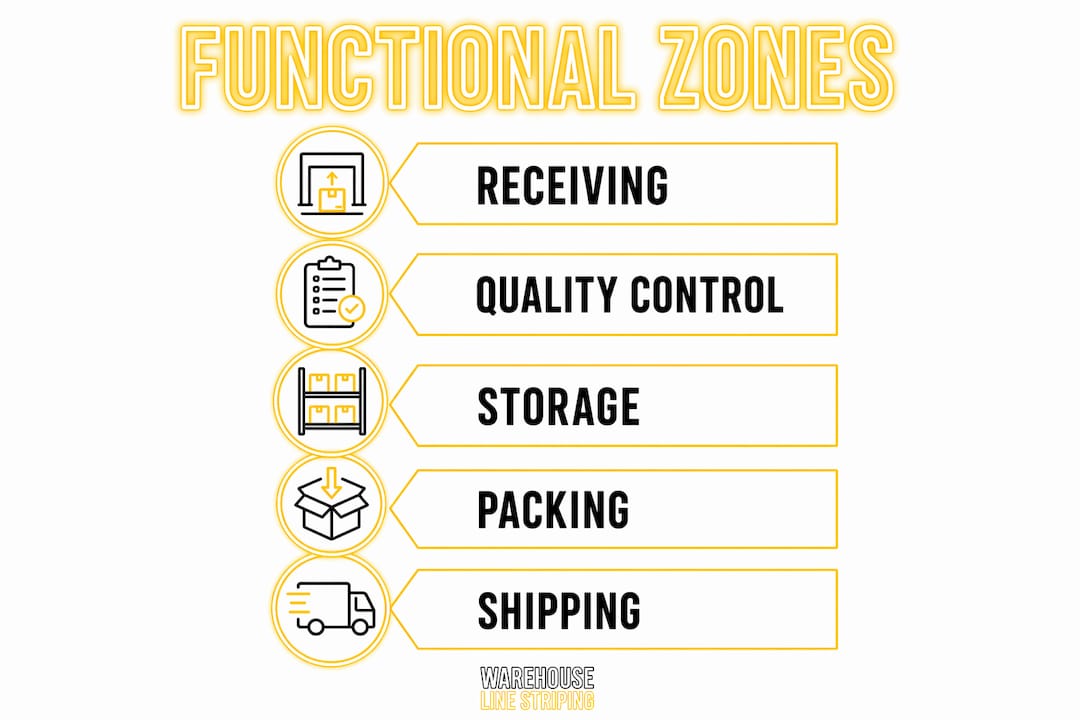
Zone sequencing follows product flow logic. Receiving and quality control anchor one end of the facility near inbound docks. Storage occupies the largest central area. Picking, packing, and shipping cascade toward outbound docks. When these zones are out of sequence, product travels backward through the building, adding labor minutes to every order.
Zone sizing is where most planners make a costly error. Zones sized for average daily volume will fail during peak periods. Size every zone for your peak volume, then verify that the resulting footprint fits within your building’s usable area. Usable storage area typically accounts for only 40 to 50% of total building footprint once aisles, staging lanes, and safety clearances are factored in. That figure surprises most planners who assume they have more usable space than they do.
Follow this sequence when defining zones:
- Plot dock doors and assign inbound versus outbound doors first.
- Position receiving and quality control adjacent to inbound docks with enough staging depth for full truck loads.
- Define the storage zone boundaries based on your pallet position count requirement.
- Place picking and packing zones between storage and outbound docks to keep product moving in one direction.
- Assign shipping staging lanes directly in front of outbound dock doors.
- Locate battery charging rooms and maintenance areas at the building perimeter, away from primary traffic lanes.
Pro Tip: Separate pedestrian packing areas from forklift travel lanes with a physical or marked buffer. Mixing foot traffic and powered equipment in the same corridor is the most common source of preventable incidents in distribution centers.
Battery charging areas for electric forklifts require strategic placement with ventilation and direct access to main operational zones. A charging room buried in a corner forces forklifts to travel through active pick aisles during shift changes, creating congestion at exactly the wrong moment.
How do aisle widths and equipment requirements impact layout design?
Aisle width is the variable that controls storage density, equipment compatibility, picking speed, and safety simultaneously. Most planners treat it as a secondary decision. It is actually one of the first constraints you should lock down, because it determines how many rack rows fit in your building.
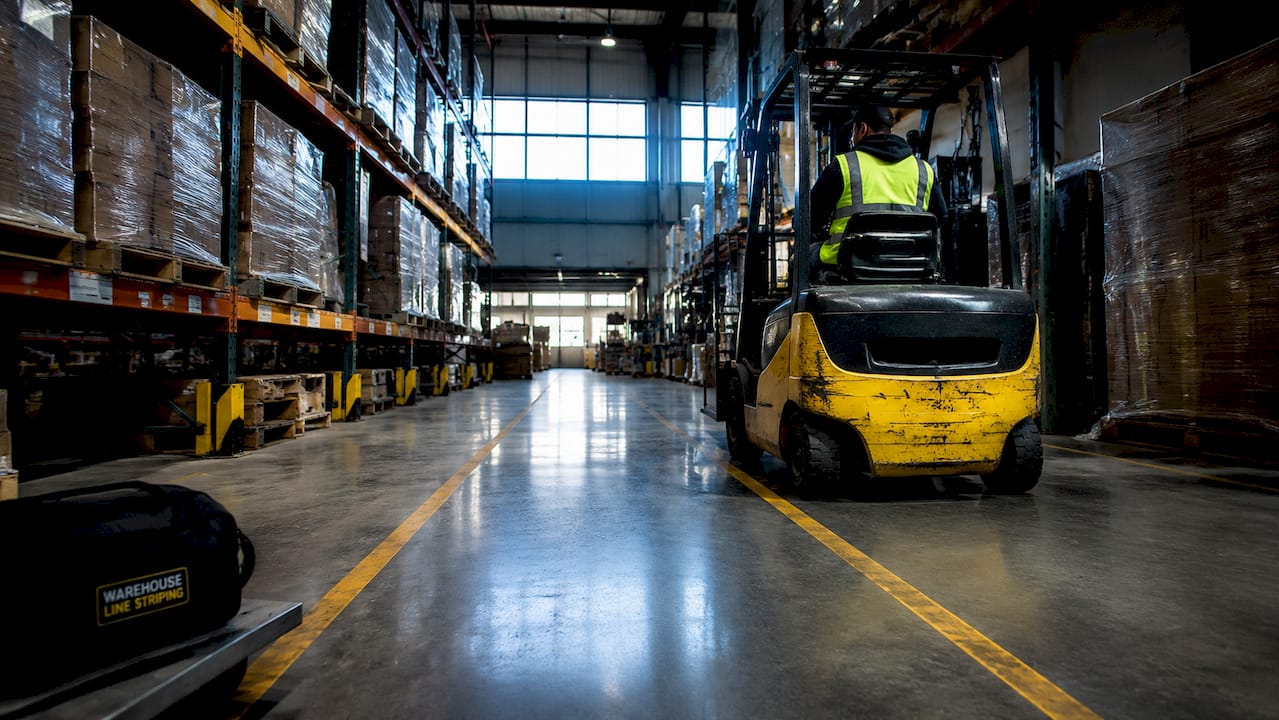
OSHA 29 CFR 1910.22 mandates that aisles be at least 3 feet wider than the largest piece of equipment operating in them. This is a floor, not a target. Facilities that compress aisles below this standard face citation risk and, more practically, forklift damage to racking that compounds over time.
The three aisle width categories each carry distinct operational tradeoffs:
- Wide aisles (11 to 13 feet): Compatible with counterbalance forklifts. Highest throughput per aisle, easiest operator training, but lowest storage density. Best for high-velocity pallet movement.
- Narrow aisles (8 to 10 feet): Require reach trucks. Increase storage density by 20 to 25% compared to wide aisles. Require more precise operator skill and slower travel speeds.
- Very narrow aisles, or VNA (5 to 7 feet): Require wire-guided or rail-guided turret trucks. Deliver the highest storage density of any configuration, but demand significant capital investment in specialized equipment and guidance systems.
Aisle width affects not just safety, but also forklift type compatibility, picking speed, and storage density. It is a critical and often underestimated variable that shapes every other layout decision downstream. (Source)
Mixing aisle widths within a single facility is a legitimate strategy. High-velocity A-SKU zones can use wide aisles for speed, while slower-moving C-SKU zones use narrow or VNA configurations to maximize density. The key is ensuring your equipment fleet matches each zone’s aisle specification. Running a counterbalance forklift into a narrow aisle zone is both a safety violation and a rack damage guarantee.
For a detailed breakdown of compliant aisle configurations by equipment type, the aisle width compliance guide covers OSHA-aligned standards with specific measurements for each forklift category.
What are the best racking options for maximizing vertical space?
Racking selection determines how effectively you convert cubic footage into usable pallet positions. The right system depends on your SKU count, inventory rotation requirements, and the ceiling height you have available.
| Racking type | Best for | Key tradeoff |
|---|---|---|
| Selective pallet rack | High SKU count, FIFO rotation | Lower density, full aisle access required |
| Drive-in / drive-through | Low SKU count, high volume per SKU | LIFO rotation, slower access |
| Push-back rack | Medium SKU count, LIFO acceptable | Higher cost, moderate density gain |
| Shuttle rack | High-density cold storage or bulk | High capital cost, excellent density |
| AS/RS | Very high throughput, automation-ready | Highest cost, requires early infrastructure |
Switching from block stacking to selective pallet racks increases pallet positions by 67% and reduces wasted floor area by 35%. That is not a marginal improvement. It is a facility transformation achievable without adding square footage.
Vertical optimization compounds these gains further. Matching rack heights and beam spacing to your actual SKU dimensions increases pallet capacity by 30 to 50% without any building expansion. Most facilities leave significant vertical space unused because beam levels are set to accommodate the tallest SKU across the entire facility rather than zone by zone.
Vertical optimization requires accounting for sprinkler clearance of at least 18 inches below deflectors, forklift reach capability at maximum height, beam deflection under load, and SKU height variance by zone. Ignoring any one of these factors produces a racking configuration that either violates fire code or cannot be safely operated.
Pro Tip: Audit your beam spacing annually. As your SKU mix evolves, beam levels set three years ago may no longer match your current inventory profile, and you may be leaving pallet positions on the table.
AS/RS systems require 20 times the electrical power of other automation types and specialized floor load capacity. If AS/RS is in your five-year plan, the electrical infrastructure and floor slab specifications must be addressed during initial construction or major renovation, not when you are ready to install the system.
How to incorporate safety and compliance into your layout
Safety compliance is not a layer applied on top of a completed layout. It is a structural input that shapes zone boundaries, aisle widths, marking systems, and equipment placement from the start. Facilities that treat safety as a finishing step routinely discover that their completed design requires expensive rework to meet OSHA and NFPA standards.
The non-negotiable compliance elements that belong in every distribution center layout plan include:
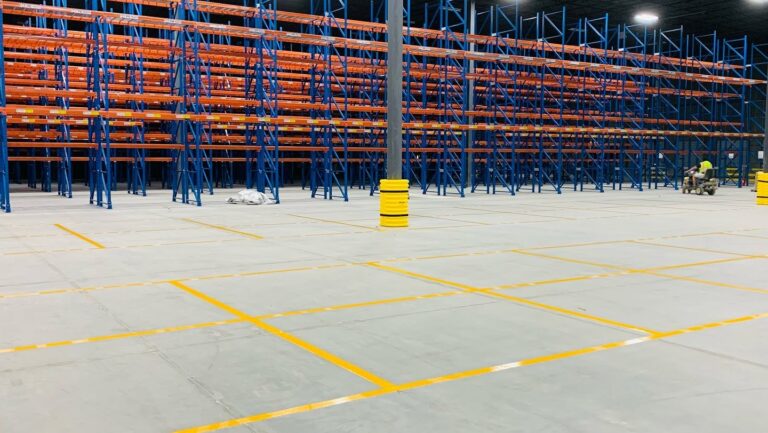
- Pedestrian and forklift separation: Dedicated pedestrian pathways must be physically separated from forklift travel lanes, either by painted floor markings, barriers, or both. Sacrificing aisle clearance or pedestrian separation creates costly operational and legal exposure.
- Emergency exit clearance: OSHA requires a minimum 28-inch clear path to all emergency exits at all times. Exit routes must be marked and kept free of staging inventory.
- Fire lane marking: NFPA 13 requires clear access lanes for sprinkler system maintenance and fire suppression equipment. These lanes must be marked and kept clear regardless of operational pressure to use every square foot for storage.
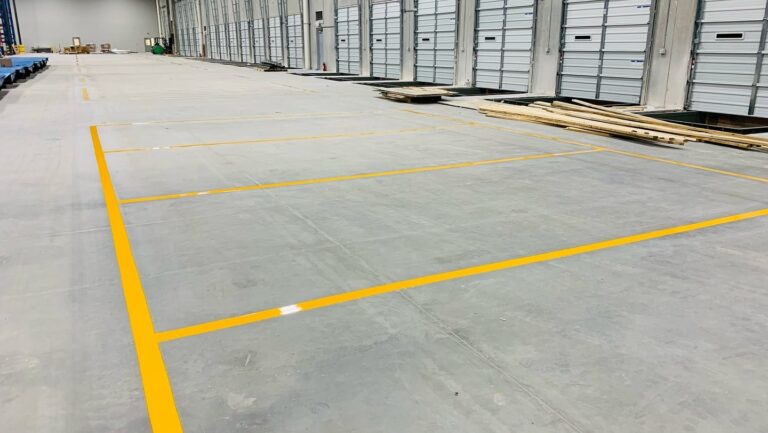
- Dock clearance zones: Dock leveler areas and trailer restraint zones require marked clearances that prevent pedestrian entry during loading and unloading operations.
- Expansion buffer zones: Building in designated expansion areas prevents the gradual encroachment of storage into safety lanes as operations grow. Overcrowded facilities are where compliance violations accumulate fastest.
For facilities planning growth, distribution center expansion floor planning requires reserving buffer zones from day one. Adding capacity into a facility that has no planned expansion space forces compromises on aisle widths and safety clearances that are difficult and expensive to reverse.
Key takeaways
Effective distribution center floor layout planning requires locking in data, zoning logic, aisle specifications, and compliance requirements before any racking or marking is installed.
| Point | Details |
|---|---|
| Start with data, not drawings | Collect SKU velocity, equipment specs, and building constraints before sketching any layout. |
| Size zones for peak volume | Zones sized for average throughput will fail during peak periods and create costly bottlenecks. |
| Aisle width drives everything | OSHA mandates aisles at least 3 feet wider than the largest equipment, and this constraint shapes storage density and forklift selection. |
| Vertical space is underused | Matching rack heights to SKU profiles increases pallet capacity by 30 to 50% without expanding the building footprint. |
| Safety is a structural input | Pedestrian separation, fire lanes, and exit clearances must be designed in from the start, not added after the layout is complete. |
Why most layout projects fail before the first rack goes in
The most consistent mistake I see in distribution center layout projects is not a technical error. It is a process error. Teams start with a floor plan and a vendor’s rack layout proposal, then work backward to justify the design. That sequence produces facilities optimized for the vendor’s catalog, not the operation’s actual SKU velocity and flow patterns.
Copying another facility’s layout is the specific version of this mistake that I find most damaging. A layout that works brilliantly for a 50,000-square-foot e-commerce fulfillment center will perform poorly in a 200,000-square-foot regional distribution center with a completely different order profile. The geometry is different, the equipment is different, and the SKU mix is different. The layout must reflect those realities.
The second failure mode is treating automation as a future problem. Every facility I have seen attempt to retrofit AS/RS or conveyor systems into a layout that was not designed for them has paid a significant premium in structural modifications, electrical upgrades, and operational downtime. The infrastructure planning for automation costs a fraction of the retrofit when addressed during initial design.
Layout planning is also not a one-time event. Operations evolve, SKU mixes shift, and throughput demands change. The facilities that maintain peak efficiency treat their floor layout as a living document, reviewed at least annually against current operational data. The ones that do not find themselves managing around a design that no longer fits their business.
— ET
How Warehouse Line Striping supports your layout execution
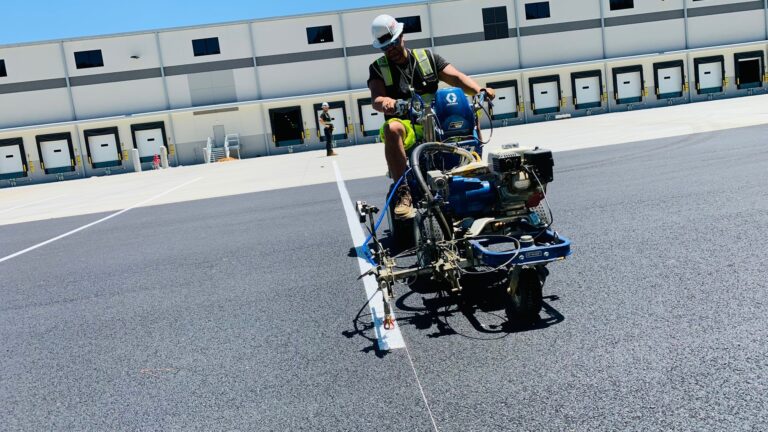
Once your layout plan is finalized, precise floor marking is what converts a design document into an operational reality that your team can follow safely and efficiently.
Warehouse Line Striping has completed over 10,000 projects in distribution centers and industrial facilities nationwide, applying OSHA-compliant floor markings that last 3 to 7 years using industrial-grade epoxy coatings. From aisle boundary lines and pedestrian pathways to pallet grid markings and fire lane designations, every marking is installed to your layout specifications with minimal operational disruption. Their floor markings for lean operations service translates your zone boundaries and pick paths into durable, high-visibility floor graphics that reduce errors and support compliance audits. For facilities focused on pick path efficiency, the pick path floor marking guide details how marking systems directly reduce travel time and mispicks.
FAQ
What is distribution center floor layout planning?
Distribution center floor layout planning is the process of organizing storage zones, aisle configurations, equipment pathways, and functional work areas within a facility to maximize throughput, safety, and space utilization. It requires analyzing SKU velocity, equipment specifications, and building constraints before any physical design decisions are made.
How wide should aisles be in a distribution center?
OSHA 29 CFR 1910.22 requires aisles to be at least 3 feet wider than the largest piece of equipment operating in them. Wide aisles run 11 to 13 feet for counterbalance forklifts, narrow aisles run 8 to 10 feet for reach trucks, and very narrow aisles run 5 to 7 feet for specialized turret trucks.
How much of a distribution center’s footprint is actually usable for storage?
Usable storage area typically accounts for only 40 to 50% of total building footprint once aisles, staging lanes, and safety clearances are factored in. This figure is the baseline for calculating how many pallet positions your facility can realistically support.
When should automation be planned in a distribution center layout?
Automation infrastructure must be planned during initial facility design, not as a retrofit. AS/RS systems require 20 times the electrical power of other automation types and specialized floor load capacity, making late-stage integration prohibitively expensive.
What is the most common mistake in distribution center layout planning?
Starting layout design from a sketch or copying another facility’s floor plan without analyzing your own SKU velocity and order profile is the most common and costly mistake. Successful layout planning requires your operational data to drive every design decision.