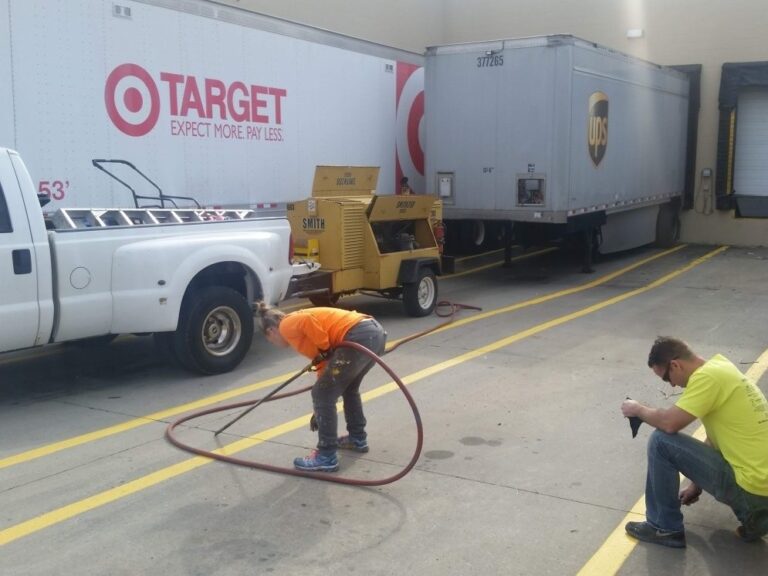
Why Distribution Center Redesigns Become Necessary
Most distribution centers don’t fail overnight. They degrade slowly, through workarounds that become habits, temporary fixes that become permanent, and layouts that quietly stop matching the operation running inside them. Understanding why distribution center redesigns become necessary is less about spotting dramatic breakdowns and more about recognizing the cumulative weight of small operational compromises. This article breaks down the real triggers, from capacity ceilings and network misalignment to technology gaps and safety constraints, so you can assess where your facility stands before those compromises start costing you customers.
Table of Contents
- Key takeaways
- Why distribution center redesigns become necessary
- Network misalignment and footprint problems
- Modular design and future-proofing your facility
- Strategic trade-offs and resilience in redesign
- Real-world triggers: capacity, technology, and safety
- My take on when redesign becomes unavoidable
- Make your redesign stick with the right floor markings
- FAQ
Key takeaways
| Point | Details |
|---|---|
| Layout waste is measurable | Broken layouts can waste up to 40% capacity, making redesign a financial decision, not just an operational one. |
| Network misalignment compounds costs | Redundant facilities and inefficient routes signal that your distribution footprint no longer matches your demand map. |
| Modular design reduces redesign risk | Reconfigurable layouts let you adopt automation and absorb SKU growth without shutting down operations. |
| Resilience requires explicit trade-offs | Balancing service level, cost, and sustainability means making deliberate decisions rather than defaulting to legacy configurations. |
| Safety and tech gaps are redesign triggers | Dock flow problems and outdated technology are not maintenance issues. They are structural design failures that require integrated solutions. |
Why distribution center redesigns become necessary
The most common misconception in logistics operations is that a facility only needs redesign when it physically runs out of space. In reality, the triggers appear long before the walls close in. Operational friction, stalled throughput, and daily workarounds are the real early indicators that your current design has hit its ceiling.
Consider what happens when a distribution center starts using overflow trailers as permanent storage. That is not a space problem. That is a design problem wearing a space costume. The same applies when pickers develop unofficial routes to avoid congested aisles, or when receiving teams build informal staging areas because the dock-to-storage flow was never properly designed.
The data behind this is striking. Picking inefficiencies account for 55 to 65% of total warehouse operating costs, and poor slotting alone can extend pick paths by 30 to 50%. When your labor costs per order are climbing despite a stable headcount, the layout is almost certainly the culprit.
- Stagnant throughput KPIs despite adding labor or extending shifts
- Overflow storage in trailers, parking lots, or off-site annexes becoming routine
- Picking path lengths increasing without changes to SKU count
- Informal workarounds that new employees are trained into as standard practice
Pro Tip: If your KPIs have plateaued despite optimized labor scheduling, stop looking at the workforce and start looking at the floor plan. Stagnant performance with stable inputs is a layout signal, not a people problem.
The importance of redesigning distribution centers at this stage is that incremental fixes stop working. Slotting adjustments, software patches, and process tweaks can only compensate for so much. When the underlying physical design is misaligned with the operation, you need structural change.
Network misalignment and footprint problems
Operational inefficiencies inside a single facility are one thing. Network-level misalignment is another problem entirely, and it tends to be far more expensive. As companies grow through acquisition, expand into new markets, or shift channel mix toward direct-to-consumer, their distribution footprints frequently lag behind.
Redundant warehouses, underutilized facilities, and inefficient shipping routes are classic signs that a network redesign is overdue. A facility that made sense geographically five years ago may now be adding two days of transit time to a region that represents 30% of your volume. That is not a carrier problem. That is a footprint problem.
The reasons for distribution center upgrades at the network level typically include:
- Post-merger redundancy, where two overlapping networks never got rationalized
- Demand shifts that moved volume concentration to regions without adequate coverage
- Transportation cost spikes driven by inefficient miles between DCs and delivery zones
- Stockouts in high-velocity markets caused by inventory being positioned too far from demand
The critical insight here is that network redesign is not a one-time project. Markets shift, fuel costs change, consumer expectations evolve. A footprint that was optimized in 2021 is almost certainly carrying inefficiencies by now. Treating network design as an ongoing discipline rather than a periodic event is what separates reactive operations from genuinely resilient ones.
Modular design and future-proofing your facility
One of the most underappreciated challenges in distribution center design is the cost of being wrong. When a facility is built around a fixed layout, every significant operational change, whether that means adding automation, absorbing a new product line, or shifting from bulk to each-pick, requires a major reconfiguration project. That means downtime, capital expenditure, and disruption.

Modular warehouse design solves this by treating the layout as a variable rather than a constant. Reconfigurable racking systems, movable conveyor infrastructure, and zone-based picking areas allow a facility to adapt without rebuilding. This matters especially as automation adoption accelerates. A facility that cannot accommodate a goods-to-person system without a six-month shutdown will always be behind the curve.
The benefits of warehouse redesign toward modularity are concrete. You can absorb SKU growth incrementally. You can pilot automation in one zone without disrupting the rest of the operation. You can respond to seasonal volume spikes by reconfiguring flow rather than leasing overflow space. Rigid layouts create operational risk that compounds over time, while modular designs give you options.
- Scalable automation adoption without full facility shutdowns
- Zone reconfiguration to accommodate new order profiles or fulfillment channels
- Reduced capital risk when testing new workflows before full commitment
- Faster response to volume spikes or market shifts
Pro Tip: When evaluating your existing layout for adaptability, ask one question: how many weeks of downtime would a major reconfiguration require? If the answer is more than two, you are carrying significant operational risk that a modular redesign could eliminate.
Strategic trade-offs and resilience in redesign
The most sophisticated distribution center redesigns are not just about fixing what is broken. They are about making deliberate decisions regarding what you are willing to trade off going forward. Balancing service level, cost, and sustainability is not a side conversation in a redesign project. It is the core of it.
Here is how that trade-off thinking plays out in practice:
- Service level vs. cost. A regionalized network with more facilities closer to customers improves delivery speed but increases fixed overhead. You need to know your service level commitments before you can design the right footprint.
- Inventory buffers vs. lean operations. Carrying more safety stock builds resilience but ties up working capital. The right answer depends on your supplier lead times and demand volatility.
- Consolidation vs. redundancy. Fewer, larger DCs reduce per-unit costs but create single points of failure. The events of 2020 and 2021 demonstrated exactly how quickly consolidated networks can collapse under disruption.
- Carbon constraints. Regulatory pressure and customer expectations around emissions are already reshaping where companies locate facilities and how they configure last-mile delivery. Ignoring this in a redesign project means building something that will need revision within five years.
Flexible network design is what keeps these trade-offs manageable. When your distribution strategy is built to absorb change rather than resist it, you spend less time reacting to market shifts and more time capitalizing on them.
Real-world triggers: capacity, technology, and safety
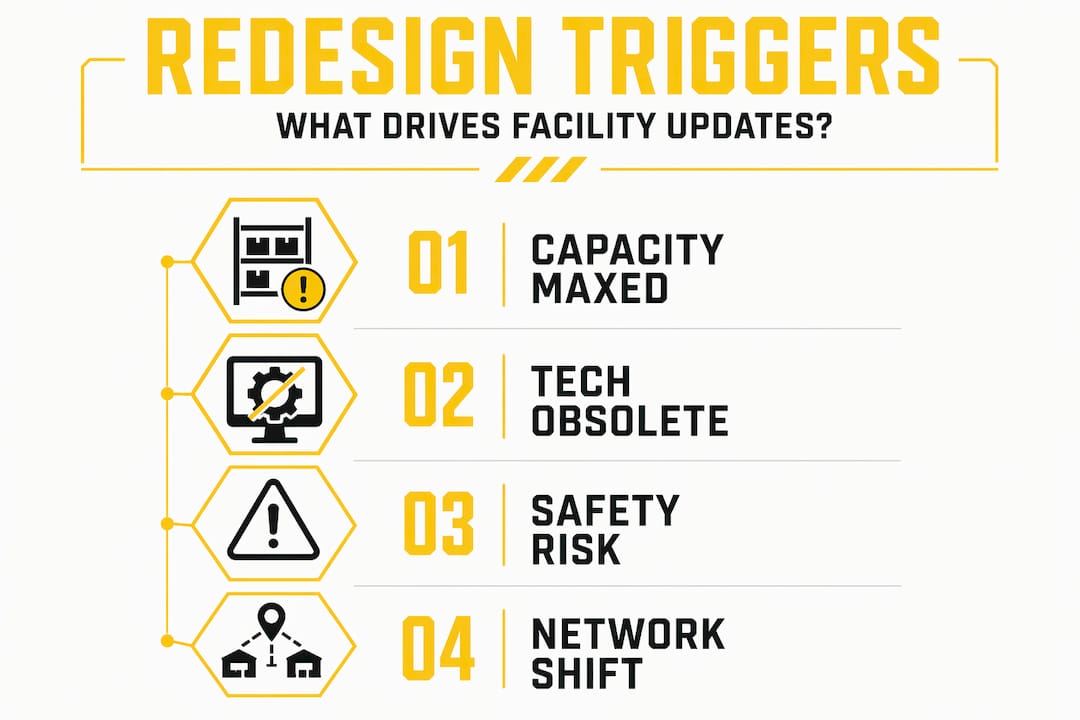
Abstract principles are useful, but concrete examples make the case more clearly. Dollar Tree’s decision to build a 1 million square foot facility designed for both current volume and future expansion is a direct response to the cost of being under-built. When a retailer is paying premium rates for overflow storage and watching delivery costs climb, the math on a new facility starts working faster than most finance teams expect.
Technology modernization is another underappreciated driver. Legacy warehouse management systems, manual receiving processes, and paper-based tracking are not just inefficiency problems. They are design constraints. When you upgrade to a WMS with real-time slotting recommendations or add conveyor automation, the physical layout often needs to change to support the new workflows. You cannot bolt modern technology onto a 1990s floor plan and expect it to perform.
Safety is where the operational and structural converge most directly. Dock-side workflow and layout are interdependent. When dock flow is constrained, vehicles and pedestrians share space in ways that create incidents. When receiving is undersized relative to inbound volume, product sits in aisles and creates trip hazards. These are not safety program failures. They are design failures that safety programs cannot fully compensate for.
Pro Tip: When building a business case for redesign, include safety incident costs and near-miss frequency data alongside throughput and labor metrics. Safety data often provides the clearest financial argument for structural change.
My take on when redesign becomes unavoidable
I’ve seen a lot of facilities that were technically functioning but operationally exhausted. The teams inside them were working hard, the KPIs were being managed, and the workarounds had become so normalized that nobody questioned them anymore. That is the most dangerous state a distribution center can be in.
What I’ve learned is that the real cost of delayed redesign is not the one-time capital expense you are avoiding. It is the compounding operational debt you accumulate every month you run a layout that no longer fits your operation. Every workaround adds friction. Every informal process creates training debt. Every temporary fix becomes a permanent constraint.
The facilities that handle redesign well treat it as a systems issue, not a layout inconvenience. They recognize that a dock flow problem is connected to receiving capacity, which is connected to slotting, which is connected to pick path efficiency. You cannot fix one piece without understanding how it interacts with everything else.
My honest advice: if your team has stopped questioning the workarounds, the redesign conversation is already overdue. Act before the capacity ceiling becomes a growth ceiling.
— Eric
Make your redesign stick with the right floor markings
When a distribution center redesign is complete, the floor plan exists as a concept until it is marked on the ground. That is where execution either reinforces or undermines everything the redesign was meant to achieve.
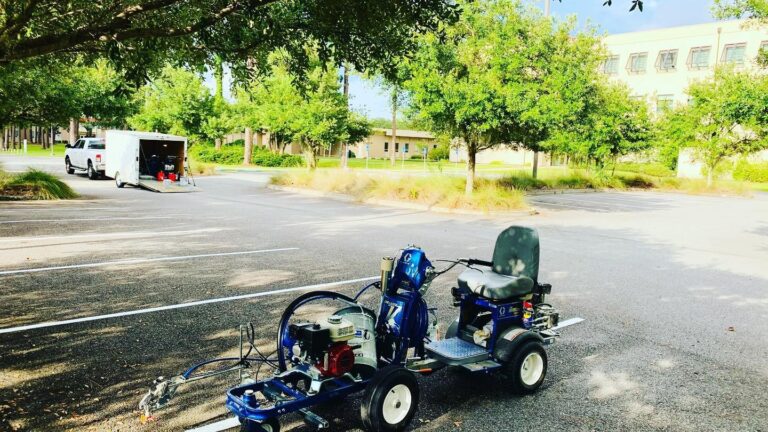
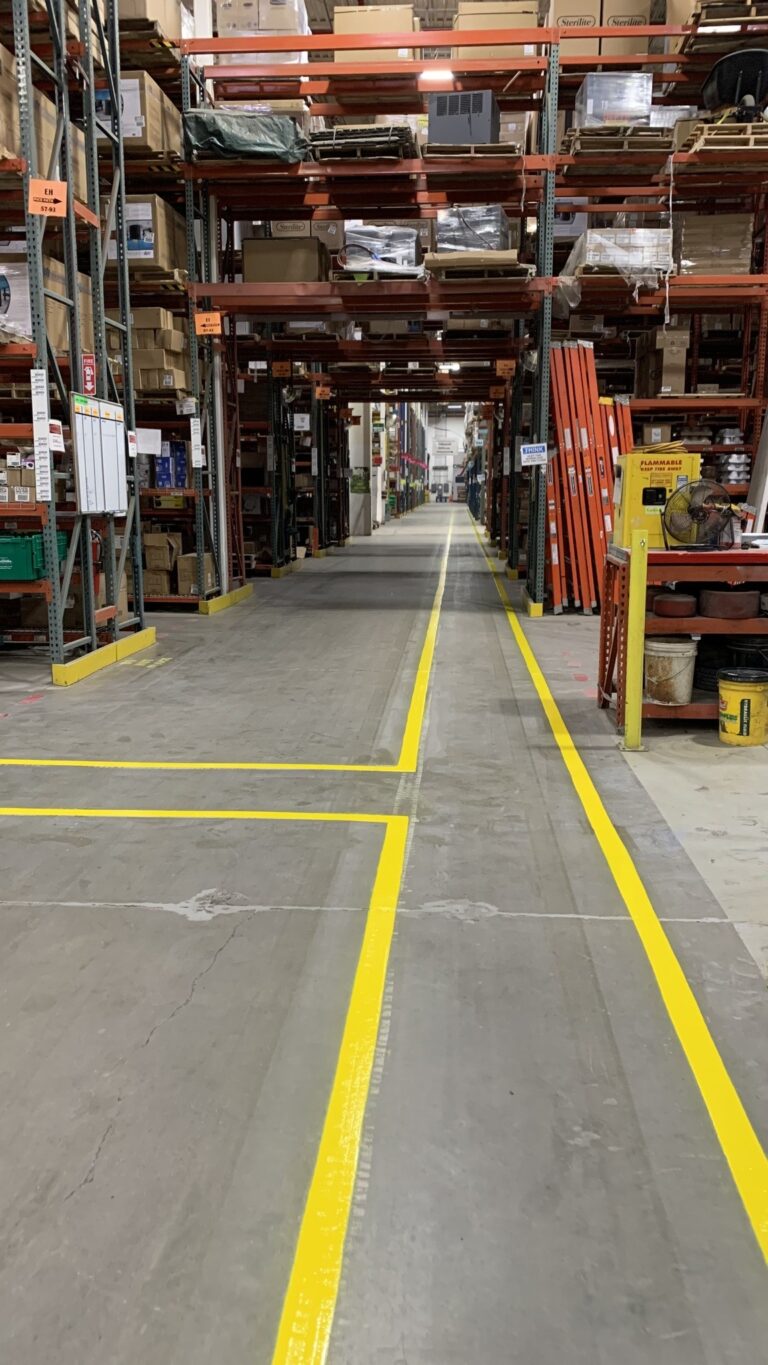
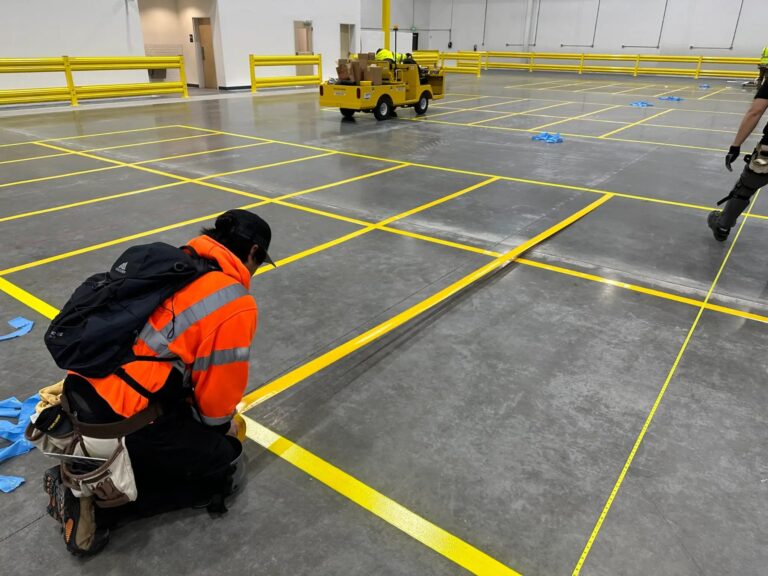
Warehouselines has completed over 10,000 floor marking projects in distribution centers and industrial facilities across the country. Their OSHA-compliant epoxy coatings last 3 to 7 years, which means the traffic lanes, safety zones, and workflow paths you design today will stay visible and intact through years of heavy forklift traffic. If your redesign involves new dock flow configurations, updated pedestrian corridors, or reconfigured pick zones, precise warehouse floor striping translates those design decisions into daily operational reality.
Warehouselines serves facilities across major logistics corridors, including distribution centers in Texas, Ohio, Florida, and the Southeast. Their team works around your operating schedule to minimize disruption during installation. To see the full list of service locations nationwide, visit their site and connect with a specialist who understands the specific demands of post-redesign floor marking.
FAQ
What are the most common signs a distribution center needs redesign?
The clearest signs include stalled throughput despite stable labor, overflow storage becoming routine, and informal workarounds that new employees are trained into as standard practice. Physical layout limitations that force service compromises are the most reliable structural indicator.
How does poor layout affect distribution center costs?
Broken layouts can waste up to 40% of usable capacity and drive labor costs per order 20 to 30% higher than optimized facilities, making layout redesign one of the highest-return investments in operations.
How often should a distribution network be redesigned?
Network design should be revisited regularly rather than treated as a one-time project, since market shifts, transportation costs, and demand patterns change continuously. Most operations benefit from a formal network assessment every two to three years.
What is the advantage of modular warehouse design?
Modular layouts allow facilities to reconfigure zones, adopt automation, and absorb SKU growth without major shutdowns. This reduces the capital risk and downtime associated with traditional fixed-layout redesign projects.
Why does dock flow matter in a distribution center redesign?
Dock flow constraints directly affect both throughput and safety, since dock-side workflow and layout are interdependent. Redesigning dock areas as part of a broader facility overhaul addresses both operational bottlenecks and incident risk simultaneously.