Warehouse Floor Coating Maintenance Tips for Managers
Warehouse floor coating maintenance is the practice of protecting epoxy and polyurethane floor systems through scheduled cleaning, chemical management, and proactive inspections. The industry term for this discipline is protective coating lifecycle management, and it covers everything from daily dust removal to planned topcoat reapplication. Done right, it extends coating life to 7–12 years and prevents the far more expensive outcome of full floor replacement. Facility managers who treat floor care as a janitorial task miss the bigger picture. It is actually a chemical and liability management function governed by OSHA 29 CFR 1910.22, manufacturer warranty terms, and pH-specific cleaning protocols.
1. Warehouse floor coating maintenance tips: how often to clean and inspect
Daily sweeping or dust-mopping in high-traffic zones is the single most protective habit you can build. Grit and abrasive particles act like sandpaper under forklift tires. Every pass grinds them deeper into the coating surface.
Cleaning frequency should match traffic intensity, not a fixed calendar.
- High-traffic zones (loading docks, main aisles, staging areas): sweep daily, wet-mop weekly
- Medium-traffic zones (pick aisles, cross-aisles): sweep three times per week, wet-mop biweekly
- Low-traffic zones (storage bays, perimeter areas): sweep weekly, wet-mop monthly
Weekly wet-scrubbing with a pH-neutral cleaner removes embedded oils and residues that daily sweeping misses. Monthly visual inspections should focus on joint edges, coating bubbles, and any areas showing color change or surface dusting. Schedule a professional assessment annually. That assessment should produce a written report identifying delamination risks, moisture transmission signs, and zones due for topcoat refresh.
OSHA requires warehouse floors to stay clean, dry, and free of hazards at all times. Non-compliance carries penalties starting at $13,000 per instance. That number alone justifies a documented cleaning schedule.
Pro Tip: Request the manufacturer’s approved cleaner compatibility list before purchasing any cleaning product. Using an unapproved product, even once, can void your coating warranty.
2. What cleaning products and equipment protect coatings best?
Neutral-pH cleaners in the pH 6–9 range are the correct choice for epoxy and polyurethane coatings. They lift soil without attacking the resin binder. Products certified by EPA Safer Choice or Green Seal meet both environmental and chemical compatibility standards worth checking against your manufacturer’s approved list.
The wrong products cause permanent damage.
- Avoid: alkaline cleaners above pH 11, solvent-based degreasers, and abrasive powder cleansers
- Avoid: steel-bristle brooms and black or red scrubbing pads on coated surfaces
- Use: microfiber dust mops for daily sweeping
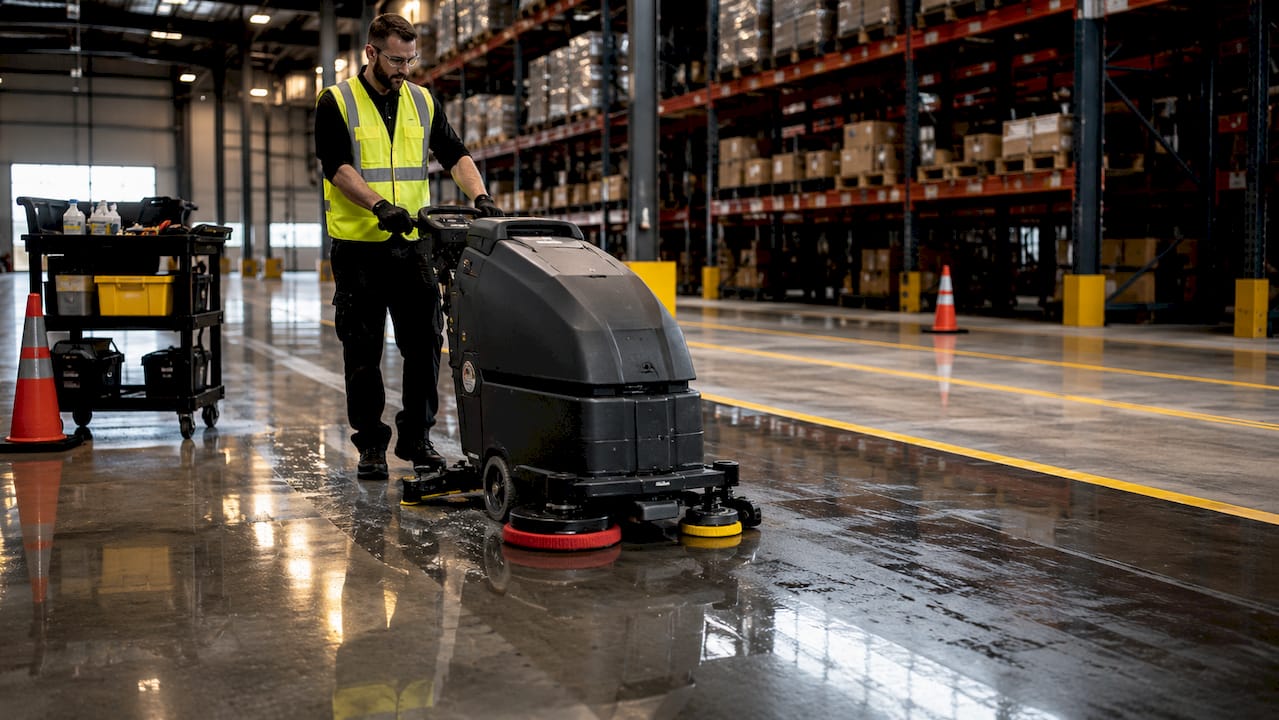
- Use: auto scrubbers fitted with white or tan floor pads for wet cleaning
Alkaline cleaners and abrasive powders create micro-scratches and cause the coating to swell, which voids warranties. That is not a theoretical risk. Manufacturers inspect failed coatings and can identify chemical damage under magnification.
Auto scrubbers are the right tool for large warehouse floors. They apply consistent pressure, recover dirty water, and reduce the labor time of manual mopping by a significant margin. Tennant and Nilfisk both manufacture industrial-grade scrubbers widely used in distribution centers.
Pro Tip: Match your scrubber pad color to the soil type. White pads work for light daily maintenance. Tan pads handle moderate soiling. Never use red or black pads on coated floors, regardless of soil level.
3. How to respond to spills and chemical leaks on coated floors
Speed is the defining factor in spill response. OSHA requires spill cleanup within 30 minutes to prevent coating degradation and slip hazards. Every minute beyond that window increases the risk of chemical penetration into the coating layer.
Follow these steps for every spill event:
- Contain immediately. Place absorbent pads or dry sand around the spill perimeter to stop spreading.
- Absorb the bulk. Use granular absorbent or oil-dry compound for petroleum-based fluids. Do not push the spill with a squeegee.
- Clean the residue. Apply a manufacturer-approved neutral-pH cleaner to the affected area. Scrub with a tan pad and recover with a wet-dry vacuum.
- Inspect the coating. Check for discoloration, softening, or lifting at the spill site. Document what you find.
- Log the incident. Record the substance, volume, response time, and any coating changes observed. This log supports warranty claims and OSHA compliance records.
Hydraulic oil, battery acid, and industrial solvents are the highest-risk substances in most warehouses. Battery acid from forklift charging stations is particularly aggressive. Place spill stations with absorbent pads and dry sand within 20 feet of every charging area and loading dock. That placement cuts response time and removes the excuse of not having supplies nearby.
4. What role do forklift and traffic patterns play in coating wear?
Worn or damaged forklift wheels cause two distinct types of coating damage: abrasive surface wear from flat spots and point-load stress from hard wheel edges. Both accelerate coating failure faster than chemical exposure in most facilities.
Forklift wheel condition belongs in your floor protection program, not just your equipment maintenance log.
- Inspect forklift wheels monthly for flat spots, chunking, and hardness changes
- Replace polyurethane wheels before they develop flat spots larger than one inch
- Rotate forklift routes quarterly to distribute wear across the full floor surface
- Install rubber or polyurethane wheel mats at fixed stopping points like charging stations and dock doors
- Use aisle markings and forklift routing to enforce traffic patterns that spread load evenly
Concentrated traffic zones wear through topcoats two to three times faster than distributed traffic zones. Loading docks and main cross-aisles are the first areas to show failure. Plan topcoat refreshes for those zones on a shorter cycle than the rest of the floor.
Forklift operator training is an underused floor protection tool. Operators who understand that sharp turns at speed damage coatings will change their behavior when given a clear reason. A 15-minute briefing tied to your floor maintenance program costs nothing and reduces wear visibly over a quarter.
5. How to budget and plan your floor coating maintenance lifecycle
Lifecycle planning treats floor maintenance as a predictable operating cost, not an emergency line item. Budgeting for topcoat reapplication every 2–7 years depending on traffic volume costs far less than emergency full-floor replacement. The math is straightforward once you map your traffic zones and assign wear rates to each.
| Maintenance Activity | Frequency | Cost Profile |
|---|---|---|
| Daily sweeping and dust-mopping | Daily | Low, in-house labor |
| Wet scrubbing with neutral cleaner | Weekly | Low, equipment and supplies |
| Visual inspection and documentation | Monthly | Low, in-house time |
| Professional floor assessment | Annually | Moderate, third-party fee |
| Topcoat refresh (high-traffic zones) | Every 2–4 years | Moderate, planned capital |
| Full topcoat reapplication | Every 5–7 years | Higher, planned capital |
Lifecycle planning spreads these costs across a 10-year budget horizon, making each line item manageable. Facilities that skip annual inspections typically face unplanned full replacements at three to four times the cost of proactive recoating.
Joint deterioration is a specific cost trap. Failing expansion joints allow moisture and debris to undercut the coating edge, causing delamination that spreads inward. Addressing joint sealant annually costs a fraction of the repair bill once delamination takes hold.
Moisture transmission through the concrete slab is the most common cause of coating failure that no amount of surface cleaning prevents. If your annual inspection reveals vapor emission above the coating manufacturer’s limit, budget for a moisture mitigation primer before the next topcoat application. Skipping that step guarantees delamination within one to two years.
When bidding maintenance contracts, require vendors to provide a written scope that specifies cleaner pH ranges, pad types, and inspection documentation formats. Vague contracts produce inconsistent results and give you no recourse when work falls short.
Key takeaways
Consistent cleaning, strict chemical controls, and scheduled topcoat refreshes are the three practices that determine whether a warehouse floor coating lasts 3 years or 12.
| Point | Details |
|---|---|
| Clean by traffic zone | High-traffic areas need daily sweeping and weekly wet-scrubbing to prevent grit damage. |
| Use pH-neutral cleaners only | Cleaners above pH 11 void warranties and cause micro-scratches in epoxy coatings. |
| Respond to spills within 30 minutes | OSHA requires fast spill cleanup; battery acid and hydraulic oil are the highest-risk substances. |
| Inspect forklift wheels monthly | Worn wheels cause point-load damage that accelerates coating failure in concentrated traffic zones. |
| Plan topcoat refreshes proactively | Budgeting for recoating every 2–7 years costs far less than emergency full-floor replacement. |
What I’ve learned from watching facilities get floor maintenance wrong
Most facility managers I’ve worked with treat their epoxy floors the way they treat their parking lots: clean when visibly dirty, fix when visibly broken. That approach works fine for asphalt. It destroys epoxy coatings.
The facilities with the best floor performance share one habit. They treat their floor care addendum as a compliance document, not a suggestion sheet. They know which cleaners are approved, which pad colors are permitted, and who is responsible for monthly inspections. That level of specificity sounds excessive until you see a warranty claim denied because a cleaning crew used the wrong degreaser twice.
The other thing I’ve seen consistently is that forklift maintenance and floor maintenance are managed by completely separate teams with no shared accountability. The equipment team replaces wheels when forklifts perform poorly. The facilities team patches floors when they look bad. Nobody connects the two. Facilities that assign a single point of accountability for both see measurably longer coating life.
My honest recommendation: build your maintenance program around your manufacturer’s care specifications, not generic best practices. Generic advice gets you to average outcomes. Manufacturer-specific protocols, combined with OSHA-compliant floor markings that guide traffic away from vulnerable zones, get you to the upper end of the coating’s rated lifespan.
— ET
How Warehouse Line Striping supports your floor maintenance program
Floor markings and floor coatings are not separate systems. They work together. Worn or missing markings push traffic into unintended zones, concentrating wear on coating areas that were never designed for that load.
Warehouse Line Striping has completed over 10,000 projects across warehouses, distribution centers, and industrial facilities nationwide. Their floor marking systems use industrial-grade epoxy materials that bond to coated surfaces without compromising the underlying coating warranty. OSHA-compliant layouts protect both workers and your floor investment by directing traffic where the coating is built to handle it. Facility managers can reach Warehouse Line Striping’s team 24/7 to discuss maintenance-aligned marking programs for their specific facility layout.
FAQ
How often should warehouse floors be professionally inspected?
Annual professional inspections are the industry standard. They target joint edges, surface dusting, forklift vibration damage, and moisture transmission signs that routine cleaning does not reveal.
What pH level is safe for cleaning epoxy warehouse floors?
Cleaners in the pH 6–9 range are safe for epoxy coatings. Alkaline cleaners above pH 11 cause micro-scratches and coating swelling, which voids manufacturer warranties.
How long does a warehouse floor coating last with proper maintenance?
Proactive maintenance including scheduled topcoat refreshes extends coating life to 7–12 years. Without consistent care, the same coating may fail in three to four years.
What causes warehouse floor coatings to delaminate?
Moisture transmission through the concrete slab is the most common cause of delamination. Skipping moisture mitigation primers when vapor emission exceeds the manufacturer’s limit guarantees coating failure.
Does forklift wheel condition affect floor coating life?
Yes. Worn forklift wheels create flat spots and hard edges that grind through topcoats and cause point-load stress damage. Monthly wheel inspections are a direct floor protection measure.