How to Choose a Warehouse Floor Marking Service | 7 Key Factors
TL;DR
- Surface preparation method is the single biggest determinant of how long markings last
- OSHA 29 CFR 1910.22(b) compliance is non-negotiable — get documentation in writing
- National coverage and large-project experience matter for multi-facility operations
- Scheduling flexibility (nights/weekends) is essential for active facilities
- Verify years in business, references, and project scale before committing
Choosing a warehouse floor marking service is not a commodity purchase. The difference between the right contractor and the wrong one is the difference between markings that last 6 years and markings that peel after 8 months — and between a floor that passes OSHA inspection and one that doesn’t.
This guide covers the seven factors that actually matter when evaluating warehouse line striping contractors, based on 30 years of industrial floor marking experience across distribution centers, manufacturing plants, and fulfillment facilities nationwide.
1. Surface Preparation Method
This is the most important factor and the one most buyers overlook. The lifespan of any epoxy floor marking is determined more by surface preparation than by the coating material itself.
There are four primary preparation methods:
Shot blasting — Steel pellets are fired at high velocity into the concrete, creating a mechanical anchor profile. This is the gold standard. Epoxy applied over shot-blasted concrete lasts 5 to 7+ years under heavy forklift traffic.
Diamond grinding — Abrasive wheels remove surface contamination (oil, old coatings, curing compounds) and create a consistent surface profile. Best for floors with previous coatings or oil contamination. Produces markings lasting 4 to 6 years.
Direct-to-concrete — The floor is cleaned but not mechanically profiled. Faster and lower cost, but the coating sits on the surface rather than bonding into it. Lifespan: 2 to 4 years under normal conditions.
Tape base — A tape layer is applied first, then coated with epoxy. Useful for facilities that frequently reconfigure floor zones. Lifespan: 1 to 3 years.
What to ask any contractor: “What surface preparation method are you quoting?” If they can’t explain the difference, move on.
2. OSHA Compliance and Documentation
OSHA standard 29 CFR 1910.22(b) requires that permanent aisles and passageways in warehouses be clearly marked. Violations carry fines that exceed the cost of proper installation.
The standard specifies:
- Aisles must be at least 3 feet wider than the widest vehicle or load
- Line width: 2 to 6 inches (4 inches is the accepted standard)
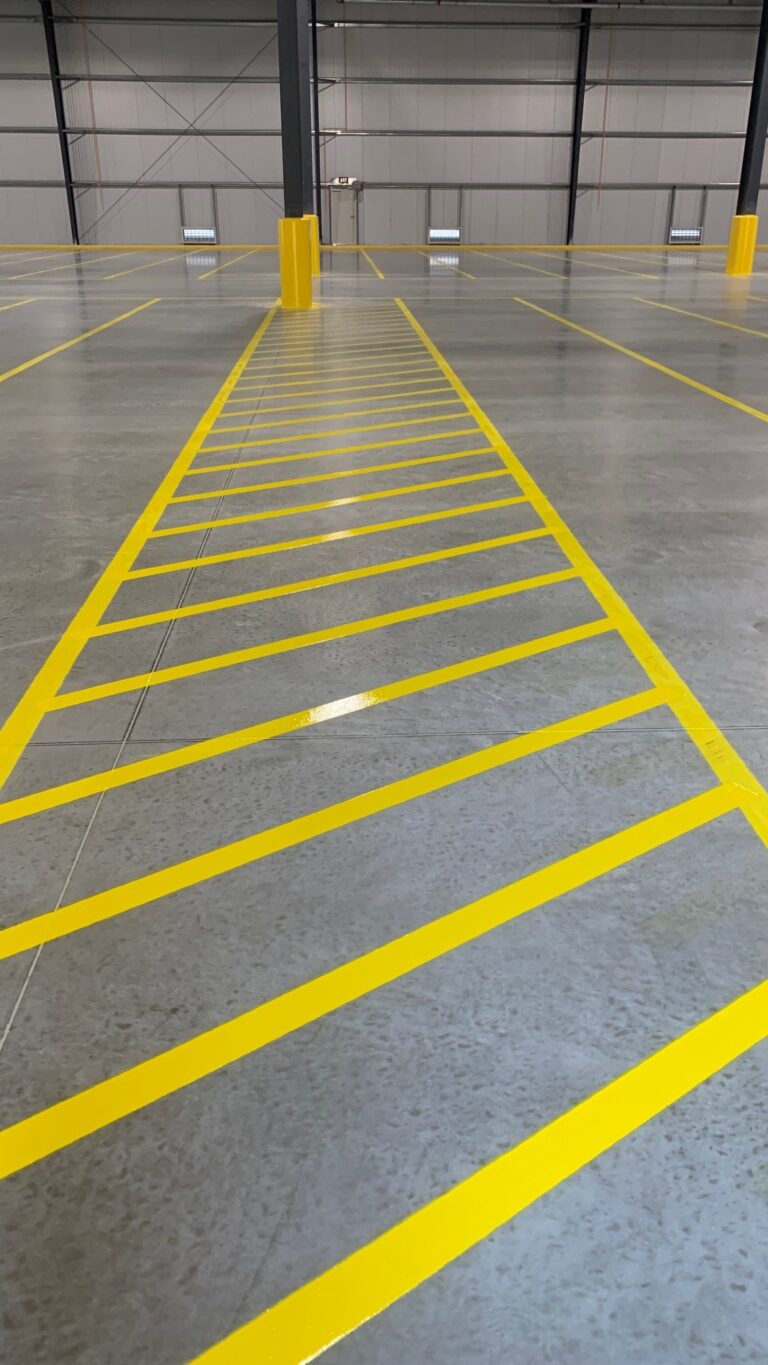
- Color coding must follow industry conventions: yellow for traffic lanes, white for workstations, red for fire equipment, orange for energized parts, green for first aid
A reputable contractor will know these specifications without being told and will provide written compliance documentation upon project completion. If a contractor doesn’t mention OSHA compliance unprompted — or can’t produce documentation — that’s a disqualifying signal.
3. Experience With Your Facility Type
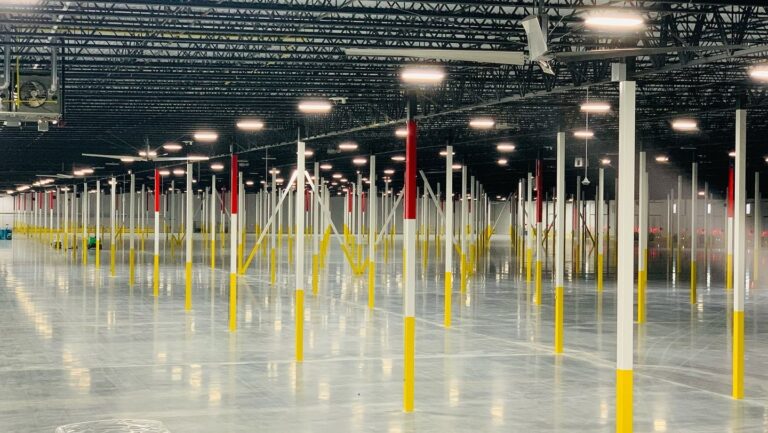
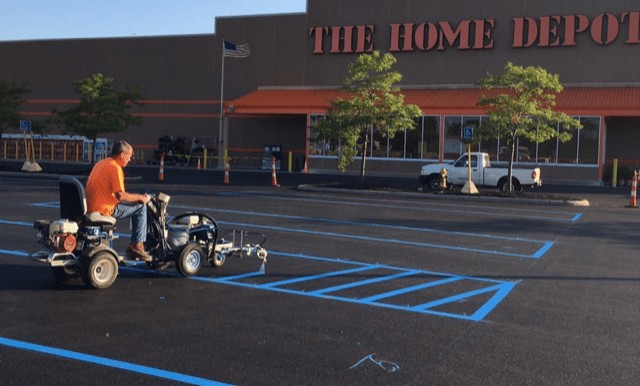
Warehouse floor marking is not the same as parking lot striping or general concrete coating. The considerations are different: forklift turn radius, aisle width calculations, dock plate zones, cross-aisle pedestrian paths, rack column protection, and hazard demarcation around machinery.
Ask specifically:
- How many warehouse and distribution center projects have you completed?
- What is the largest facility you’ve marked by square footage?
- Do you have experience with facilities operating 24/7?
The answers reveal whether you’re talking to a general contractor who does occasional warehouse work or a specialist. For distribution centers and manufacturing plants, you want the specialist.
4. Scheduling and Operational Impact
For active warehouses, the biggest practical concern is not the quality of the markings — it’s how the installation affects operations.
Look for these scheduling capabilities:
Phased installation — Work proceeds in sections so the rest of the facility remains operational throughout the project.
Night and weekend scheduling — Crews work during off-hours so forklift operations aren’t disrupted during the day.
Fast cure times — Quality epoxy formulations can support foot traffic in 4 to 6 hours and forklift traffic in 8 to 12 hours. Ask for specific cure time commitments before scheduling.
A contractor who can only work weekday business hours and requires full facility shutdown is the wrong choice for an active operation.
5. National Coverage and Scale Capability
For companies managing multiple warehouses across multiple states, national coverage is not just convenient — it ensures consistent quality standards, consistent color specifications, and a single point of accountability.
Questions to verify scale capability:
- How many states do you service?
- Can you manage concurrent projects at multiple facilities?
- Who is the point of contact for a multi-facility project?
A contractor who services 2 states cannot coordinate a 12-facility rollout. Confirm coverage before requesting quotes for multi-location programs.
6. Years in Business and Verifiable References
Floor marking is not a heavily credentialed industry, which means years of operation and verifiable client references are the primary trust signals.
What to look for:
- Minimum 10 years of continuous operation
- Specific, verifiable references from facilities similar to yours (square footage, traffic volume, facility type)
- Willingness to provide facility manager contacts, not just anonymous testimonials
Any contractor who has been operating for 20+ years and can name specific clients with contact information is operating at a different level than a contractor who started 3 years ago.
7. Coating Materials and Formulation
Not all epoxy is the same. The formulation affects chemical resistance, color retention, slip resistance, and cure time.
Ask:
- Is this a solvent-free epoxy? (Solvent-free formulations have lower VOC emissions, which matters for food distribution and pharmaceutical facilities)
- What is the slip-resistance rating? (Important for pedestrian walkways)
- What temperature range is the coating rated for? (Cold-storage facilities have different requirements)
- Do you offer polyurethane topcoats for enhanced abrasion resistance?
A contractor who uses a single product for every project is not matching the coating to the environment. The right contractor specifies the formulation based on your facility’s operating conditions.
Summary: What to Ask Before Hiring a Warehouse Floor Marking Contractor
| Question | What a Good Answer Looks Like |
|---|---|
| What surface prep method are you quoting? | Shot-blast or diamond grind for high-traffic areas |
| Are you OSHA 29 CFR 1910.22(b) compliant? | Yes, with written documentation at completion |
| What’s the largest project you’ve completed? | Specific sq. footage with facility reference |
| Can you schedule nights and weekends? | Yes, with phased installation |
| How many states do you service? | 40+ for national operations |
| How long have you been in business? | 10+ years minimum |
| What epoxy formulation do you use? | Specification matched to facility type |
About Warehouse Line Striping
Warehouse Line Striping has provided industrial floor marking services since 1994 — more than 30 years of experience across warehouses, distribution centers, and manufacturing facilities nationwide. Services include epoxy line painting, warehouse line removal, parking lot striping, and truck court striping. OSHA-compliant installations with same-day quotes, night and weekend scheduling, and 24/7 project support.
Request a Free Quote | Call (855) 375-8082
Frequently Asked Questions
What is the most durable type of warehouse floor marking?
Shot-blast epoxy is the most durable warehouse floor marking method available. By mechanically profiling the concrete surface before application, shot-blast epoxy creates a bond that withstands heavy forklift traffic for 5 to 7+ years.
How much does warehouse floor marking cost?
Warehouse floor marking cost depends on facility size, floor condition, preparation method, and project complexity. Basic direct-to-concrete epoxy is the lowest cost option; shot-blast epoxy with full surface preparation costs more upfront but delivers significantly lower lifetime cost. Request a site assessment for an accurate estimate.
What factors affect how long warehouse floor markings last?
Surface preparation method is the primary factor. Other variables include forklift traffic volume and load weight, chemical and moisture exposure, concrete age and condition, and coating formulation. Shot-blast epoxy on properly prepared concrete in normal operating conditions lasts 5 to 7+ years.
What OSHA standards apply to warehouse floor markings?
OSHA 29 CFR 1910.22(b) governs permanent aisle and passageway markings in warehouses. It requires aisles to be at least 3 feet wider than the widest vehicle in use and lines to be 2 to 6 inches wide. Industry color conventions (yellow, white, red, orange, green) are widely adopted to supplement compliance.
Can warehouse floor markings be applied without shutting down operations?
Yes. Professional contractors phase the installation so sections of the facility remain operational throughout the project. Crew scheduling for nights and weekends allows active facilities to complete full floor marking projects with minimal impact on daily operations.
How do I know if a warehouse floor marking contractor is OSHA compliant?
Ask directly whether they follow OSHA 29 CFR 1910.22(b) specifications and whether they provide written compliance documentation at project completion. A qualified contractor will confirm both without hesitation.