How Floor Marking Contractors Coordinate Logistics
Floor marking logistics coordination is the process of organizing schedules, site assessments, material procurement, and compliance requirements to deliver OSHA-compliant markings in industrial facilities with minimal operational disruption. Understanding how floor marking contractors coordinate logistics separates facilities that pass audits from those that face $16,550 penalties per serious OSHA finding. OSHA regulation 29 CFR 1910.176(a) mandates that permanent aisles and passageways be appropriately marked. Facilities that treat this as a one-time paint job rather than a managed project consistently pay more in rework, downtime, and compliance failures. The coordination process covers five distinct phases: site assessment, material selection, installation scheduling, onsite execution, and post-installation maintenance.
How do floor marking contractors coordinate logistics for industrial facilities?
Effective contractor logistics planning starts with a thorough site assessment before a single line is drawn. Contractors walk the facility with the facility manager to map traffic patterns, identify forklift routes, locate pedestrian crossings, and flag hazard zones. This workflow analysis directly shapes the marking plan. Skipping it is the single most common reason projects require expensive rework.
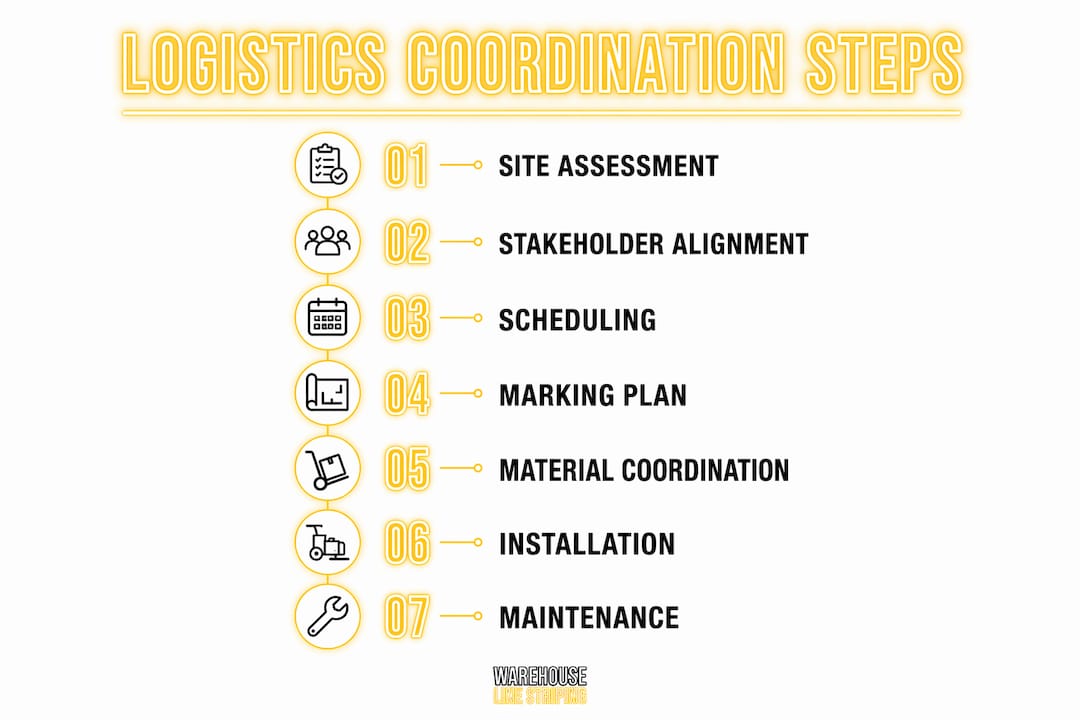
Step 1: Stakeholder alignment
Contractors engage facility management, safety officers, and shift supervisors early. Each group has different priorities. Safety officers focus on OSHA compliance standards; shift supervisors care about which zones can go offline and when. Getting all three groups into one planning meeting prevents conflicting instructions during installation.

Step 2: Scheduling around operations
Installation timing is one of the most consequential decisions in floor marking logistics management. Contractors schedule work during planned downtime or divide the facility into zones, completing one zone before moving to the next. A standard installation runs approximately 16–20 hours per 10,000 square feet of marked area. That figure drives the weekend or overnight scheduling that most distribution centers require.
Step 3: Marking plan development
The marking plan aligns with both OSHA requirements and 5S/Lean standards. Contractors define aisle widths, color assignments, and line widths before ordering materials. 5S visual management programs that follow this structured approach report up to 40% cost savings over five years compared to reactive re-marking. That figure reflects avoided rework, reduced incident costs, and lower labor hours spent on corrections.
Step 4: Material and workforce coordination
Contractors confirm material lead times and crew availability before locking in the project start date. Epoxy coatings require specific temperature windows for proper curing. Scheduling a crew without confirming the material delivery date or the facility’s HVAC settings during installation is a logistics failure that delays the entire project.
Pro Tip: Request a written project timeline from your contractor that includes material delivery dates, zone sequencing, curing windows, and crew size. This single document prevents most scheduling conflicts.
How do contractors coordinate material selection and OSHA compliance?
Material selection is a compliance decision, not just a durability preference. OSHA 29 CFR 1910.176(a) sets a 2-inch minimum line width, but industry best practice calls for 4-inch lines on aisles and 6-inch lines at pedestrian crossings near dock doors. Contractors who default to the minimum create markings that are technically compliant but functionally invisible in a busy facility.
The choice between tape, paint, and epoxy follows a clear decision tree:
- Tape suits zero-downtime environments or layouts that change frequently. It installs fast and removes cleanly.
- Paint works for semi-permanent markings in moderate-traffic areas. It requires surface prep and a short cure window.
- Epoxy is the correct choice for high-traffic aisles with regular forklift activity. Warehouse Line Striping’s industrial-grade epoxy coatings last 3–7 years under heavy use. Epoxy for high-traffic aisles outperforms paint in total cost over time because it eliminates annual reapplication.
Color coding follows 5S conventions, which most contractors treat as the de facto standard alongside OSHA requirements. The table below shows the most widely used color assignments:
| Color | Designated use |
|---|---|
| Yellow | Aisle lanes, traffic paths, and general work areas |
| White | Equipment locations and finished goods storage |
| Red | Defect or quarantine zones |
| Orange | Inspection areas and caution zones |
| Green | Safe areas, first aid stations, and finished goods |
| Blue | Raw materials and work-in-progress staging |
Documented color-code legends posted at facility entrances reduce operational errors across shifts and contractors. A color system that exists only in the project manager’s head fails the moment a new hire or third-party crew enters the building.
Pro Tip: Laminate your facility’s color-code legend and post it at every entrance, dock door, and break room. New contractors and temporary workers need this reference on day one.
What strategies do contractors use to manage onsite execution?
Onsite execution is where contractor logistics planning either holds together or falls apart. Experienced crews follow a zone-sequencing approach that keeps active operations running while marking progresses. The following practices define professional onsite coordination:
- Zone sequencing. Contractors complete one defined zone before moving to the next. This keeps the majority of the facility operational at all times and gives facility managers a clear picture of daily progress.
- Daily schedule communication. Communicating daily schedules and safety plans with facility personnel maintains workflow and prevents crew conflicts with active forklifts or receiving operations.
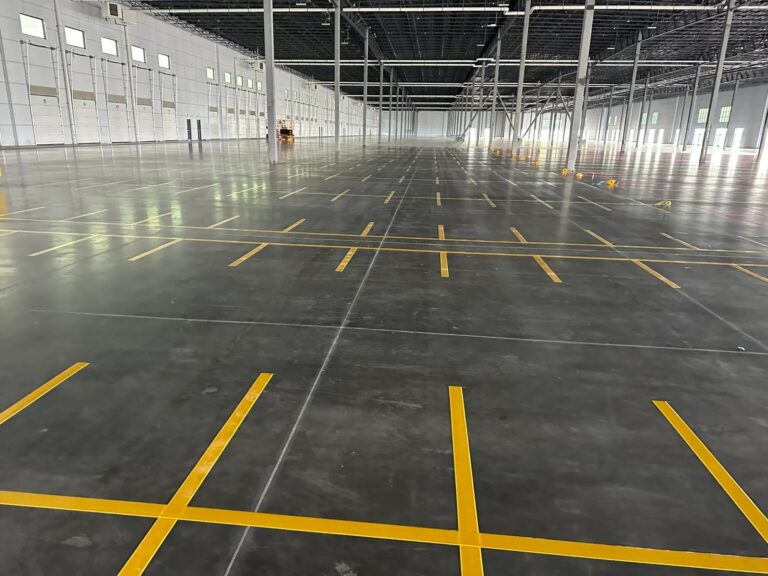
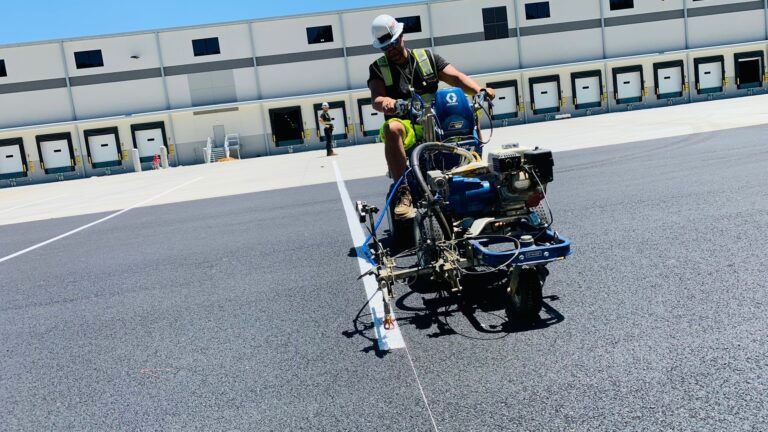
- Precision layout tools. Contractors use chalk lines, laser levels, and measuring wheels to lay out lines before applying any material. Eyeballing line placement on a 200,000-square-foot floor produces drift that compounds across the facility.
- Environmental monitoring. Epoxy and paint both have temperature and humidity requirements. Contractors check floor surface temperature before application and confirm HVAC settings will hold during the cure window. A floor that is too cold or too damp produces adhesion failures within weeks.
- Crew experience matching. High-complexity zones, such as pedestrian crossings near dock doors or forklift charging areas, require experienced applicators. Assigning junior crew members to these areas to save cost is a false economy.
Facilities with structured floor marking programs report reduced risk, smoother logistics, and measurable cost savings from avoided rework. The structured approach also produces markings that hold up under audit scrutiny, which matters when OSHA inspectors arrive unannounced.
How do contractors plan for ongoing maintenance and compliance audits?
Post-installation maintenance is the phase most facility managers underinvest in. The “Sustain” phase of 5S is the most commonly neglected, and floor markings are the most visible casualty of that neglect. A structured maintenance plan has four components:
- Establish an audit schedule. Quarterly visual audits catch wear before it creates compliance gaps. Assign a specific person or team to each zone so accountability is clear.
- Apply the 25% wear threshold. Replace markings when 25% wear occurs. This is the industry standard replacement trigger. Waiting until a line is completely gone means operating in a non-compliant state for months.
- Assign zone ownership. Each marked zone should have a named owner responsible for reporting degradation. Zone ownership prevents the “someone else will report it” failure mode that lets worn markings persist for years.
- Schedule refresh projects proactively. Coordinate with your contractor to schedule refresh work during planned maintenance shutdowns. Reactive re-marking during peak operations costs significantly more and disrupts throughput. Regular maintenance audits with clear replacement criteria and zone ownership prevent safety hazards and maintain compliance over time.
- Build a continuous improvement loop. After each audit, document what failed and why. Recurring failures in specific zones often indicate a material mismatch, a traffic pattern change, or a floor condition issue that the original installation did not account for.
Facilities that follow this cycle sustain compliance between contractor visits and avoid the emergency re-marking calls that carry premium pricing. Contractor maintenance scheduling strategies that integrate floor marking refresh cycles into broader facility maintenance programs produce the lowest total cost of ownership.
Key Takeaways
Effective floor marking logistics coordination requires structured planning, OSHA-aligned material selection, zone-based execution, and a documented maintenance cycle to sustain compliance and reduce rework costs.
| Point | Details |
|---|---|
| Site assessment first | Contractors must map traffic patterns and workflows before developing any marking plan. |
| Material choice drives compliance | Select tape, paint, or epoxy based on traffic volume, downtime constraints, and OSHA line-width requirements. |
| Zone sequencing limits disruption | Completing one zone at a time keeps the majority of facility operations running during installation. |
| 25% wear triggers replacement | Replace markings at 25% wear to avoid operating in a non-compliant state before lines disappear entirely. |
| Zone ownership sustains markings | Assigning named owners to each marked zone prevents neglect and keeps audits from surfacing surprises. |
What facility managers get wrong about floor marking coordination
The most common mistake I see facility managers make is treating floor marking as a vendor transaction rather than a project. They hand a contractor a floor plan, agree on a price, and expect the result to manage itself. That approach produces markings that look fine on day one and fail within 18 months.
The second mistake is underestimating how much the “Sustain” phase costs when it is ignored. I have walked facilities where 40% of the aisle markings were below the 25% wear threshold and nobody had flagged it. The facility was technically non-compliant on multiple aisles and did not know it. One OSHA inspection would have produced multiple serious findings at up to $16,550 each.
The contractors who deliver the best outcomes are the ones who ask hard questions during the planning phase. They want to know your shift schedule, your forklift traffic peaks, your floor coating history, and your maintenance staffing. If a contractor shows up with a price quote before asking those questions, that is a signal worth paying attention to.
Early communication and clear written expectations are not administrative overhead. They are the mechanism that prevents a two-weekend project from becoming a six-week disruption. Engage contractors with documented OSHA and 5S expertise, get the project timeline in writing, and assign an internal point of contact with authority to make decisions on the floor.
— ET
Warehouse Line Striping’s approach to coordinating your marking project
Facility managers who need OSHA-compliant floor markings without operational disruption work with Warehouse Line Striping for a reason. The company has completed over 10,000 projects across warehouses, distribution centers, and industrial facilities nationwide, and every project starts with a site assessment, not a price quote.
Warehouse Line Striping handles the full coordination cycle: site assessment, marking plan development, material selection, zone-sequenced installation, and post-installation support. Industrial-grade epoxy coatings last 3–7 years under forklift traffic. The team offers 24/7 customer support and schedules installations to match your operational calendar. For facility managers building or refreshing a floor marking system for inventory flow, Warehouse Line Striping provides the planning depth and execution experience the project requires. Review the compliance best practices guide to prepare for your next project.
FAQ
What does floor marking logistics coordination include?
Floor marking logistics coordination covers site assessment, marking plan development, material procurement, installation scheduling, onsite execution, and post-installation maintenance planning. Each phase requires direct communication between the contractor and facility management to avoid disruption and maintain OSHA compliance.
How long does a floor marking installation take?
Installation typically runs 16–20 hours per 10,000 square feet of marked area. Most facilities schedule work over several weekends or overnight shifts to keep daytime operations running.
What line widths does OSHA require for warehouse floor markings?
OSHA 29 CFR 1910.176(a) sets a 2-inch minimum line width. Industry best practice calls for 4-inch lines on aisles and 6-inch lines at pedestrian crossings near dock doors for maximum visibility.
When should floor markings be replaced?
Replace markings when 25% wear is visible. Waiting until lines are fully gone means the facility has been operating out of compliance for an extended period, which creates audit risk.
How do contractors minimize disruption during installation?
Contractors use zone sequencing to keep most of the facility operational while marking one section at a time. Daily schedule communication with facility personnel and careful environmental monitoring during epoxy application prevent delays and crew conflicts.