How Floor Markings Support SKU Organization in Warehouses
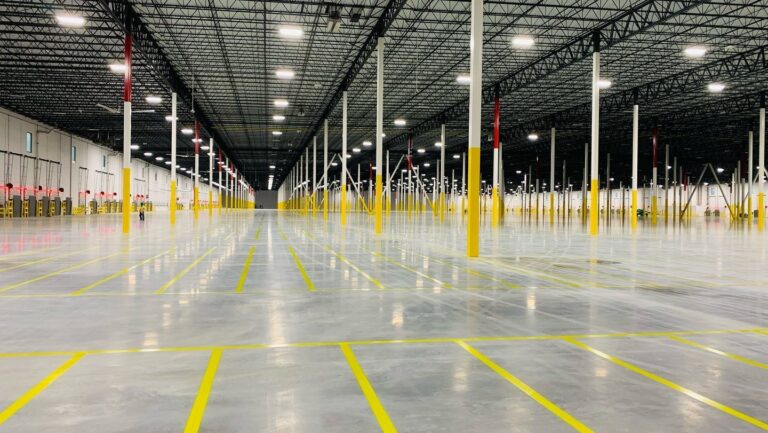
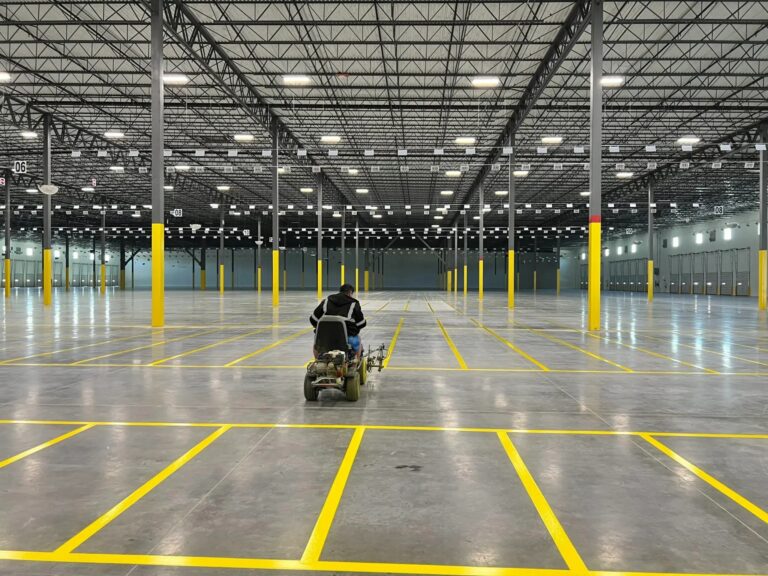
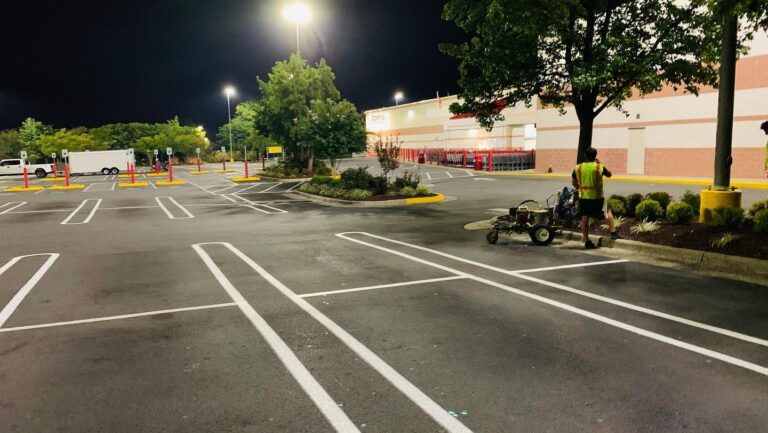
Floor markings are visual management tools painted or taped onto warehouse floors to designate specific storage locations, define traffic lanes, and reinforce SKU organization across every shift. The industry term for this practice is visual floor management, and it sits at the core of both OSHA 1910.176(a) compliance and the 5S methodology. When applied correctly, floor markings tell every worker exactly where each SKU lives without a supervisor present. Warehouse Line Striping has completed over 10,000 projects applying this principle across distribution centers and industrial facilities nationwide. Understanding how floor markings support SKU organization is the first step toward a self-managing warehouse floor.
How floor markings support SKU organization through zoning
Floor markings create physical boundaries that group SKUs by velocity, category, or storage requirement. Without those boundaries, workers default to informal habits, and inventory drifts into the wrong locations within weeks.
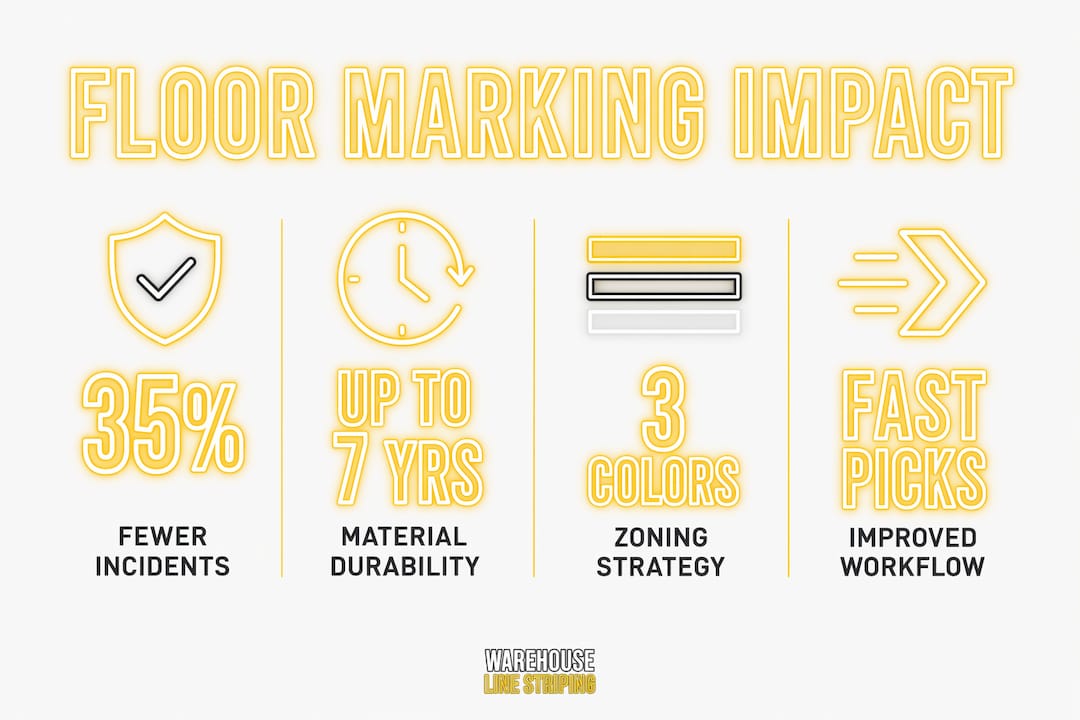
The most effective SKU zoning strategies use color coding to separate product families. Yellow typically marks traffic lanes, white outlines storage positions, and red flags hazardous or quarantine areas. Color coding and marking standards improve SKU identification and storage accuracy when a posted legend reinforces uniform interpretation across all shifts. The legend is not optional. Without it, color choices mean different things to different workers.

Velocity-based placement is the highest-impact zoning decision you can make. Fast-moving SKUs placed near packing areas with clearly marked floor zones reduce retrieval time and lower labor costs measurably. A floor outline around a pallet position for your top 20% of SKUs does more for throughput than any software dashboard.
The 5S methodology adds another layer through shadowing. Shadow outlines for movable equipment like pallet jacks and bins let workers instantly spot what is missing or misplaced. That same principle applies to SKU handling equipment stored at each zone.
Key elements of an effective SKU zoning system:
- Color legend posted at every entry point so all workers read zones the same way
- Floor outlines for each SKU position within a zone, not just the zone boundary
- Dedicated zones for bulk, climate-sensitive, and high-velocity SKUs marked with distinct colors
- Shadow outlines for bins and carts assigned to specific SKU families
- Clear aisle boundaries separating pick paths from storage zones
Pro Tip: Consistency matters more than color choice. A facility that uses three colors applied uniformly outperforms one that uses eight colors inconsistently. Pick your system, post the legend, and enforce it.
How do floor markings integrate with WMS and SKU labeling?
A warehouse management system (WMS) assigns each SKU a location code, typically in a bay-shelf-bin format. Floor markings make those digital codes physical. When the floor zone for Bay 12 is outlined and labeled, workers can scan barcodes and confirm locations without cross-referencing a screen.
Integrating floor markings with SKU location mapping and WMS enhances inventory accuracy and picking efficiency. The floor becomes a physical index of the digital system. Wave picking and cycle counts run faster when workers navigate by visual zones rather than relying entirely on handheld devices.
The practical benefits of WMS-aligned floor marking include:
- Reduced picking errors because physical zones match digital location codes exactly
- Faster cycle counts since counters can verify zones visually before scanning
- Cleaner receiving workflows when inbound SKUs have a marked floor position waiting
- Easier onboarding for new workers who learn the floor layout before mastering the WMS
Pro Tip: Update floor markings and WMS location codes at the same time. A zone that exists on the floor but not in the system, or vice versa, creates more confusion than having no system at all.
The pick path design matters as much as the zone boundaries. Arrows and directional markings embedded in the floor guide workers through the most efficient sequence, cutting travel time per order.
What floor marking materials work best for high-traffic SKU zones?
Material selection determines whether your floor marking system lasts three months or seven years. The three main options are vinyl tape, floor paint, and epoxy coatings. Each serves a different operational need.
| Material | Durability | Installation time | Best use case |
|---|---|---|---|
| Vinyl tape | 6–18 months | Hours | Changing layouts, low-traffic zones |
| Floor paint | 1–3 years | 1–2 days | Medium-traffic aisles, budget installs |
| Epoxy coating | 3–7 years | 2–4 days | Forklift lanes, permanent SKU zones |
Paint and epoxy markings last longer under heavy forklift traffic but require downtime during installation. Tape is faster to apply and easier to reposition, making it the right choice when SKU layouts change frequently. Epoxy is the right choice when a zone is permanent and forklifts cross it daily.
Surface preparation is the factor most managers underestimate. Improper surface preparation causes most floor marking failures. Industrial diamond grinding removes sealers and debris before epoxy or paint application. Without it, markings peel within months, wasting the investment and creating a compliance gap under OSHA 1910.176(a).
Pro Tip: Never apply epoxy or paint over a sealed or contaminated floor. The marking will look fine for the first few weeks, then lift at the edges under forklift traffic. Diamond grinding adds a day to the project and years to the result.
Warehouse Line Striping uses industrial-grade epoxy coatings rated for 3–7 years and includes professional surface preparation on every project. That preparation step is what separates a marking that holds from one that peels.
How do floor markings reduce errors and improve workflow efficiency?
Warehouses with comprehensive floor marking systems report up to 35% fewer navigation-related incidents and measurable improvements in operational efficiency. That number reflects both safety gains and productivity gains from clearer visual guidance.
Color-coded floor markings outline paths for forklifts and pedestrians, reducing collisions and keeping traffic moving in predictable patterns. When a forklift operator knows exactly where the pedestrian lane ends and the storage zone begins, reaction time is not the only safety barrier.
Floor markings also support FIFO inventory rotation. Marked entry and exit points for each SKU zone enforce the discipline of pulling from the front and stocking from the back without requiring a supervisor to monitor it. The FIFO floor marking approach works because the floor itself communicates the rule.
Best practices for maintaining marking clarity over time:
- Inspect markings monthly and repaint or re-tape any worn sections before they become invisible
- Update zone boundaries immediately when SKU layouts change, not at the next scheduled maintenance cycle
- Use high-contrast colors on floors with heavy dust or debris accumulation
- Train new workers on the floor legend during onboarding, not after their first picking error
Floor marking is described as the “glue” that holds a 5S program together, physically embodying organizational standards and enabling self-management. That framing is accurate. A well-marked floor reduces the number of decisions a worker has to make per shift, and fewer decisions mean fewer errors.
Key Takeaways
Floor markings are the most cost-effective physical tool for enforcing SKU organization, reducing picking errors, and maintaining OSHA compliance across every shift.
| Point | Details |
|---|---|
| Zone SKUs by velocity | Mark fast-moving SKUs near packing areas with dedicated floor outlines to cut retrieval time. |
| Align markings with WMS | Match floor zone labels to WMS location codes so physical and digital systems reinforce each other. |
| Choose materials by traffic level | Use epoxy for permanent forklift zones and vinyl tape for layouts that change frequently. |
| Prepare surfaces before marking | Diamond grinding before epoxy or paint application prevents peeling and extends marking life to 3–7 years. |
| Maintain and update consistently | Inspect markings monthly and update zones in the WMS and on the floor at the same time. |
Why floor marking strategy is the most underrated SKU management decision
Most warehouse managers I talk to treat floor markings as a finishing touch. They design the racking, configure the WMS, assign the SKU locations, and then ask someone to put down some tape. That sequence is backwards.
The floor marking layout should be designed alongside the SKU slotting strategy, not after it. When you mark the floor first, you force clarity about zone boundaries, traffic flow, and the physical logic of your inventory. Gaps and conflicts show up on the floor before they show up in your pick error rate.
The other mistake I see consistently is skipping the legend. A color system without a posted legend is a private language. It works fine while the person who designed it is on the floor. It breaks down the moment you have a new shift, a temp worker, or a layout change. Consistency in color codes and floor marking layout matters more than the specific colors chosen. Post the legend at every entry point and review it whenever you change a zone.
Surface preparation shortcuts are the most expensive mistake in this space. I have seen facilities spend significant budget on epoxy markings that started peeling within 90 days because the contractor skipped diamond grinding. The floor looked sealed and clean, but the epoxy had nothing to bond to. The 5S floor marking guide covers this in detail, and the principle is simple: the marking is only as permanent as the surface beneath it.
The facilities that get this right treat floor markings as infrastructure, not decoration. They update them when SKU slotting changes, they train every new hire on the legend, and they budget for repainting the same way they budget for racking maintenance. Those facilities run with fewer supervisors per shift because the floor manages the workflow.
— ET
Professional floor marking services for SKU-driven warehouse layouts
Designing a floor marking system that holds up under forklift traffic and supports your SKU organization strategy requires more than tape and a color chart. The materials, surface preparation, and layout logic all have to work together.
Warehouse Line Striping delivers OSHA-compliant floor marking systems built for high-traffic distribution centers and warehouses nationwide. With over 10,000 completed projects and industrial-grade epoxy coatings rated for 3–7 years, every installation includes professional surface preparation and 24/7 support. The floor marking systems for inventory flow guide covers the full range of solutions available for SKU zoning, pick path design, and WMS-aligned layouts. Contact Warehouse Line Striping to get a layout assessment for your facility.
FAQ
What is visual floor management in a warehouse?
Visual floor management is the practice of using painted or taped markings on warehouse floors to designate storage locations, traffic lanes, and SKU zones. It is the physical implementation of 5S and OSHA 1910.176(a) requirements.
How do floor markings reduce SKU picking errors?
Floor markings align physical storage zones with WMS location codes, so workers confirm picks visually before scanning. Warehouses with comprehensive marking systems report up to 35% fewer navigation-related incidents.
What floor marking material lasts longest in forklift areas?
Epoxy coatings last 3–7 years in heavy forklift traffic when applied over a properly prepared surface. Industrial diamond grinding before application is required to prevent peeling.
How often should warehouse floor markings be updated?
Inspect markings monthly and repaint or re-tape worn sections immediately. Update floor zones and WMS location codes at the same time whenever SKU slotting changes.
Do floor markings need to meet OSHA standards?
Yes. OSHA 1910.176(a) requires that permanent aisles and passageways in warehouses be clearly marked. Failure to maintain visible markings creates both a compliance violation and a safety hazard.