Hazmat Storage Zone Floor Marking: OSHA Guide for Safety Officers
Hazmat storage zone floor marking is the primary visual system that defines safe boundaries, controls traffic, and prevents accidental contact with hazardous materials in industrial facilities. Without precise, maintained markings, workers and equipment operators lose critical spatial cues that separate safe zones from chemical storage areas. OSHA regulations under 29 CFR 1910.176 and 1910.144 set the compliance framework, but the real-world execution requires material knowledge, layout planning, and ongoing maintenance. This guide gives safety officers and facility managers the specific standards, material comparisons, and installation steps needed to build a marking system that holds up under daily industrial conditions.
What OSHA regulations and color codes govern hazmat storage zone floor marking?
OSHA’s two primary standards for hazmat storage zone floor marking are 29 CFR 1910.176 and 29 CFR 1910.144. Together, they define when marking is required, what colors mean, and how markings must be maintained. Understanding both is the starting point for any compliant hazmat floor marking program.
OSHA 1910.144 assigns specific meaning to each color used in industrial floor marking:
- Red is reserved for fire protection equipment and immediate danger zones. Red should not be used to mark routine chemical storage boundaries, as it signals emergency conditions to workers.
- Yellow and yellow-black stripes designate caution and physical hazards. These are the accepted convention for hazmat zone boundaries, storage perimeters, and areas where chemical exposure risk exists.
- Black and white markings indicate housekeeping zones and traffic control areas rather than immediate physical hazards. Using black and white inside a hazmat storage area creates ambiguity that OSHA inspectors will flag.
- Orange signals dangerous machine parts or energized equipment, not chemical storage.
OSHA 1910.176 requires that aisles and passageways used by mechanical equipment be appropriately marked, but it does not mandate a specific color or width. Yellow is an accepted convention, not a strict legal requirement. This distinction matters because it gives facilities flexibility in design while still requiring that markings be visible, durable, and consistently maintained.
Key regulatory principle: OSHA inspectors assess whether floor markings clearly delineate safe paths and remain legible under normal operating conditions. A faded yellow line is not compliant, even if it was correctly placed at installation.
The practical takeaway is this: yellow marks the boundary, red marks the danger, and anything degraded marks a citation waiting to happen. Facilities that treat color coding as a one-time decision rather than an ongoing standard consistently fail audits on the maintenance criterion.
Which materials are best for hazmat storage zone floor marking?
Material selection determines whether your hazmat floor marking survives the first six months or lasts seven years. The four primary options are industrial-grade tape, paint, epoxy coatings, and embedded markers. Each has a distinct performance profile in chemical storage environments.

| Material | Durability | Chemical Resistance | Installation Speed | Best Use Case |
|---|---|---|---|---|
| Industrial PVC tape | Moderate | Good | Fast | Temporary zones, frequent reconfiguration |
| Alkyd floor paint | Low to moderate | Poor | Moderate | Low-traffic areas, dry environments |
| Epoxy coating | High | Excellent | Slow | Permanent hazmat zones, forklift traffic |
| Embedded markers | High | Excellent | Slow | High-wear aisles, permanent boundaries |
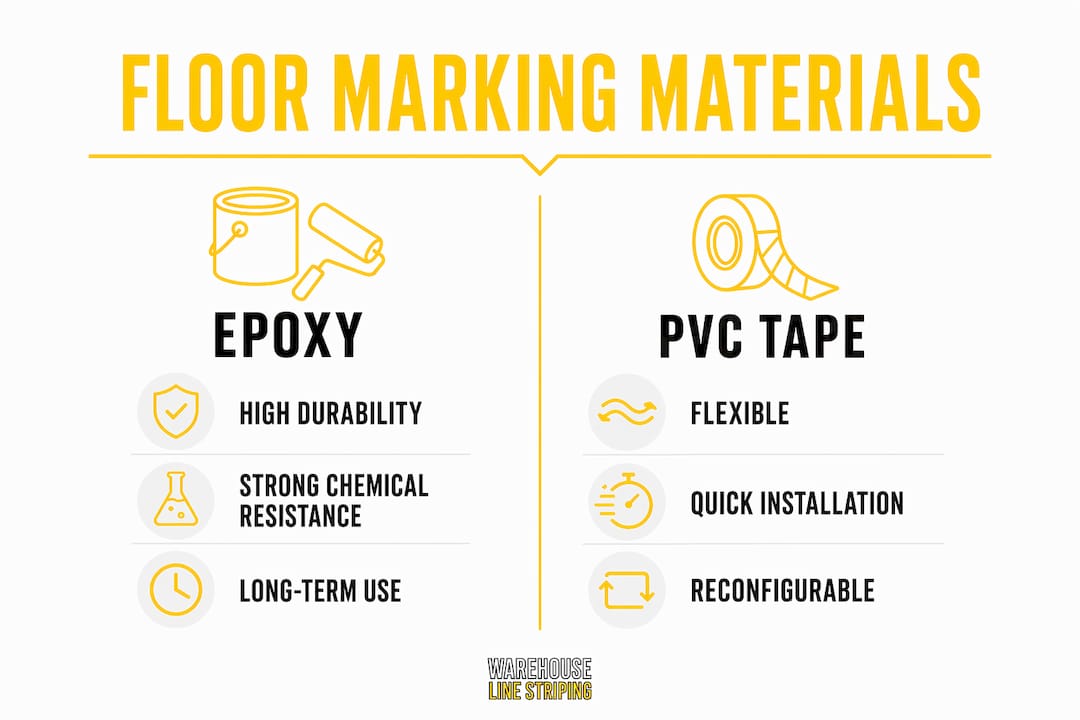
Epoxy coatings are the strongest performer in active hazmat storage environments. They bond directly to concrete, resist chemical spills, and withstand repeated forklift passes without peeling or fading. Warehouse Line Striping’s epoxy systems are rated to last 3 to 7 years under industrial conditions, which means fewer reapplication cycles and lower long-term compliance risk.
Industrial-grade PVC tape is the right choice when zone configurations change regularly or when a facility needs to mark areas quickly before a scheduled audit. High-tack PVC tape designed specifically for floor marking outperforms general-purpose tape in chemical storage zones subject to heavy equipment traffic. The key word is “industrial-grade.” Standard tape from a hardware store will lift at the edges within weeks under forklift pressure and chemical exposure.
Paint is the weakest option in hazmat environments. Alkyd and latex floor paints lack the adhesion and chemical resistance needed to survive regular cleaning with industrial solvents. Facilities that use paint in chemical storage areas typically repaint every 12 to 18 months, which creates compliance gaps during degradation periods.
Pro Tip: Before selecting a material, document the specific chemicals stored in each zone and cross-reference them against the material’s chemical resistance chart. A tape rated for petroleum products may fail within weeks in a zone storing chlorinated solvents.
Industrial-grade floor tapes must withstand forklift wear and chemical exposure, and they require scheduled audits for visibility. Build that audit cycle into your material selection decision from day one.
How to plan and execute effective hazmat zone floor marking installations
Effective installation starts with a site assessment, not a tape measure. Before marking a single line, you need a complete picture of equipment dimensions, traffic patterns, chemical storage locations, and emergency access requirements.
Phase 1: Assessment and layout planning
- Measure the largest piece of mechanical equipment operating in or near the hazmat storage area. Aisle width must be sufficient for that equipment plus a safety margin on each side. OSHA specifies no minimum width, so your equipment dimensions are the governing constraint.
- Map all pedestrian traffic routes that intersect with equipment paths. Separate pedestrian and equipment corridors wherever possible.
- Identify emergency access points, spill containment areas, and eyewash or safety shower locations. These must remain unobstructed and clearly marked at all times.
- Consult your facility’s Safety Data Sheets (SDS) to confirm which chemicals are stored in each zone. This informs both color selection and the chemical resistance requirements for your marking material.
Phase 2: Surface preparation and application
- Clean the floor surface thoroughly. Grease, dust, and chemical residue prevent adhesion for both tape and epoxy. For epoxy applications, mechanical surface preparation such as shot blasting or grinding is standard practice.
- Apply markings in a single continuous session for each zone where possible. Inconsistent line widths or interrupted markings create visual ambiguity that workers and inspectors both notice.
- Use line widths of at least 2 inches for visibility under normal lighting conditions. Four-inch lines are preferable in high-traffic or low-light areas.
- Mark zone boundaries completely. A partial perimeter is more dangerous than no perimeter because it implies a boundary that does not exist.
Phase 3: Documentation and ongoing maintenance
Periodic visibility audits with photo documentation are critical to maintaining ongoing compliance and avoiding inspection citations. Schedule quarterly walkdowns at minimum, and photograph each marked zone from a consistent vantage point so degradation is visible across audit cycles.
Pro Tip: Create a floor marking map as a formal document in your facility’s safety management system. When OSHA inspectors arrive, producing a current map with audit dates demonstrates a proactive compliance program rather than reactive patching.
Floor marking standards require integration with traffic control, segregation, and emergency access planning. A marking system designed in isolation from these factors will have gaps that only become visible during an incident or inspection.
For facilities managing complex layouts, reviewing distribution center safety zone examples provides practical benchmarks for zone separation and marking density.
What common mistakes should you avoid in hazmat floor marking?
The most costly mistakes in hazmat floor marking are not technical. They are systemic. Facilities that treat floor marking as a facilities maintenance task rather than a safety program consistently produce the same set of failures.
Inconsistent color use is the most common citation trigger. When yellow appears in some zones and orange appears in others for the same hazard type, workers cannot build reliable spatial awareness. Effective hazmat floor marking requires integration with a facility-wide color standard, not zone-by-zone improvisation.
Reactive installation produces fragmented systems. A facility that adds tape around a new chemical drum after a near-miss has not built a safety system. It has patched a gap. Reactive marking without system design leads to less effective safety outcomes in hazmat zones, and OSHA inspectors recognize the difference between a designed system and accumulated patches.
- Degraded markings that are partially visible are more hazardous than no markings. A faded line implies a boundary that workers may trust but cannot reliably see. Permanent aisle markings must remain legible under normal conditions or be replaced immediately.
- Aisle obstructions placed inside marked zones are a direct citation risk. The marking defines the safe path. Storing materials inside that path eliminates the safety benefit entirely.
- Floor marking that does not align with hazard communication labeling on containers creates a disconnect between the zone boundary and the specific chemical hazard. Both systems must be consistent.
Compliance reality: OSHA inspectors look beyond the mere presence of markings to their clarity and maintenance status during facility audits. A marking program that passes visual inspection on day one but degrades without a maintenance schedule will fail the next audit.
Slip and fall prevention is directly connected to marking visibility. Facilities that maintain clear, intact floor markings as part of an integrated floor safety program report fewer incidents in chemical storage areas. The marking system and the floor surface condition are not separate concerns.
Key takeaways
Compliant hazmat storage zone floor marking requires yellow or yellow-black boundaries, industrial-grade materials, and documented maintenance audits to satisfy OSHA 1910.176 and 1910.144 requirements.
| Point | Details |
|---|---|
| Color code compliance | Use yellow or yellow-black stripes for hazmat zone boundaries; reserve red for fire and emergency areas only. |
| Material selection | Epoxy coatings last 3 to 7 years in active hazmat zones; industrial PVC tape suits reconfigurable areas. |
| System design over patches | Design floor marking as an integrated system with traffic control and emergency access, not as reactive additions. |
| Maintenance and audits | Conduct quarterly photo-documented visibility audits; replace degraded markings immediately to avoid citations. |
| Hazard communication alignment | Floor marking must align with SDS documentation and container labeling under OSHA 1910.1200. |
What I’ve learned about floor marking as a safety system
After reviewing hundreds of facility audits and installation projects, the pattern is clear: facilities that fail OSHA inspections on floor marking almost never fail because they chose the wrong color. They fail because they treated marking as a one-time task.
The facilities that consistently pass audits treat their floor marking program the way they treat their fire suppression system. It has a design document, a maintenance schedule, an assigned owner, and a budget line. When a line fades, it gets replaced before the next audit, not after the citation.
The integration point that most safety officers miss is the connection between floor marking and hazard communication. Floor marking identifies storage boundaries but does not replace chemical-specific hazard labeling on containers. When a worker sees a yellow boundary, they know a hazard exists. The SDS and container label tell them what that hazard is. Both systems must be present and consistent. A facility with perfect floor markings and missing SDS documentation is still non-compliant.
Leadership commitment is the variable that determines whether a marking program sustains itself. When safety officers have authority to schedule repainting without a capital approval process, markings stay current. When every touch-up requires a facilities work order and a three-week queue, degradation becomes the default state.
Professional installation services like those offered by Warehouse Line Striping solve the execution gap, but the program design and audit commitment have to come from inside the facility. The best marking system in the world degrades without an owner.
— ET
How Warehouse Line Striping supports compliant hazmat zone marking
Warehouse Line Striping has completed over 10,000 floor marking projects in warehouses, distribution centers, and industrial facilities nationwide. For hazmat storage zones specifically, the process starts with a site assessment that maps chemical storage locations, equipment dimensions, and traffic patterns before a single line is applied.
Every installation uses industrial-grade epoxy coatings rated for 3 to 7 years of durability under forklift traffic and chemical exposure. The team handles surface preparation, layout design, and application in a single coordinated process that minimizes facility downtime. Maintenance programs and scheduled visibility audits are available to keep your marking system compliant between full reapplication cycles.
For facilities building or rebuilding their floor marking program, the warehouse floor marking guide covers layout planning and zone delineation in detail. To discuss a custom assessment for your facility, visit Warehouse Line Striping or contact the team directly.
FAQ
What color should hazmat storage zone floor markings be?
Yellow or yellow-black stripes are the accepted convention for hazmat zone boundaries under OSHA 1910.144. Red is reserved for fire protection and emergency danger areas and should not be used for routine chemical storage perimeters.
Does OSHA specify a minimum width for hazmat floor markings?
OSHA 1910.176 does not specify a minimum line width or aisle width. Aisle width must accommodate the largest equipment in use plus a safety margin, and markings must be visible and durable under normal operating conditions.
How often should hazmat floor markings be inspected?
Quarterly photo-documented visibility audits are the recommended minimum. OSHA inspectors assess marking clarity and maintenance status during facility audits, so degraded lines must be replaced before they become illegible, not after a citation is issued.
Can floor tape replace epoxy in a hazmat storage zone?
Industrial-grade PVC tape is acceptable for hazmat zones with lower traffic or frequent reconfiguration needs. In high-traffic areas with forklift activity and chemical spill exposure, epoxy coatings provide significantly greater durability and chemical resistance.
Does floor marking satisfy all OSHA hazard communication requirements?
No. Floor marking identifies zone boundaries but does not replace container labeling or SDS documentation required under OSHA 1910.1200. Both systems must be present and consistent for full hazard communication compliance.