Why OSHA Markings Are Required in Warehouses
If you’ve ever treated floor markings as a cosmetic touchup between bigger projects, you’re not alone. But understanding why OSHA markings are required in warehouses changes that perspective fast. These markings aren’t décor. They’re a legally mandated safety control, and under the 2023–2026 OSHA Warehouse NEP, inspection intensity for warehouse facilities has increased significantly. Getting this right isn’t optional. It’s one of the most direct ways you protect your people, pass inspections, and keep operations running without interruption.
Table of Contents
- Key takeaways
- Why OSHA markings are required in warehouses: the regulatory foundation
- The real safety case for floor markings
- Best practices for compliant floor markings
- Managing layout changes without losing compliance
- My perspective on what actually goes wrong
- Get professional floor marking support
- FAQ
Key takeaways
| Point | Details |
|---|---|
| OSHA legally requires markings | Two specific standards, 29 CFR 1910.22 and 1910.176, mandate marked permanent aisles and passageways. |
| Faded markings equal violations | Degraded or missing floor markings are among the most common causes of OSHA citations in warehouses. |
| Colors follow ANSI guidelines | OSHA defers to ANSI Z535.1 for color standards; yellow for caution and red for danger are widely used. |
| Layout changes require marking updates | When workflows or storage arrangements shift, existing markings must be reviewed and updated immediately. |
| Professional installation extends compliance | Durable, epoxy-grade materials and scheduled maintenance reduce citation risk and extend marking lifespan. |
Why OSHA markings are required in warehouses: the regulatory foundation
The two standards you need to know are 29 CFR 1910.22 and 29 CFR 1910.176. Together, they form the regulatory backbone of warehouse floor marking requirements, and they cover more ground than most facility managers realize.
Under 29 CFR 1910.22, OSHA requires that walking-working surfaces provide safe access and egress. Permanent aisles and passageways must be appropriately marked, meaning the markings must be visible and understandable under real conditions. Think about your floor under low lighting, dust accumulation, or heavy forklift traffic. If a worker can’t immediately recognize a safe path in those conditions, the marking fails its legal purpose regardless of whether lines technically exist.
29 CFR 1910.176(a) goes further, specifying that aisles used by mechanical equipment must be marked and kept clear of obstructions. This is the standard that directly addresses forklift and pedestrian separation. Key points that trip up facility managers:
- OSHA does not specify exact line widths or specific colors in the regulatory text itself
- Aisle widths are performance-based. You must accommodate the largest equipment plus adequate safety clearance
- Markings must be permanent, not just present. Temporary tape placed before an inspection does not satisfy the standard
- The word “appropriately” is a performance standard, not a free pass. Inspectors assess whether your markings communicate hazard zones effectively under actual operating conditions
“The fundamental purpose of OSHA floor markings is to communicate hazard zones continuously in the environment so workers never have to guess which path is safe.” — OSHA 1910.176 regulatory context
That framing matters. When you see floor markings through the lens of continuous hazard communication rather than periodic housekeeping, the whole compliance picture becomes clearer.
The real safety case for floor markings
The numbers behind warehouse injuries put the importance of OSHA signage in sharp focus. OSHA inspectors heavily target pedestrian-vehicle interface violations because struck-by incidents involving forklifts are among the most serious warehouse injuries. Clear, visible markings are the first physical defense against those collisions.
Here’s where the gap between intention and reality shows up:
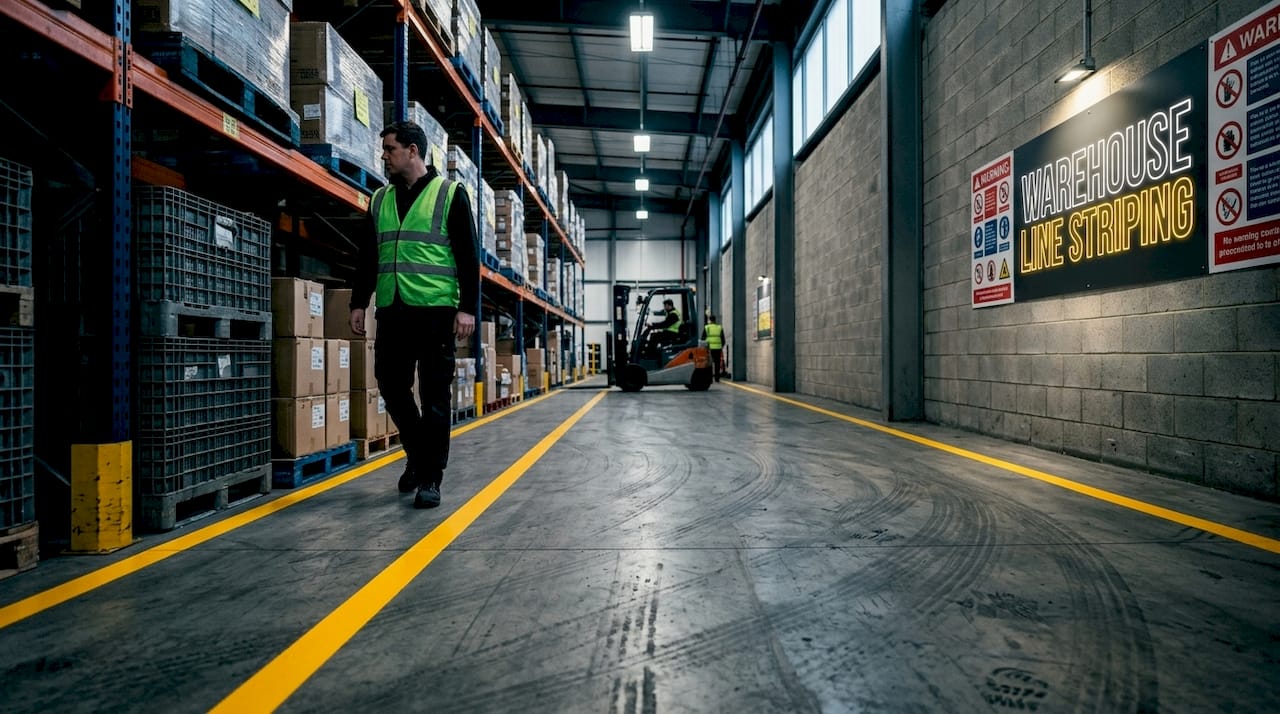
- Forklift operators rely on marked boundaries to know where pedestrians are expected to walk. Without those boundaries, they’re making judgment calls at every intersection.
- Workers naturally find the shortest path between two points. Without marked pedestrian corridors, that path runs directly through forklift travel lanes.
- Faded or obstructed markings create a specific category of hazard that’s worse than no markings at all. Workers believe a safe path exists, but the boundary no longer accurately represents reality.
That last point deserves emphasis. Many warehouse floor marking failures come not from an absence of markings but from degraded or obsolete ones that no longer match actual safe routes. A yellow line that’s 60% worn communicates false confidence to your workforce.
OSHA also recognizes the compounding risk when inventory or pallets encroach on marked aisles. A visually clear aisle that’s physically blocked during an emergency evacuation is both a citation and a life-safety failure. The visual control only works when it’s reinforced by housekeeping discipline.
Pro Tip: Walk your facility at floor level once per quarter, specifically looking for markings that are partially blocked by pallets, equipment, or debris. What looks obvious from a management office often isn’t visible from a forklift operator’s seat.
You can see detailed examples of how pedestrian and forklift separation works in practice across distribution center environments. The spatial relationships matter as much as the markings themselves.
Best practices for compliant floor markings
OSHA gives you performance standards. Industry practice fills in the specifics. Here’s how the two compare:
| Element | OSHA requirement | Industry best practice |
|---|---|---|
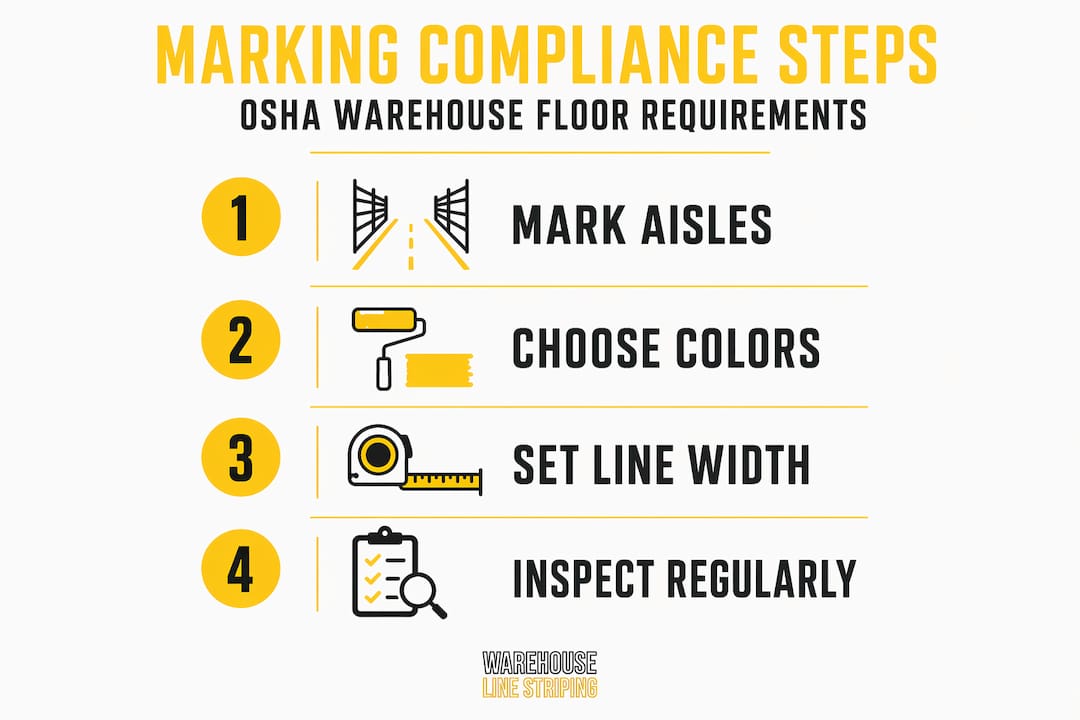
| Line color | No color specified; references ANSI standards | Yellow for aisles/caution, red for danger zones, green for safety areas |
| Line width | Not specified | 4 to 6 inches for primary aisles |
| Material | Must be permanent | Epoxy paint or industrial-grade tape rated for forklift traffic |
| Aisle width | Performance-based clearance | Largest equipment width plus 3 feet minimum on each side |
| Maintenance | Must remain visible and intelligible | Quarterly inspection, annual recoating or replacement |
Color standards come from ANSI Z535.1, which assigns yellow to caution areas, red to immediate danger, and green to first aid or safety equipment locations. OSHA doesn’t mandate these colors explicitly, but citing ANSI alignment during an inspection demonstrates you followed recognized industry standards. That matters when an inspector is writing a citation.
Industry standards recommend 4 to 6 inch wide yellow lines as the minimum for primary aisle markings. Narrower lines fade faster and become harder to distinguish in low-light conditions. If your current lines are under 4 inches, they’re technically compliant only if they remain visible and intelligible. In practice, thinner lines rarely survive a full year of warehouse traffic.
Material choice is where compliance gets expensive fast if you make the wrong call. Temporary floor tape may seem like a quick fix, but durable tape or epoxy paint is required for lasting compliance. Facilities that use low-grade tape often find themselves restriping two or three times per year, spending more than a single professional installation would have cost.
Pro Tip: Schedule marking inspections immediately after any major forklift route changes. High-traffic pivot points degrade in weeks, not months, and those are exactly the spots OSHA inspectors check first.
Managing layout changes without losing compliance
Warehouse operations are not static. Seasonal inventory surges, new equipment, reorganized pick paths, and racking expansions all have one thing in common: they can make your existing floor markings wrong overnight. And wrong markings are sometimes more dangerous than no markings at all.
Here’s a practical process for staying ahead of that problem:
- Designate a markings owner. Someone on your team needs to own floor marking compliance specifically, not just as part of a general safety role. That person signs off before any layout change goes live.
- Add a marking review step to every layout change approval. Before pallets move, before racking shifts, before a new staging zone is created. Review whether existing lines still reflect reality.
- Audit after any operational incident. Near misses, forklift contacts, and trip events often reveal that a marking was faded, blocked, or simply no longer positioned where workers needed it.
- Document your marking layout as a living document. A floor plan with marked aisle locations gives you a baseline to compare against. Without it, you’re relying on memory to spot gaps.
- Schedule professional restriping on a fixed cycle. Logistics facilities that operate on a planned restriping calendar have fewer citation events than those that restripe reactively after a problem appears.
Integrating marking reviews into your broader traffic management program pays off. Warehouse layout changes can create mismatches between markings and actual safe paths, and those mismatches are exactly what OSHA inspectors are trained to find.
Pro Tip: After racking or storage reconfiguration, photograph the entire floor before and after. That documentation can support your defense if a citation ever disputes whether markings were in place and appropriate.
My perspective on what actually goes wrong
I’ve seen warehouse after warehouse treat floor markings as a project they’ll get to “when things slow down.” The markings are there, technically, but they’re 40% visible, they were installed two facility reconfigurations ago, and nobody has looked at them critically since the last OSHA inspection.
What makes this pattern so persistent is that markings feel passive. They don’t make noise. They don’t generate alerts. They just sit there on the floor, and as long as nobody trips or gets cited, managers assume they’re fine.
The shift that actually produces results is treating markings the way you treat fire suppression systems. You wouldn’t wait until a fire to find out your suppression system was degraded. Markings are the same category of safety control. They exist to prevent an event, and you can only verify they’re working before the event.
The warehouses I’ve seen avoid chronic OSHA citation issues share one trait. They have a specific, named person accountable for marking condition. Not a committee. One person who walks the floor, knows the standard, and has budget authority to call for restriping without a two-week approval process. That accountability structure does more than any specific marking material or color scheme.
Line material choice and maintenance frequency directly impact OSHA compliance, and they require genuine collaboration between safety and facilities teams. When those two groups are siloed, markings fall through the cracks of both departments. The facilities team thinks safety owns it. The safety team assumes facilities handles it. Nobody does.
— ET
Get professional floor marking support
When compliance and durability are both on the line, the right installation approach pays for itself quickly. OSHA penalties for repeat floor marking violations can reach into the tens of thousands of dollars per citation. A professional marking program, by comparison, delivers lasting results.
Warehouse Line Striping has completed over 10,000 projects across warehouses and distribution centers nationwide, using industrial-grade epoxy coatings that hold up for 3 to 7 years under heavy forklift traffic. Whether you need a new layout designed from scratch, outdated markings professionally removed, or a complete floor marking system built to OSHA and ANSI standards, the team brings both technical expertise and 24/7 support. Explore the pallet storage marking guide to see how a well-designed system works across common warehouse configurations.
FAQ
What OSHA standards require warehouse floor markings?
OSHA 29 CFR 1910.22 requires permanent aisles to be appropriately marked, and 29 CFR 1910.176(a) requires aisles used by mechanical equipment to be marked and kept clear. Both standards apply in most warehouse environments.
Does OSHA specify colors for warehouse floor markings?
OSHA does not mandate specific colors in its regulatory text, but it references ANSI Z535.1, which assigns yellow to caution areas and red to danger zones. Following ANSI color standards is considered industry best practice and supports compliance during inspections.
How wide do warehouse floor marking lines need to be?
OSHA does not specify a minimum line width. Industry standards recommend 4 to 6 inch wide lines for primary aisle markings to maintain adequate visibility under real warehouse conditions, including dust and wear.
Can temporary floor tape satisfy OSHA marking requirements?
No. OSHA requires markings to be permanent and remain visible and intelligible over time. Temporary or low-grade tape that fades or peels quickly does not meet the performance standard and is a common source of citations.
How often should warehouse floor markings be inspected?
At minimum, markings should be inspected quarterly and immediately after any significant layout change or operational incident. High-traffic pivot points and pedestrian-vehicle intersections degrade the fastest and should be checked more frequently.